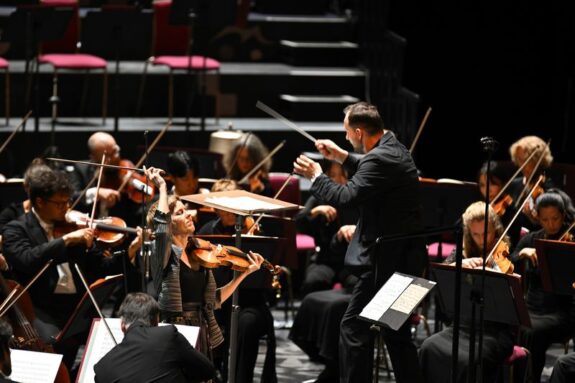
 United Kingdom BBC Proms 2025 [22] – Pärt, Dvořák, Sibelius: Isabelle Faust (violin), Gewandhausorchester Leipzig / Andris Nelsons (conductor), Royal Albert Hall, London 26.8.2025. (JR)

Port – Cantus in memoriam Benjamin Britten
Dvořák – Violin Concerto, Op.53
Sibelius – Symphony No. 2 Op. 43
The BBC Proms season will soon be at an end and the late summer always brings a bevy of top-class foreign orchestra to the Royal Albert Hall. The concert was the turn of the Gewandhausorchester Leipzig, the oldest civic orchestra in the world, dating back to 1743.
The curtain-raiser for this Prom was a mere six minutes long, Arvo Pärt’s Cantus in memoriam Benjamin Britten, written to convey the Estonian composer’s lamentation on hearing of Britten’s death in 1976. Pärt had great affinity with Britten and with the ‘purity’ of his music. Pärt chose a combination of a simple descending scale (in A minor) and the chiming of a church bell. Pärt dubbed this technique his ‘tintinnabuli’ style (Latin tintinnabulum means a little bell). Nelsons started the piece almost inaudibly and I even wondered whether he had placed the bell in the Upper Gallery (no, it was at the back of the stage but virtually hidden): BBC Radio 3 engineers will have had to increase the volume so that listeners on the wireless could hear anything at all. Nelsons built up a tremendous crescendo and then created a wall of string sound to end the haunting piece. Nelsons kept a firm grip on the evenness of tempo. We were off to a fine start.
Hilary Hahn was to have been the soloist in the Dvořák Violin Concerto but suffered a double pinched nerve injury last summer; she returned to the concert stage in February this year, but a few weeks ago (after the Proms Guide was printed) she announced that, sadly, her recovery was not yet complete and cancelled her next engagements (including this Prom) through until November. In stepped a top-class replacement, Isabelle Faust, to play the concerto, which she says is one of her favourites. Faust has recorded it only once, about 20 years ago, with Jiří Bělohlávek and the Prague Philharmonia, but has played it regularly, last year with the Concertgebouw, and is scheduled to play it again with the same orchestra next year in Amsterdam. Faust used a score, which was understandable, but somehow did not quite relax quite enough to wholly inhabit the music. I cannot fault her virtuosity (spectacular double-stopping courtesy of Joseph Joachim’s collaboration with the composer), but I was not overwhelmed. Perhaps it is that sort of piece, lovely tunes, but on this evening there was little interpretation. I did admire the mellow tone of Faust’s instrument, and the melting loveliness of the slow movement. The Finale (allegro giocoso) was suitably frisky and felt very Czech; Faust was lilting and joyful throughout. Rustic oompahs from the quartet of horns helped the atmosphere. A sombre encore (Nicola Matteis, Jr’s Fantasia in A minor) was fine but inappropriate to follow the Dvořák, even though you could have heard a pin drop.
The orchestra positively gleamed in the Sibelius, every section astounded with its quality of sound, from the lush hard-working strings (led by the admirable Andreas Buschatz) right to the back desks, burnished brass and honed woodwind. They demonstrated their strength in meeting Nelson’s demands for urgency and beauty of sound. The performance had plenty of menace, it was hard to imagine Sibelius had composed this symphony not in his bleak granite homeland but in sunny Rapallo, on holiday in Italy. Some critics and musicologists have detected sunrises, but most point to a call for Finnish independence from Russia and a generally dark mood until the very final bars when the movement erupts into the symphony’s home key, D major. I highlight just one player who commanded attention on his every contribution – Spanish oboist Javier Ayala-Romero, who joined the orchestra only last year.
Nelsons was in full control of the work throughout, never let the tension slip and his command of his orchestra in the final pages as the tension mounted in the inexorable climax was exemplary. What an orchestra, what a conductor, what a symphony. The applause went on and on, many around me felt sure they had not heard a finer account of this work – and possibly never will.
John Rhodes
Featured Image: Andris Nelsons conducts violinist Isabelle Faust and the Gewandhausorchester Leipzig © Chris Christodoulou/BBC
I too thought the Sibelius symphony was superlative. At first I thought it started too slow, but it turned out that it gave the strings the ability to really play through the contrapuntal lines so sonorously that one could have listening to Bruckner… Memorable (but not, apparently, liked by all reviewers).