 United Kingdom Cumbria Opera Festival 2025 [1] – Mozart, The Marriage of Figaro: Soloists, Chorus; Jessica Meakin, Julian Cann (violins), Hannah Borlase (viola), Daniel Crompton (cello), Hannah Gillingham (flute), Sarah Davies (oboe), William Hammond (clarinet), Ursula Leveaux (bassoon), Alistair Burton (harpsichord continuo) / Melvin Tay (conductor). Penrith Methodist Church, 23.8.2025. (CK)
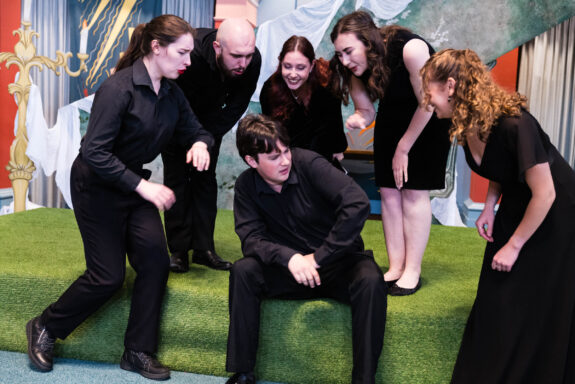
The Cumbria Opera Festival, now in its third manifestation (previously in 2021 and 2023), is the brainchild of the young conductor Joe Davies, and everything that happens here is coloured by his irrepressible energy and optimism. And if that sounds like a prelude to a judgement along the lines of ‘Good effort’, forget it: there are young musicians here of the highest calibre. Almost all of them – singers and production team alike – are returning to the Cumbria Opera Festival: they are already veterans of Festivals at Garsington, Longborough, Buxton, Holland Park, the Grange and elsewhere. Some of them have come through youth schemes such as El Sistema and the Jette Parker at Covent Garden.
The focus of the Festival is, very clearly, to introduce opera to people who have never been to one, but who might well give it a try when it is presented to them, excellently performed and produced, on their doorstep. In pursuit of this, the Festival events move athletically from venue to venue the length and breadth of the county: Appleby, Barrow, Carlisle, Grange, Kendal, Keswick, Penrith. It is the height of the Lake District tourist season, so who knows? Visitors looking to spend an evening doing something new might find their lives turned upside down.
I saw this Figaro on its third and final night in Penrith Methodist Church: unprepossessing on the outside, but with an interior whose light and airy elegance takes your breath away. A perfect setting for Mozart. It was beautifully decorated by the opera team: even the TV screens were garlanded with greenery. As for the audience: a respectable turnout of Cumbria’s diehard but ageing supporters of the Arts? Not a bit of it: a vibrant crowd, upstairs and down, many of them young. Joe and his team are evidently doing something right.
The opera was sung in English: a real advantage in following this most complicated of comic plots. Lucy Britton’s bespoke translation was clear, racy and punchy: it was displayed on screens either side of the stage, which was hardly necessary, so skilful were the singers in projecting the words, and so inventive was Persia Babayan-Taylor’s direction in clarifying each comic situation. A sensibly slimmed-down version of the libretto was used, compressing the opera’s four acts into two, dispensing with some of the peripheral roles and shortening the recitatives.
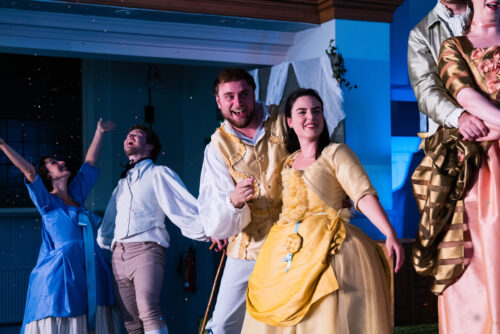
The soloists were a joy. Ross Cumming’s Figaro was virile, confident and engaging – a playmaker prepared to take risks. Sofia Kirwan-Baez’s Susanna was in many ways the heart of the performance: even though she hardly ever has the stage to herself – she sings almost exclusively in Duettini, Terzetti and so on – we were always conscious of her voice and her presence, both amusing and affecting. Gabriella Noble was an irrepressible Cherubino and a natural comedian: the same was true of Holly Brown’s tart Marcellina. George Robarts as the Count had a commanding stage presence and a voice to match, powerful indeed in his third act aria. Caroline Taylor brought dignity and depth of feeling to her portrayal of the Countess: so much so that she seemed – with a little more sweetness at the top of her range – a Marschallin in the making. Chris Murphy brought an amusing touch of pomposity – never overdone – to the forthright lawyer Bartolo.
Joe Davies had arranged Mozart’s score for a string quartet and single woodwinds without losing an iota of its beauty, its energy or its elegance: an extraordinary feat. Melvin Tay conducted this small band with buoyancy and infectious delight. For such a small ensemble to carry the burden of Mozart’s ingenuity and expressive refinement must have seemed a marathon, but it never showed.
Persia Babayan-Taylor’s direction was endlessly resourceful, making good comic and dramatic use of the gallery high up behind the stage. Emma Turner’s set was simple and beautiful, its centrepiece like a large diagonal bolt of fabric, a vernal green draped lightly with white silk: upon which PJ Summers’s lighting played, turning it red for discord, blue for moonlight, gold for final reconciliation. The costumes (Meg Bowyer, Nina Fuster-McClements) were gorgeous.
This Figaro was a delight to the ears and the eye: it made me regret that I had missed the previous Festivals (which had featured, among other things, Mozart’s other Da Ponte operas). Earlier in the day there had been more delight: a Young Artists’ Showcase featuring six singers from Cumbria, all aged 18-25 and understudying key roles in Figaro and Britten’s Turn of the Screw (to be performed later in the week), took part in a seamless hour of arias from the two operas, interwoven and wittily directed by Nuala Sankey: quite a feat, since it would be hard to name two operas less alike.
Faye Bowness and Sam Weakley made an engaging Susanna and Figaro (I would put my money on Faye’s Susanna to be top dog in their marriage). Rebecca Chandler’s Cherubino was endlessly entertaining, with an arsenal of comic poses and facial expressions that would have made her a star of the silent screen (how fortunate, then, that we could hear her as well).
In the Britten arias, Charlotte Thomson made a memorably passionate and vulnerable Governess; Hannah Weakley, her voice pure and bell-like, was very touching in Flora’s aria; and Andrew Woodmass-Calvert’s Peter Quint, his voice blanched and otherworldly, sounded both beautiful and unsettling. All was well, though, in the end, as they joined together in the wonderful Scena ultima that closes Mozart’s opera (in the evening performance they formed half of the chorus). As Joe (characteristically) writes in the Festival brochure, ‘this is your chance to get to know these brilliant Cumbrian artists before they’re selling out Covent Garden!’
Chris Kettle
Featured Image: Young Artists’ Showcase at the Cumbria Opera Festival 2025 © Chris Tribble
For more about the Cumbria Opera Festival 2025 click here.
Production:
Director – Persia Babayan-Taylor
Designer – Emma Turner
Lighting designer – PJ Summers
Costume designer – Meg Bowyer
Arranger – Joe Davies
Translator – Lucy Britton
Cast:
Count Almaviva – George Robarts
Countess Rosina – Caroline Taylor
Susanna – Sofia Kirwan-Baez
Figaro – Ross Cumming
Cherubino – Gabriella Noble
Bartolo – Chris Murphy
Marcellina – Holly Brown
Chorus:
Faye Bowness, Lydia Lythgoe, Charlotte Thomson, Hannah Weakley (sopranos)
Rebecca Chandler, Rosemary Jones, Janet Rougvie (altos)
Cade Strathern, Andrew Woodmass-Calvert (tenors)
Lawrence Smith, Fern Warwick, Sam Weakley (basses)