 United States Wagner, Die Walküre: Soloists, Orchestra of Santa Fe Opera / James Gaffigan (conductor). Crosby Theatre, Santa Fe, 30.7.2025. (HS)

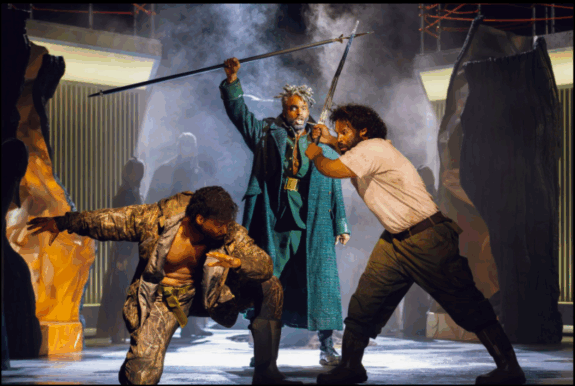
There is a lot going on in director Melly Still’s busy, eye-catching and insightful staging of Wagner’s Die Walküre, seen and heard in the second of six scheduled performances at Santa Fe Opera. So much happens visually that it sometimes distracts from the extraordinary singing and the glorious work from the orchestra conducted by James Gaffigan.
Gaffigan’s often-subtle approach to the score yields one terrific moment after another, both musically and dramatically. As famous as the bigger moments are (‘Ride of the Valkyries’, the fiery Prelude to Act I and the ‘Magic Fire Music’ at the end), the intimate moments take precedence in this presentation. They are, after all, the heart and soul of the personal dramas that make the opera so compelling. One seldom hears such a hushed orchestra underlying the Act I scene when Sieglinde and Siegmund discover their connection, or the later scenes when Wotan wrestles with his own missteps in scenes with Fricka or his disobeying daughter, Brünnhilde. With a delicate touch in these moments, the ensuing bigger, louder moments became even more moving.
If the semi-outdoor setting – Santa Fe’s Crosby Theatre has a roof and no sides – sometimes clipped the resonance of the orchestra’s outcries compared with an enclosed theater, the rumbles of thunder as actual storms passed at a distance during this performance added aptly to the atmosphere.
Still’s production put extra layers on Wagner’s already complex story and built-in connections to the music, with mixed results. The setting and costumes reference different eras and times. Hunding’s house has mid-twentieth century furniture and kitchen appliances, and the eight Valkyrie sisters are in clothes associated with various famous women. Wotan wears a generalissimo’s military uniform, and Valhalla is represented by a platform enclosed with red ropes from which the gods can observe what is going on below. The characters emerge through vertical ropes that make up the walls, as if in response to a character’s reference to them in the story, which populates the stage with interesting visuals. Erda is especially striking as she appears, a nude figure that looks formed from the greens and browns of the earth, to interact with Wotan in his epic narration of how things got to this stage. There is Loge, his hands red with fire, when he is mentioned, and Alberich can be seen lurking in the shadows with his pregnant consort.
One payoff for all this is a final tableau in which Sieglinde, carrying the nascent Siegfried, and Alberich’s pregnant consort, carrying Siegfried’s eventual nemesis, Hagen, stand on opposite corners gazing down at Brünnhilde trapped by fire (though that may only be meaningful to those who actually know how Die Walküre fits into the Ring cycle.) As much as I found all this fascinating, it was also distracting when the orchestra and singers were giving us their all in scene after scene.
In Act I, an exhausted Siegmund turns up after fleeing a battle with Hunding and his men, and everything focuses on the delicately evolving relationship with Sieglinde. Tenor Jamez McCorkle and soprano Vida Miknevičiūtė portrayed their mutual attraction both visually and musically. McCorkle’s rough demeanor was softened by his warm voice, and Miknevičiūtė, lithe in figure with a voice capable of every level of intensity from rich to light, was able to catch all the angles of the character. Scenes with Hunding crackled with foreboding, Soloman Howard’s resonant bass having an elegance that added depth to his muscle.
The end of the first act blossomed into spring, with gorgeous work by the tenor and soprano in the final scene when the sense of caution finally gives way to love (and lust). McCorkle’s ‘Winterstürme’ was passionate, and Miknevičiūtė’s ‘Du bist der Lenz’ was an appropriately gorgeous response.
From the first moments of Act II, bass-baritone Ryan Speedo Green, in a role debut as Wotan, portrayed the troubled god as if he had been doing it for years. Sensitive to every singer around him, he delivered one great moment after another in his rich baritone, as silky as it is powerful. His bickering with his wife Fricka (Sarah Saturnino) and daughter and titular Valkyrie Brünnhilde (Tamara Wilson) laid out the conflicts that trigger the rest of the opera’s story and had layer upon layer to savor.
The scenes between Green and Wilson, the most heart-tugging of the opera, were stunning. They were quick to respond to every flicker of emotion from the other. When Wotan shares his quandary with Brünnhilde (having been reprimanded by Fricka, the goddess of marriage, for allowing the incestuous fervor of Siegmund and the married Sieglinde), the musical and dramatic arc was gripping.
In the final half hour, it was easy to get caught up in the playing-out of the consequences in some of the most intimate and glorious music in the opera. Green and Wilson seemed to be sharing secret cues on how to tug at the other’s soul as they sang: Wilson’s a cappella ‘War es so schmalich’ was a treasure, and Green’s ‘Leb’ wohl’ felt totally natural. At the end of a long night of singing, his voice rose over the full orchestra to nail the last words in the opera – ‘Wer meines Speeres Spitze fürchtet durchschreite das Feuer nie!’ A stunning moment.
Saturnino’s Fricka held her own in the scenes with Green and hovered as a presence over other scenes from her Valhalla perch in a distinctive white Victorian dress crisscrossed with red lines (echoing the ropes bordering the elevated platform).
Earlier, the big set piece of the opera, ‘The Ride of the Valkyries’, sounded great from the octet of singers, mostly drawn from artists currently singing in one of the four other operas on offer this summer. In addition to the motley costumes, the scene was puzzling too as the fallen warriors they had brought back to Valhalla played some sort of game with rope loops – another example of a director trying to do too much.
In sum, the musical and individual dramatic values had to overcome some confusing and overly complex staging, but they prevailed and did so brilliantly.
The same cast (with Christine Goerke replacing Tamara Wilson) is scheduled to perform the entire opera twice over six nights in May 2026 with the Los Angeles Philharmonic and conductor Gustavo Dudamel.
Harvey Steiman
Production:
Director – Melly Still
Scenic & Costume designer – Leslie Travers
Lighting designer – Malcolm Rippeth
Choreographer – Tinovimbanashe Sibanda
Wigs & Makeup – David Zimmerman
Cast:
Brünnhilde – Tamara Wilson
Wotan – Ryan Speedo Green
Siegmund – Jamez McCorkle
Sieglinde – Vida Miknevičiūtė
Fricka – Sarah Saturnino
Hunding – Soloman Howard
Valkyries – Jennifer Johnson Cano, Deanna Ray Eberhart, Jessica Faselt, Wendy Bryn Harmer, Gretchen Krupp, Aubrey Odle, Lauren Randolph, Jasmin Ward
I completely agree regarding the over-elaborate and distracting stage business, the worst of it occurring during the Act I love duet, when Siegmund and Sieglinde had to fight against a web of ropes pulling the lovers apart. The two singers delivering the great music Wagner wrote for the dramatic moment, were forced to contend with unwelcome stage extras inserting themselves into the action to absolutely no defensible end. It was the most egregious example of sabotage-by-director I ever hope to witness.
I had great trouble with the Immolation Scene. Wotan was not there to gently place Brünnhilde on the bier, then call up the flames. Brünnhilde simply walked off the stage. And was it necessary for Fricka to spend then entire first act, and more, stalking about the balcony, i.e. Valhalla. We know she was judgmental, but…..
I agree about the playing and singing being excellent, but when I saw it opening night, I felt that Gaffigan sacrificed some excitement and momentum, in his effort to keep the dynamics under tight rein. Particularly in the first act.
Couldn’t agree more. The music was fantastic. The production distracting. There is no need to make the complex story more complex, adding characters which, while true to the cycle, don’t have singing roles. Or dressing the Valkyries as famous women through history when the flourish, while cute, adds nothing to the drama of this story. In fact, for me, it took away the seriousness of the Act III. And ‘heroes’ brought to Valhalla felt more like despondent refugees in the way the opera staged that scene.
I liked the production (seen on 8 August) a lot more than the other commenters and the reviewer did. In the Valkyries scene, they begin by bringing back fallen warriors, but the part when actors are ‘play[ing] some sort of game with rope loops,’ is a separate scene. I took it that they were playing horses, not the heroic dead; the libretto is full of talk of Grane and steeds at that point. I thought it worked rather well. Compared to the last two Walküres I have seen, the MET production by Robert Lepage (which I think I saw in 2011) and the traveling Mariinsky Theatre production (2007 in New York), I thought the whole thing well thought out, interesting, and not the least distracting. I was pleasantly surprised.
And as noted by all, the singing was marvelous. It was a great evening.