
 United States Sean Hickey, Sapiens: Vladimir Rumyantsev (piano). The Checkout, Chicago, 27.9.2025. (ZC)
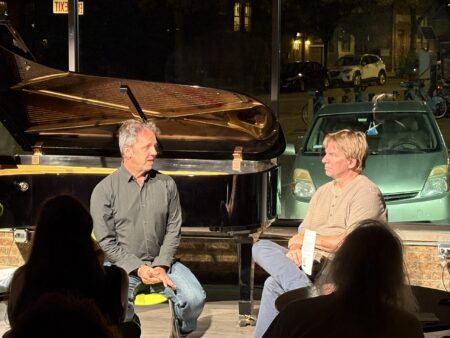
Chicago has no shortage of performance spaces, but none quite like The CheckOut. Housed in a former 7-Eleven on Clark Street in Uptown, the venue opened its doors on 12 September under the stewardship of Access Contemporary Music. In just two weeks, it has staked its claim as one of the city’s most intriguing cultural outposts. The inaugural festival gave a sense of the possibilities: two sold-out nights devoted to Arvo Pärt’s hushed mysticism, the Black Oak Ensemble channeling Studs Terkel’s working-class ethos, chamber music turns from the Palomar Trio and Kontras Quartet and, finally, Wicked Drawl – a band that refuses genre with a gleeful mash of cabaret, country, classical and jazz.
The space itself is spare. The mood inside is unpretentious, more open rehearsal than velvet-seat concert hall. A converted convenience store has its limits yet, in this context, the rough edges feel right: seating for sixty, exposed overhead ducts, and tables and chairs of the mass-produced variety that call to mind a community center. A modest bar sits off to the side, selling liberations, and storefront windows show cars rumbling past. Curious pedestrians can even sneak a peek as they pass. Seth Boustead, ACM’s founder, is everywhere at once: selling tickets, ushering, pitching the next event and, above all, making the case for music as a communal experiment.
Experimentation was on my mind when I caught the performance by pianist Vladimir Rumyantsev of Sean Hickey’s Sapiens. It wasn’t my first choice, but I had missed the Pärt nights and was kept away from other concerts by an unavoidable trip to New York. But Hickey’s piece, newly recorded on Sono Luminus, had piqued my interest, and a few listens to Rumyantsev’s album persuaded me this was a good bet.
Hickey’s inspiration was Yuval Noah Harari’s best-selling book of the same name, an epic that dares to compress the human story into one volume. In pre-concert remarks, Hickey admitted that he began sketching musical ideas as soon as he cracked open Sapiens, though it wasn’t until 2016 that he started shaping them into a large-scale work. In the early months of the pandemic, he finished the score in just five weeks. The result is not a literal retelling but a set of musical signposts, scenes, images and abstractions of human history refracted through the piano.
Hearing it live, I thought of Olivier Messiaen’s vast keyboard cycles which are equally encyclopedic in ambition, drawing on bird song, theology and scripture. Hickey’s piece, nearly fifty minutes long and divided into eight movements, fits that mold. ‘Pre History’, the opening, begins not on the keyboard but with Rumyantsev’s breath, heavy and percussive as if conjuring humanity’s first stirrings. ‘Double Helix’, a dazzling fugue, braids independent musical lines until they threaten to snap apart under their rhythmic strain. The closing movement, ‘Commonwealth’, projects a fragile optimism, with Rumyantsev gravely shaping noble chords before leaving the audience suspended on a final, uncertain note.
What makes Sapiens so engaging is its stylistic restlessness. In one moment, Hickey ventures into the atonality of Cage; in the next, he toys with minimalism, such as in the fifth movement where Rumyantsev’s performance developed a single C into patterns of surprising depth. The score keeps listeners on edge, pulling them between familiarity and estrangement. For me, the work truly clicks in the third movement when Hickey’s use of melody seizes its place in the work’s palette of sound. Sapiens is music that succeeds both as a cohesive whole, as it was performed on this occasion, or as individual movements.
Rumyantsev navigated the dense terrain of the score with impressive command. The CheckOut is hardly acoustically plush – the walls are bare, the air conditioning hums – but he drew a wide and nuanced dynamic range from the instrument, never letting the sound turn harsh or diffuse. His fleet fingers were always guided by an intellect attuned to both the score and Hickey’s ambitions. The result was a meticulous, expressive interpretation that matched the complexity of Hickey’s textured and demanding work.
By the time the applause settled, I realized The CheckOut had accomplished something rare. A convenience store turned concert hall had become a laboratory, where new music could sound provisional and necessary, where history itself could be compressed into breath, keystroke and resonance. Uptown may never look at that 7-Eleven the same way again.
Zach Carstensen
Featured Image: Pianist Vladimir Rumyantsev © Zach Carstensen
Thank you! I’m so pleased you enjoyed the piece, Vladimir’s exceptional artistry, and the tremendous setting. I truly appreciate it.