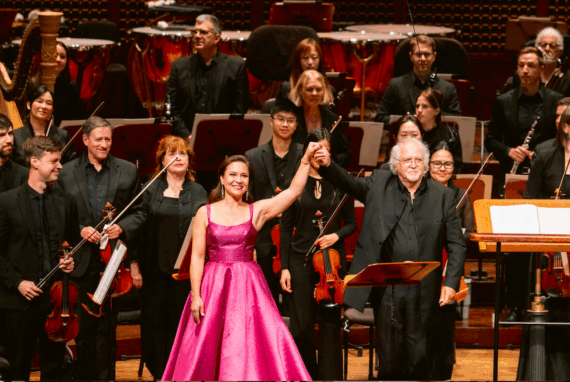
 United States Berg, Mahler: Irene Roberts (mezzo-soprano), San Francisco Symphony / Sir Donald Runnicles (conductor). Davies Symphony Hall, San Francisco, 29.9.2025. (HS)

Berg – Seven Early Songs
Mahler – Symphony No.1 in D major
Conductor Sir Donald Runnicles has a long history in San Francisco. As music director of San Francisco Opera from 1992 to 2008 he produced many exciting evenings of operas by Verdi, Puccini, Strauss and, especially, Wagner. His brilliant Ring cycle in 1990 cemented his hiring as music director, and in the course of his tenure we got to know how intensely he could get an orchestra into the music. It has been 23 years since he conducted the San Francisco Symphony (often once or twice per season), and let us hope this will not be the last time. It has been a while since I heard a Mahler Symphony No.1 with such energy.
That symphony was my gateway into Mahler’s magic. As a teenager, I ushered for classical performances at the Shrine Auditorium in Los Angeles with my mother, who taught piano and made sure I got a music education. At one of those concerts, Erich Leinsdorf conducted the visiting Boston Symphony in Mahler No.1. Just imagine the effect all those fanfares, bird calls and glorious full-orchestra climaxes (not to mention a funeral march based on a minor-key version of ‘Frère Jacques’) had on my adolescent sensibilities.
In those days there were only a few, usually European, conductors who had the temerity to conduct any of Mahler’s sprawling symphonies. In the early 1960s, Leonard Bernstein ventured onto the field and made it okay for other American conductors. Today, almost any serious conductor can revel in Mahler’s world, in many instances bringing their own takes on what these works can mean.
Runnicles is no stranger to challenging works. At San Francisco Opera he led memorable renditions of Don Carlo, Guillaume Tell and an amazing Saint François d’Assise. Mahler’s first symphony spans less than an hour, about the same as Beethoven’s Eroica, but in its 50 minutes the Mahler traverses a dizzying variety of styles. Runnicles’s approach was emphatic. Contrasting dynamics created the personality of each episode and individual phrase. Muscle often prevailed over elegance, but in Mahler’s world that worked just fine. The opening measures, which play cuckoo sounds from the woodwinds against a sustained pedal tone that ranged over several octaves, were a bit scary rather than quiet and mysterious. The walking tune that finally emerges as the first theme (lifted from the composer’s Songs of a Wayfarer) felt like a step back from bustle, not the clearing of the clouds that we usually hear.
As the incidents took their turns, the pace never flagged but never rushed either. The muted offstage fanfares, echoing the first appearance of them by the clarinets, had vigor even though they were barely audible. The long, wandering build-up to the exuberant finish of the first movement benefited from a sense of unerring attention, especially in the way the tunes bounced around the orchestra. Each section or soloist seamlessly linked to the rest.
The minuet that frames the second movement seemed to pose as elegant rather than actually be elegant, and the bumptious ländler between the minuet sections simply upped the ante. The trio only relaxed a bit before finishing vigorously.
The funeral march in the third movement reflected Mahler’s direction – ‘solemn, without dragging’ – just right. Timpanist Edward Stephan set an unhurried tempo and principal bass Scott Pingel intoned the minor-key nursery rhyme with the musical equivalent of a ‘straight face’. The overlapping repeats, which suggest rather than actually execute a round, emerged naturally around the orchestra. The contrasting klezmer-like sections could have dripped with a bit more schmaltz, but the movement came to a quiet, dignified finish.
The storm that opened the finale was executed with intensity and subsided nicely before the recurring fanfares gradually took over. Each iteration had a slightly different cast which made for a thrilling finish when it all came together at the end.
Throughout, the momentum created increasing intensity as each solo moment added beautifully articulated punctuations. Among the notables were harpist Katherine Siochi, clarinetist Carey Bell and oboist Eugene Izotov. The whole brass section distinguished itself with orotund sound and crisp rhythm.
The first part of the program served as a sort of Viennese hors d’oeuvre. Both Mahler and Berg were writing in Vienna at the same time. Although the orchestral version of Berg’s Seven Early Songs dates from 1928, he started writing the original version for mezzo-soprano and piano in 1905 – just before he began his studies with Schoenberg and adopted the atonal palette they are best known for. The revision played here of the Symphony No.1 (which debuted in 1988) was done in 1906, around the same time Berg was writing the Seven Early Songs.
The extravagantly perfumed, harmonically complex, slow-moving, lushly orchestrated soundworld of these songs put me in mind of Wagner’s Parsifal. Both the soloist, mezzo-soprano Irene Roberts (who has performed at San Francisco Opera five times, most recently as Offred in The Handmaid’s Tale), and Runnicles opted for decisiveness over suppleness. As sonically attractive as this was, it missed some of the sinuousness of Berg’s phrasings. The first few songs were big rather than subtle. ‘Nacht’ emphasized lusciousness over ambiguousness. The richness of sound minimized the softness of ‘Schilflied’ and the lightness of ‘Die Nachtigall’. Better was the restlessness of ‘Traumgekrönt’ and the sexiness of ‘Im Zimmer’.
At the end, though, the sheer loveliness of the harmonies made the songs an apt starter for the big meal to follow.
Harvey Steiman
Featured Image: Mezzo-soprano Irene Roberts and conductor Donald Runnicles after Berg’s Seven Early Songs © Kristen Loken
Listen to the late internationally acclaimed soprano Chloe Owen sing the Berg on YouTube.