 Germany Verdi, La traviata: Soloists, Chorus, Extra Chorus and Extras of Oldenburg State Theatre, Oldenburg State Orchestra / Carlo Goldstein (conductor). Oldenburg State Theatre, 27.9.2025. (DM-D)
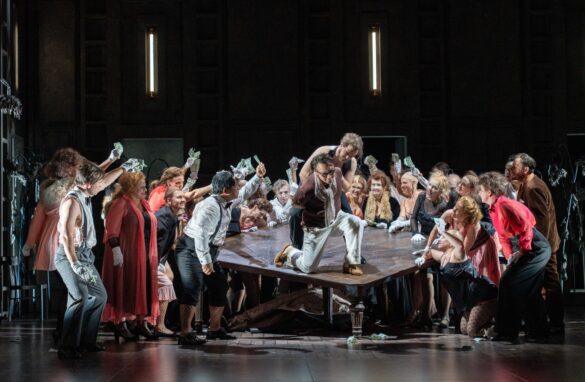
As soon as the first notes of the overture sounded from the pit, the curtain opened briskly to reveal, in the middle of an otherwise empty stage, a large bed with a naked woman on it, lying with her back to us, while a man was getting dressed and tossed a wad of banknotes onto the bed before leaving at leisure. The naked woman threw on a red robe and disappeared towards the back of the stage. This was Violetta (played by a double, Selma Goebel), a contemporary prostitute, nothing demi-monde or apparently glamourous here! Violetta returned, now the soprano Laura Pisani, fully dressed, and she inaugurated the scene of festivities – a sex orgy in this production, with members of the cast and chorus fully dressed or partially naked. The group of guests frequently moved as if in unison, backs bent, like a creepy amoeba-like organism. When Alfredo joined this party, he stood out by being dressed more fashionably, and every time he tried to fit in, he failed. He just could not find the rhythms, or yield to the stooping body posture. In return for his protestations of love, Violetta gave him not a camelia, but a sunflower. For the shifts within the scene, cast and chorus did not leave the stage: instead, they moved to the sides, into darkness, and eHe merely lay there, in positions recovering their strength for the next round of sex, or of frozen but ongoing sexual activity. The stage was completely empty, however, for Violetta’s big aria. Here, Violetta was completely alone.
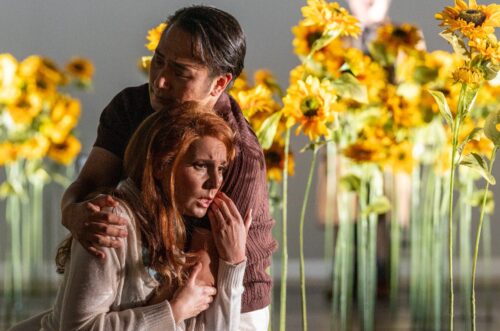
For Act II and the idyllic Scene 1 in the country, the stage was a sunlit field of sunflowers, the sunlight changing to reveal darkening shadows, in line with the doom of the plot. For Scene 2, we returned to the stark interior environment of the first act: what we saw turned out to be Violetta’s nightmare – singer and double kept changing places. Similarly, Act III was Violetta’s hallucination: Pisani sang from the side of the stage while Goebel enacted the role. Only at the very end of the opera, in the moments of Violetta’s death, did Pisani return to the bed, central to that scene.
Jan Essinger’s production was set in contemporary times, signalled by the costumes designed by Benita Roth in a present-day Les Misérables fashion. The brutish Baron Douphol appeared in shabby trousers and vest, for example. Sonja Füsti designed the set to reveal more of the characters and their situation, with the bland, drab, dismal dirty, dark grey of the indoors scenes, and the extraordinary contrast of the sunlit meadow of sunflowers for Act II Scene 1. Essinger’s production was engagingly contemporary, consistent and cogent, and very moving indeed.
Particular mention must be made of the employment of an intimacy coordinator for this production – a practice more common in the UK or USA, I believe, for film and television, but in its infancy for stage productions in Germany. Such awareness of the performer’s needs is commendable in its own right, and it paid off here in an aesthetic sense. From my work with an intimacy coordinator as director of a production of Mark St Germain’s The Dancing Lesson at my theatre in 2023, I was able to recognise clear signs of such work in this production of La traviata. Without exception, every movement of the many chorus and cast members which included reference to sexual activity (and there were many, many such moments and movements) was most carefully and thoroughly thought-through, explored, choreographed and executed, with the greatest of care to the individual performer’s needs. Here, the movements were carried out in a way that left no doubt that what we were meant to see was sexuality at its most carnal. However, at the same time, the way in which it was obviously choreographed placed the activity itself within an aesthetic context and at an aesthetic distance that was always obvious. There was much more immediacy despite the distance than more graphic behaviour of cast members and chorus might have been able to create.
Carlo Goldstein led the orchestra in a very nuanced rendering of the score. He particularly relished the contrasts of lush rhythms and silvery emotions in the strings. The chorus, directed by Thomas Bönisch, created a powerful impression: they sang with commitment and in perfect unison. For the run of this production, there are two singers each for Violetta, Alfredo and Giorgio Germont, who appear in different performances. On this occasion, Laura Pisani, a guest to the company, sang Violetta. Her voice was strong and well controlled throughout, with a rich (rather than thin or thinning) higher register, and equal beauty across a range of volume. Jason Kim, who is a member of the Oldenburg company, sang an ardent Alfredo, with secure, solid grounding and ringing top. Guest baritone Eddie Wade was suitably noble and stoic as Georgio Germont. Dorothee Bienert had very strong moments as Flora, and Arthur Bruce and Irakli Atanelishvili stood out among the singers of the minor roles.
Orchestra, conductor, cast and chorus worked exceptionally well together in this production, creating a carefully conceived and executed, moving and engaging, contemporary retelling of this long-established opera favourite.
Daniel Meyer-Dinkgräfe
Featured Image: Arthur Bruce (centre, Baron Douphol) and Jason Kim (Alfredo Germont) © Stephan Walzl
Production:
Director – Jan Essinger
Set Design – Sonja Füsti
Costume design – Benita Roth
Lighting design – Steff Flächsenhaar
Dramaturgy – Anna Neudert
Intimacy coordinator – Magz Barrawasser
Chorus director – Thomas Bönisch
Cast:
Violetta – Laura Pisani
Alfredo – Jasom Kim
Georgio Germont – Eddie Wade
Flora – Dorothee Bienert
Gaston – Seumas Begg
Baron Douphol – Arthur Bruce
Marquis d’Obigny – Irakli Atanelishvili
Dr Grenvil – Seungweon Lee
Annina – Friederike Hansmeier
Giuseppe – Mykola Pavlenko
Flora’s servant – Seung Jin Park
A messenger – Philip Zehnoff
Violetta’s double – Selma Goebel