 Spain Verdi, Aida: Soloists, Gran Teatro del Liceu Coro, Orquesta Sinfónica / Antonello Manacorda (conductor). Teatre Liceu, Barcelona, 4 & 9.10.2026. (JMI)
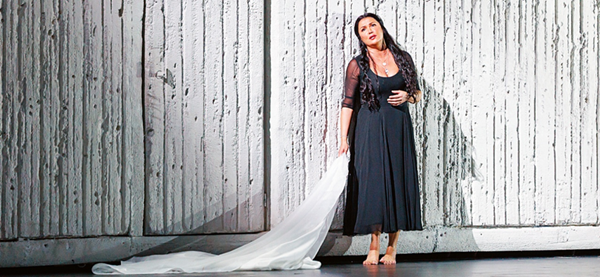
The Liceu Theatre opened its new opera season with Verdi’s Aida which was last seen here in January 2020. The casts in that 2020 staging left something to be desired when contrasted with an earlier productio n that had featured Sondra Radvanovsky in peak form. A similar situation arose this time: the presence of the marvelous Anna Netrebko in one cast was followed by Anna Pirozzi in the second.
This is a co-production of the Liceu and the Opéra national de Paris, based upon the staging that premiered at the 2017 Salzburg Festival and returned there in 2022. The stage direction is by Iranian artist Shirin Nesat – currently based in New York – who delivered a tedious production. The most objectionable aspect is the inclusion of several bizarre processions during scene changes: they add nothing and are simply boring. There are three such processions: a parade of ghostly figures, one featuring warriors and, finally, one with extras in their underwear. Worst of all, the three lasted some 17 minutes.
The staging offers little more than a large, rotating cube; an opening on one side serves as the setting where the action unfolds. I was struck by the conspicuous absence of any real stage direction aside from the arbitrary choice of costumes. Curiously, the ballet sequences were omitted entirely even though the music clearly calls for them.
Conductor Antonello Manacorda initially disappointed me. I found his leadership in Act I monotonous, but it improved as the opera went on and he ultimately delivered a solid performance. It was a carefully crafted reading. The Liceu Orchestra did well, and the Chorus was excellent.
The star of this Aida was Anna Netrebko whose superb voice completely overshadowed her fellow cast members. Her performance was formidable: she possesses a voice of extraordinary quality – singing that commands the utmost respect – and she is a compelling actress. This was a performance to remember though one must single out her singing of ‘O patria mia’ where she was simply perfect.
The second Aida was soprano Anna Pirozzi, and her performance was marked by two distinct phases. In the first part, her vocal delivery was consistent with the high standard she has demonstrated so often although I felt that her brilliant middle and upper registers were not matched by her weaker lower register. Her troubles began with ‘O patria mia’ as if something had suddenly affected her voice. Indeed, the aria’s final high notes were shouted, and she was forced to cut the concluding filado di voce. From that moment on, any note going upwards was shouted rather than sung.
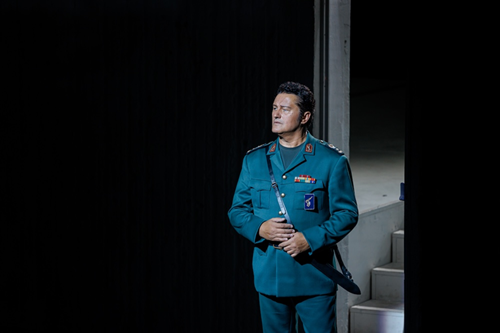
Russian tenor Yusif Eyvazov – Netrebko’s ex-husband – was initially announced as Radamès, but he withdrew (or was withdrawn) from the production. He was replaced by another Russian tenor, Ivan Gyngazov, and I did not find his performance convincing. The only high-quality aspect of his voice was the upper register, as neither his middle register, nor his vocal delivery, were adequate. Furthermore, he was little more than a statue on the stage.
In the second cast, Piotr Beczała’s performance did not have two phases but rather a single brilliant one from start to finish. Today, he is a singer of unmatched quality with a glorious voice. There is no tenor today who can surpass him: listening to him is a pure delight. If one were to raise a minor objection, it would be that the final filado in ‘Celeste Aida’ bordered on falsetto. Regardless, it was a magnificent performance
Amneris was sung by mezzo-soprano Ekaterina Semenchuk whose talent is well known. Her voice seems to have changed: she sounds today more like a soprano than a mezzo as her middle register has lost some of its quality. It is no surprise, then, that she is scheduled to sing the role of Turandot. In the second cast, Amneris was sung by mezzo-soprano Ksenia Dudnikova who once again confirmed her exceptional quality. It is the best performance I have seen from her: she has a rich, well-timbred voice and delivered a truly outstanding interpretation. She was a superb Amneris – among the best currently performing worldwide – and was superior to Semenchuk.
Amonasro was sung by baritone Artur Ruciński who once again offered his fine voice though with the persistent – and here exacerbated – problem of projection. Igor Golovatenko was originally cast as Amonasro in the second cast but cancelled and was replaced by Amartuvshin Enkhbat. He ranks among the best baritones today and was excellent here.
Ramfis was performed by Alexander Kopëczi and Giorgi Manoshvili, and George Anguladze was the King. Their performances were competent. The roles of the Messenger and the Priestess were nicely sung by Moisés Marín and Carmen Buendía
José M. Irurzun
Featured Image: Anna Netrebko (Aida) © S.Panizo
Production:
Director – Sirin Neshat
Sets – Christian Schmidt
Costumes – Tatyana Van Walsum
Lighting – Felice Ross
Chorus master – Pablo Assante
Casts:
Aida – Anna Netrebko / Anna Pirozzi
Radamès – Ivan Gyngazov / Piotr Beczała
Amneris – Ekaterina Semenchuk / Ksenia Dudnikova
Amonasro – Artur Ruciński / Amartuvshin Enkhbat
Ramfis – Alexander Köpeczi / Giorgi Manoshvili
King – George Anguladze
Messenger – Moisés Marín
Priestess – Carmen Buendía