
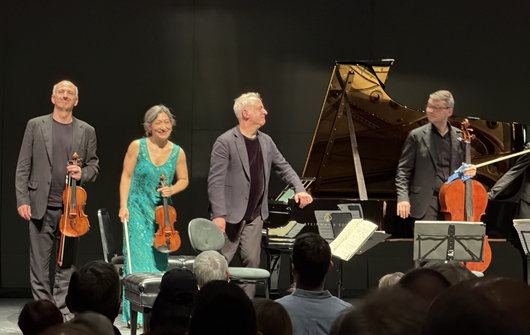
 United States Various: Jeremy Denk (piano), Takács Quartet (Edward Dusinberre, Harumi Rhodes [violins], Richard O’Neill [viola], Mihai Marica [cello]). Cal Performances, Zellerbach Hall, Berkeley, 11.10.2026. (HS)
Mendelssohn – String Quartet No.6 in F minor
Gabriela Lena Frank – Quijotadas
Franck – Piano Quintet in F minor
Encore: Dvořák – Scherzo from Piano Quintet No.2 in A major
In the past I have appreciated the elegance and technical acumen of the Takács Quartet, among the most recognizable of today’s many excellent string ensembles. Their recital before an enthusiastic audience in the University of California’s 2,000-seat Zellerbach Hall revealed a feistiness and fierce intensity
Personnel changes in recent years certainly have played a role. Founded in 1975 at the Franz Liszt Academy in Budapest, the quartet moved to the United States in 1983, taking up residence at the University of Colorado in Boulder. The last of the founders, cellist András Fejér, called it a day only last year. Edward Dusinberre has been the first violinist since 1993. Violinist Harumi Rhodes joined the roster in 2005, violist Richard O’Neill in 2020 and cellist Mihai Marica this year. The new group is on tour for the first time and, as this program shows, the results are striking.
Mendelssohn’s String Quartet No.6 in F minor may be the angriest elegy in classical music, written shortly after the death of his sister Fannie (and shortly before his own death), and this performance brought out the rage. With pianist Jeremy Denk providing his own steadiness, Franck’s Piano Quintet in F minor finished the program by digging into the music with near-feral aggression. In between, Gabriela Lena Frank’s 2005 Quijotadas, with its unusual approach to Spanish flair, added some more hair-raising moments.
Maybe it was the choice of repertoire, but the quartet seems to have upped the intensity by several notches. Dusinberre remains an elegantly expressive leader, and Rhodes continues to fit seamlessly into Dusinberre’s playing but with a bit more punch. O’Neill looked as alert as a hockey goalie, glancing around pointedly to pick up nuances in tempo and emphasis from the other musicians, often leaning forward to execute them. Despite his comparably serene countenance on stage, Marica delivered the needed muscle and, when necessary, deftness.
The Mendelssohn String Quartet differs from other musical elegies in that it is neither sorrowful nor grand. As the program notes, ‘raw emotional pain springs from nearly every page’, but tempos are hardly what one might expect: Allegro vivace assai to start, then Allegro assai and, after an Adagio third movement, an Allegro molto finale. The Takács somehow managed to express all that without losing the essential ear-soothing harmonies and melodies we associate with Mendelssohn.
The first movement began with a burst of dark energy and ended with a finality that drew enthusiastic clapping from the audience. The syncopations, dissonances and heavy moments of emphasis in the second movement were executed with extraordinary potency. The sublime calm of the Adagio brought necessary relief – the only movement in a major key – before the quartet returned to the grittiness of the opening movement to wrap up with appropriate weight.
Quijotadas is part of Takács’s current project to perform and record works by the Berkeley-raised composer Gabriela Lena Frank. Takács has premiered a good deal of her string music which reflects her family roots in Peru and China. This includes the world premiere of her concerto grosso Kachkaniraqmi in 2024 and the 2001 Leyendas, both of which are steeped in Andean traditional music. Quijotadas traces scenes from Cervantes’s Don Quixote, looking through a contemporary lens at traditional Spanish music.
The rhythms and overall sense of the five movements can charm and cause shivers of eeriness. Dusinberre and Rhodes managed to suggest panpipes in the unaccompanied opener, ‘Alborada’, and the whole quartet evoked guitars with pizzicatos in the second movement, ‘Seguidilla’, which distorted the spirited dance rhythms of Don Quijote’s homeland, La Mancha. ‘Moto Perpetuo’ had the whole quartet seething in a nervous angst.
They also caught the emotional tugs in the last two movements. ‘Asturianada’ distorted a mountain song to paint the stillness and spookiness of the cave our hero finds himself trapped in. The finale, ‘La Danza de los Arrieros’, depicted the Don’s beating at the hands of rough muleteers, an incident that led to his realization that his heroism is not what he dreamed. The music ended on a moment of resignation.
After the intermission, César Franck’s Piano Quintet in F minor amped up the intensity even further. The performance added extra emphasis with sharp sforzandos to start phrases and special attention to the music’s rhythmic vitality. For his part, Denk kept up but with a less aggressive touch. Instead of fighting against each other, the layering of textures introduced a level of refinement that elevated the whole.
The contrast was clear in the dreamy second movement, which emerged with all the necessary richness intact before the finale returned with the forcefulness of the opening movement. Framed by seductively swirling music by the strings, the finale’s increasing climaxes reached full intensity before ending with a sigh of sweet harmonies.
Dusinberre introduced the encore by noting that they wanted to lighten up after all that. The Scherzo from Dvořák’s Piano Quintet No.2 in A major hit just the right tone in a joyful – and virtuosically rapid – performance.
Harvey Steiman