
 Ireland Haydn, Mozart: Jonathan Biss (piano), National Symphony Orchestra Ireland / Peter Whelan (conductor). National Concert Hall, Dublin, 9.10.2026. (RB)
Haydn – Symphony No.22 in E-flat Major Hob.1/22 ‘The Philosopher’
Mozart – Piano Concerto No.17 in G major K453; Symphony No.41 In C major K551 ‘Jupiter’
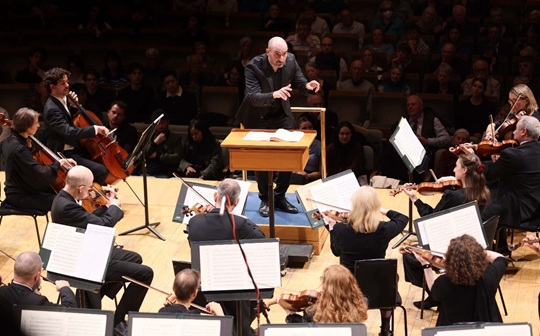
The National Symphony Orchestra Ireland (NSOI) were joined by their Artistic Partner and early music specialist, Peter Whelan, for this concert of 18th-century masterpieces. Jonathan Biss was the soloist in Mozart’s evergreen 17th Piano Concerto.
The concert opened with Haydn’s 22nd Symphony which is one of the composer’s most distinctive early works. The nickname, ‘The Philosopher’ derives from the serious, contemplative nature of its Adagio opening movement. The work is unusually scored for strings with two French horns and two cor anglais and it is that which give the first movement its rich mellow colour.
This performance was clearly informed by Whelan’s expertise in this repertoire. Vibrato was kept to a minimum on the strings; the sound was light and transparent throughout and the ornamentation tastefully executed. Whelan conjured chorale-like sonorities in the opening movement with its walking bass line in the lower strings and antiphonal exchanges between the horns and cor anglais. The NSOI combined to create the dark timbres and rich colours which typify this movement. The two Presto fast movements had energy and rhythmic drive, and Whelan coaxed an impressive range of dynamics and articulation from the players.
Jonathan Biss is renowned for his performances of Classical and contemporary works. He has released critically acclaimed recordings of two Mozart piano concertos with the Orpheus Chamber Orchestra. Mozart’s 17th Piano Concerto is one of the composer’s most popular and delightful works. Leonard Bernstein declared his admiration for the Andante middle movement while the finale anticipates Papageno’s aria in The Magic Flute. Mozart’s pet starling was obviously impressed with the latter as the composer, in one of music’s most famous anecdotes, described it trilling the music.
Whelan and the NSOI adopted a brisk tempo in the opening movement. There was impressive attention to detail, clean articulation and beautifully executed ornamentation. Biss brought a crystalline touch and Classical restraint to Mozart’s piano writing. The composer’s sparkling runs and passagework were skilfully executed and there was excellent interplay between piano and orchestra. While Mozart’s music demands lightness of touch, I found some aspects of Biss’s playing a little too precious. There was certainly scope for him to project the tone more in some of the louder sections of the music. Biss performed Mozart’s own cadenza to the first movement and used an impressive range of touch and articulation to bring out the opera-buffa charm of the work.
Biss gave an impressive, very musical account of the slow movement. The opening theme had a wonderful sense of poise and stillness and there was some highly expressive and exquisite pianissimo playing. Sadly, the performance was marred by a highly intrusive noise from an electronic device in the audience which seemed to go on much longer than it should. The orchestra and soloist showed enormous professionalism, carrying on playing while this was going on. The finale was an absolute delight, and I was impressed with the way the orchestra and soloist combined to characterise the variations. On a few occasions, Biss added in some of his own ornamentation which is very much in keeping with the style of the period. Soloist and orchestra joined forces in the buffa-like Presto coda to drive the movement to its exhilarating conclusion.
The final work on the programme was Mozart’s ‘Jupiter’ Symphony which stands as one of the pinnacles of the Classical period. It is still remarkable to think Mozart composed this work alongside his 39th and 40th Symphonies in less than six weeks. It is one of the most perfect pieces of music ever written and it demands perfection in performance.
There was much to admire in this performance from Whelan and the NSOI. Whelan’s tempo in the opening movement was spot on, and he was not afraid to highlight the more muscular, robust aspects of the music. He and the NSOI successfully balanced the ceremonial fanfares with the more lyrical elements in the score. Brass and timpani enhanced the sense of pageantry and occasion. The violins brought warmth and lyricism to the gorgeous melody which opened the slow movement. Whelan ratcheted up the dramatic tension with the minor key outbursts while at the same time keeping a sense of Classical proportion. The Menuetto was brisk and elegant with the violins clearly relishing the Ländler-like qualities of the music. The finale was for the most part admirably clear and Whelan succeeded in injecting energy and momentum into the playing as the movement progressed. In the final section the voicing and contrapuntal lines were not always as clear as they might be, although it is admittedly extremely difficult to delineate the multiple themes with the degree of clarity Mozart demands. Fanfares on the brass brought the movement to its triumphant conclusion.
Overall, there was admirable playing throughout this concert with Whelan showing himself as an adept Classical interpreter.
Robert Beattie