
 New Zealand Philipson, Mozart, Shostakovich: Benjamin Baker (violin), Yura Lee (viola), Arohanui Strings, Orchestra Wellington / Lior Balachness, Marc Taddei (conductors). Michael Fowler Centre, Wellington, 20.9.2025. (PM)
William Philipson – House of the Faun
Mozart – E-flat Sinfonia Concertante for violin and viola, K.364
Shostakovich – Symphony No.4
Classical music concerts more often than not display a certain degree of homogeneity relating to style, content, repertoire and performance standard. One of the defining features of Orchestra Wellington’s music director Marc Taddei’s tenure has been his increasing readiness to interact with his orchestra’s ‘community’, establishing in the process a wider homogeneity with local musicians, composers and music educators here in Aotearoa, New Zealand’s capital.
Taddei has established an ongoing relationship between his orchestra and a group with the name Arohanui Strings, a Sistema-like group of young musicians in the Wellington region whom he invites to take part in full orchestra concerts once or twice every year.
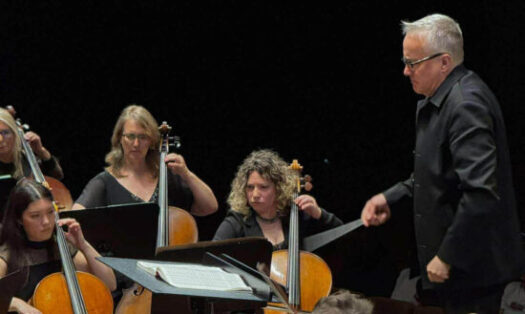
For this concert the students were to play their part in a commissioned work for the combined student-and-adult orchestra from 2025 composer-in-residence, William Philipson, a work whose name House of the Faun marked the composer’s recent visit to Pompeii, Italy, where he’d been inspired by the excavation and part-restoration of a house buried by the 79AD eruption of nearby Mt. Vesuvius. The piece was simple, concise and effective, the players maintaining their ensemble aided by the steady direction of their conductor, Lior Balachness – osmotic sequences of languid wind-and-tide evocations whose mounting waves grew up to implacable surges breaking and washing over rocky headlands. We felt a timeless kind of process, almost Ozymandias-like in the disdain shown by nature of human detailings such as faun statues, mosaic floors and Doric columns.
A few additional tunes for the young players to flex their fingers on, and they had gone, relishing their moments of glory – leaving spaces to be rearranged for the performers of the next item, Mozart’s adorable E-flat Sinfonia Concertante for violin and viola K.364. Soloists New Zealand violinist Benjamin Baker and Korean-born Los Angeles violist Yura Lee proved engagingly at one with the work and with each another, joining with Taddei’s and the orchestra’s opening tutti so that their first proper ‘solo’ entry seemed as if it had simply grown out of the music’s own essences.
Together Lee and Baker as much ‘danced’ as ‘conversed’ their exchanges, an accord which the orchestra delightedly and joyously affirmed throughout. The slow movement in both orchestral and single-instrument terms achingly realised the composer’s feelings of grief for his recently-deceased mother – however, the finale returned the players here to good-humoured gaiety, with plenty of ‘anything you can do’ spirited exchanges between the soloists that captivated us all, judging by the enthusiasm and warmth of the audience’s reception.
We needed plenty of good-humoured gaiety as preparation for the Shostakovich Fourth Symphony’s overwhelming amalgam of epic length, grandiose orchestrations, stark volatilities, ironic humour and unnerving desolation. Taddei and his spectacularly-augmented Orchestra Wellington took to the work’s opening clarion call by the winds and percussion with a sturdy kind of ‘as we mean to go on’ bite, vigour and confidence which never for a moment faltered, right to the symphony’s conclusion by the celesta’s final, ambivalently-voiced, void-addressing notes.
First-movement moments which stood out amid the orchestra’s comprehensive ‘ownership’ of the music were the excellences of the many wind solos, the crisp attack and arresting timbral characterisations of the brass, and the fiery ‘punching above their weight’ attack of the strings in their wildly vertiginous first-movement fugato passage, a mood then put into a different perspective by concertmaster Amalia Hall’s sorrowing violin solo near the movement’s end. Having underpinned various episodes of the first movement’s volatile character, a couple of percussionists were to enjoy a particular moment of focus in the relatively brief sardonic second movement’s coda, in which a skeletal-like figure appeared, undertaking a few measures of the dancing rhythm before abruptly vanishing!
Conductor Marc Taddei’s control of the epic third movement’s journeyings made for strongly-characterised contrasts, such as the laden tread of the opening and its inexorable build-up towards grandeur and then frantic sound-vortices of interaction between strings/winds/brasses interaction – all proving a perfect foil for the composer’s abrupt introduction of commedia dell’arte knockabout scenarios. After these had run their course, the heavier percussion simply cut loose! – underpinning what were the work’s arguably most tumultuous sections, a tsunami-like series of crescendos whose force unashamedly evoked the description ‘seismic’, even in earthquake-prone Wellington!
We were left with an enigmatic conclusion, wrought of desolate ambiences, with the celesta a single voice casting light into the midst of what seemed like utter ruin. It was, in fact possible to imagine we had at once come a long way from – and yet circled back around to – those earlier vistas of Mediterranean devastation with which this evening’s music had begun its incredible journey.
Peter Mechen