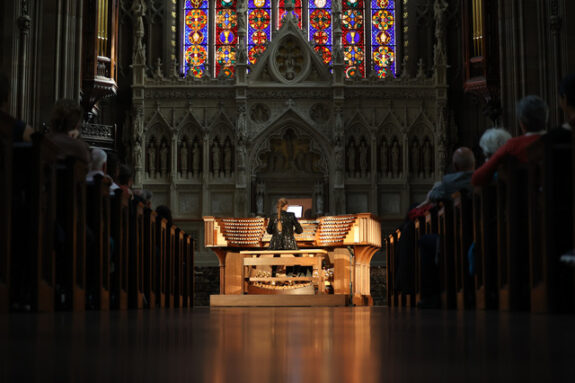
 United States Various, ‘Pipes’: Anna Lapwood (organ), Trinity Church, New York, 14.9.2025. (RP)
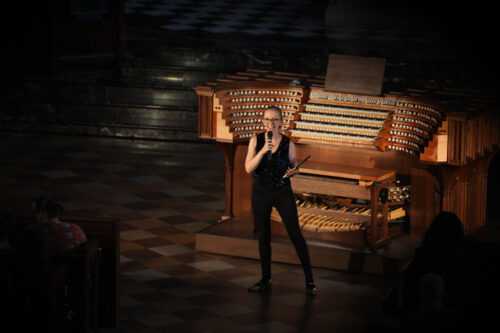
‘How do you hold a moonbeam in your hand?’ kept running through my mind while Anna Lapwood put Trinity Church’s new organ through its paces. Paint advertisements describe the color moonbeam as a warm and uplifting gray color with a hint of red and brown. Lapwood’s personality and playing are full of color, excitement and tinged with wonder. Rodgers and Hammerstein knew a lot more about moonlight than today’s marketing types.
Lapwood played the dedicatory recital of the Glatter-Götz/Rosales Opus 40 organ at Trinity Church. Every new organ is a cause for celebration, and Trinity’s more than most. The recital was just a few days after the 24th anniversary of 9/11. Although the church, a few minutes’ walk from Ground Zero, was spared major destruction, its historic 1923 Aeolian-Skinner was not. The instrument’s workings were covered in dust and grime, and it was dismantled.
An electronic organ served as an interim solution, but a total restoration of the old organ or a new one was always envisioned. Trinity Church opted for the latter, and the new organ has been a work in progress for a decade. It is a collaboration between German builder Glatter-Götz and Los Angeles tonal designer Manuel Rosales. The team is best known for the organ at Frank Gehry’s Walt Disney Concert Hall in Los Angeles. Opus 40 is their first joint effort in New York.
Visually, little has changed, although the 23.5 karat gold leaf gilding on the facade pipes is eye-catching. The number of pipes has increased from 5,000 to 8,041 pipes with 113 independent stops and 138 ranks. The majority of the organ’s features are housed in the rear gallery in Richard Upjohn’s 1846 case, while the ones in the chancel have undergone minor modifications for acoustical purposes. Lapwood performed on the mobile console, with its intricately carved woodwork, positioned in front of the chancel.
Lapwood’s career has been one of firsts. She was the first woman to be awarded an organ scholarship at Magdalen College, Oxford, in its 560-year history. She was the youngest person (21) to hold the position of Director of Music at an Oxford or Cambridge university college when she became Director of Music at Pembroke College, Cambridge in 2016. Earlier in 2025, she became the first official organist of the Royal Albert Hall, deciding to focus on concertizing rather than church music. She has attracted over two million social media followers and regularly connects with listeners as a presenter on the BBC and Classic FM.
A champion of women composers, Lapwood opened the recital with the world premiere of Eunike Tanzil’s ‘Nimbus’. Tanzil was born in Indonesia and now lives in Los Angeles. She studied at Berklee College of Music in Boston and The Juilliard School in New York, and her music has been performed by orchestras in the US, Asia and the UK. In recent years, Tanzil has written music for Hollywood films, and ‘Nimbus’ draws from that experience. Lapwood described it as joyous and, indeed, its beautiful melodies and forward propulsion made it so.
The British composer Rachel Portman’s ‘Flight’ and Italian Olivia Belli’s ‘Lumina Luminus’ followed. Portman was the first woman composer to win an Academy Award for Best Original Score, for Emma. ‘Flight’ permitted Lapwood to explore the interplay between the front and rear organs. ‘Lumina Luminus’ showcased the organ’s scintillating, shimmering, soft sounds.
Film music, rather than repertoire standards, dominated the recital. Lapwood’s choices needed no justification, but she did invoke Duke Ellington, in spirit, if not name, who said, ‘There are simply two kinds of music, good music and the other kind’. Lapwood’s forays into film music let allowed her to explore the full glory of the Glatter-Götz/Rosales. If you have all of those wonderful sounds and textures at your command, you might as well have some fun. I could be wrong, but we didn’t hear the bird calls, which are one of the organ’s specialty stops.
The Trinity bell ringers introduced ‘The Bells of Notre Dame’ from The Hunchback of Notre Dame. Amplification was needed to hear the bells, some of which date to the 1790s. Inside the church. Lapwood described John Williams’s ‘Duel of the Fates’, a musical theme from Star Wars, as her workout piece. Musically, it was a chance to hear the new organ’s terrific reed pipes do battle.
Lapwood drew from the classical repertoire with her arrangement of ‘Dawn’ and ‘Sunday Morning’ from Britten’s Four Sea Interludes from Peter Grimes. ’Dawn’ sounded in delicate colors, while the muted reeds that Lapwood employed in “Sunday Morning’ rippled with anticipation and an ominous foreshadowing of the tragedy to come. The only warhorse of the organ repertoire was Gigout’s ‘Toccata’, the piece that made Lapwood want to be an organist. She fueled it with virtuosity and passion, and the triumphant sounds all but shook the church’s foundations.
Ludovico Einaudi’s ‘Experience’ was Lapwood’s sole incursion into minimalism. She described the piece as a sustained, infinite crescendo – an effect, she opined, that the organ does better than any other instrument. It also permitted her to explore the lowest sounds from the organ’s pedal stops. In Christopher Churcher’s ‘This Shining Night’, Lapwood captured the night sky as stars appeared one by one until an entire galaxy was depicted in sound. Photos of outer space could be seen on the tablet from which she played.
It was back to Hollywood for the finale, with the Suite from Pirates of the Caribbean. Lapwood fell in love with this music as a teen and still is. There was audience participation in ‘Hoist the Colours’. Lapwood described her physical dexterity by playing five melodies simultaneously, with one in the ingenious deployment of her thumbs. It was rollicking good fun and a superb display of the Glatter-Götz/Rosales organ’s tonal spectrum.
There was an encore, a romantic flight with great soaring melodies. And with Lapwood’s shouts of ‘Play On! Blog On’ still ringing in my ears, the new Trinity Church had been properly launched to the wonder and delight of all.
Rick Perdian
Featured Image: Organist Anna Lapwood at Trinity Church © Edwin J. Torres
Eunike Tanzil – ‘Nimbus’ (world premiere)
Rachel Portman – ‘Flight’
Olivia Belli – ‘Limina Luminus’
Benjamin Britten – I. ‘Dawn’, II. ‘Sunday Morning’ (‘Four Sea Interludes’ from Peter Grimes)
Alan Menken – ‘The Bells of Notre Dame” (Hunchback of Notre Dame)
John Williams – ‘Duel of the Fates’
Ludovico Einaudi – ‘Experience’ (arr. Lapwood)
Christopher Churcher – ‘This Shining Night’
Eugène Gigout – ‘Toccata’
Hans Zimmer/Klaus Badelt – Suite from Pirates of the Caribbean