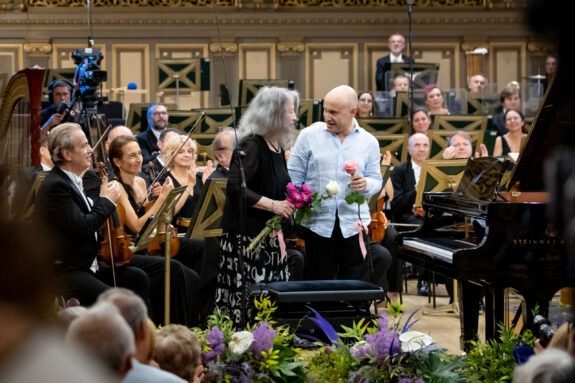
 Romania George Enescu International Festival 2025 [6] – Ravel, Debussy: Martha Argerich (piano), Orchestre Philharmonique de Monte-Carlo / Charles Dutoit (conductor). Romanian Atheneum, Bucharest, 15.9.2025. (ES-S)

Ravel – Ma mère l’Oye, M.60; Piano Concerto in G major, M.83; Valses nobles et sentimentales, M.61
Four-hand piano encore: ‘Laideronette, Impératrice des Pagodes’ from Ma mère l’Oye
Orchestral encore: ‘Pavane pour une infante défunte’
Encore: Scarlatti – Keyboard Sonata in D Minor, K.141
Debussy – La mer, L.109
The Enescu Festival’s afternoon at the Romanian Atheneum with Charles Dutoit and the Monte-Carlo Philharmonic was framed as a journey through the soundworlds of Ravel and Debussy. At its center stood Martha Argerich, whose presence alone transforms any concert into an event. Expectations were especially high: she had been scheduled earlier in the festival to play Beethoven’s First Piano Concerto with the Orchestra of the Accademia Nazionale di Santa Cecilia under Daniel Harding but had withdrawn and been replaced by Seong-Jin Cho. Thus, her return to the stage in Bucharest was charged with anticipation, and the sold-out hall confirmed her enduring magnetism.
Ma mère l’Oye, the first work in a program shaped to honor Ravel’s sesquicentennial, served as a glowing curtain-raiser. Though conceived for children, the suite carries narratives of loss, menace and transformation. In ‘Petit Poucet’, wandering lines trace the boy’s lost steps until they dissolve into silence. ‘Laideronnette, Impératrice des Pagodes’ brings pentatonic figurations that conjure both exotic charm and ironic caricature. In ‘Les entretiens de la Belle et de la Bête’, Beauty’s graceful waltz intertwines with the bassoon’s burlesque caricature of the Beast, its rasping timbre set against her elegance before strings mark his transformation. Dutoit emphasized the childlike qualities – pastel orchestration, softened contours, gentle pacing. Less present were the narrative undertones: the unease in the meandering lines, the gruff humor of the Beast, the shadows beneath the fairy-tale brightness. At times, the performance might have benefited from greater rhythmic edge to sharpen contrasts and bring out the tension beneath Ravel’s enchanted world.
After the interval, another Ravel suite, Valses nobles et sentimentales, continued in the same vein. Written as a modernist response to the Viennese waltz tradition, the cycle alternates between affectionate homage and sharp irony, its charm undercut by sudden harmonic shifts and fleeting dissonances. Dutoit shaped each miniature with care, but the contours were softened, the pulse smoothed into elegance rather than given its full edge. The strings produced a luminous sheen, woodwinds adding grace in the more reflective episodes, yet the score’s volatility remained understated. The closing epilogue, in which memories of the earlier waltzes drift in and dissolve, carried a gentle melancholy that was beautifully realized, but contrasts between the heady swirl and its dissolution could have been profiled more strongly. As in the fairy-tale suite, refinement predominated over tension – a choice that emphasized beauty if occasionally at the expense of bite.
The centerpiece of the performance was Ravel’s Concerto in G major, with Argerich reaffirming her singular blend of spontaneity, clarity and imagination. The opening movement, driven by jazz-tinged syncopations, had rhythmic vitality in abundance; runs sparkled, accents carried a mischievous energy and moments of rubato gave familiar phrases a sense of discovery. The Adagio assai revealed her gift for introspection – the long, unbroken melody unfolding with luminous simplicity, warmly answered by woodwinds. The finale burst out with dazzling agility and playful élan, never lapsing into mere display. Yet despite her decades-long partnership with Charles Dutoit, the collaboration was not always seamless; a few transitions seemed slightly unsettled, and the balance between soloist and orchestra was at times imperfectly calibrated. The Monte-Carlo brass, too, occasionally sounded a little raw, a trait noticeable elsewhere in the program. What remained most striking was Argerich’s mercurial presence – as captivating as ever and still capable of making the familiar sound freshly alive.
The ovations were immediate and insistent, and Argerich, ever generous, responded with two encores. First came an affectionate surprise. Nelson Goerner – who had appeared as a soloist with the same orchestra under Kazuki Yamada the previous day performing Ravel’s Concerto for the Left Hand – joined her at the keyboard for the original version of ‘Laideronnette, Impératrice des Pagodes’ from Ma mère l’Oye. Argentinian-born like Argerich, he has long been one of her closest musical partners, and their playful ease here radiated both intimacy and spontaneity. She then turned to Scarlatti’s Sonata in D minor, unleashing its toccata-like figuration with razor-sharp articulation and irresistible forward drive. What amazed most was her seemingly unbridled energy: at an age when many artists temper their pace, Argerich still propelled the music with a vitality that felt both natural and inexhaustible. The sparkle she brought to Scarlatti left the audience cheering with renewed fervor.
Debussy’s La mer brought the program to a close with a seascape at once expansive and elusive. Few conductors are as closely associated with French impressionist repertoire as Dutoit, and his command of Debussy’s intricate textures was evident. ‘De l’aube à midi sur la mer’ unfolded with luminous brass fanfares and finely layered strings, though climaxes sometimes blurred detail. ‘Jeux de vagues’ sparkled with agility, woodwinds and harp darting across the surface, even if ensemble precision was not infallible. In the final ‘Dialogue du vent et de la mer’, Dutoit sculpted a steady build toward grandeur, the orchestral sound gathering power in broad surges. Despite occasional imperfections, the performance projected both transparency and sweep, capturing the vastness and the shifting iridescence of Debussy’s imagined sea.
As a final encore, Dutoit led the orchestra in Ravel’s ‘Pavane pour une infante défunte’. After the brilliance and turbulence that had come before, its restrained elegance offered a moment of repose, the strings shaping the long lines with poise while winds added gentle color.
Yet, beyond the refinement of the French repertoire offered, Argerich’s artistry, still vital and deeply human, gave the performance its true distinction.
Edward Sava-Segal
Featured Image: Charles Dutoit conducting the Monte-Carlo Philharmonic © Cristina Tanase