 Romania George Enescu International Festival 2025 [3] – Korngold, Rachmaninov, Rimsky Korsakov: Bruce Liu (pianist), Royal Philharmonic Orchestra / Vasily Petrenko (conductor). Palace Hall, Bucharest. 13.9.2025. (GT)

Korngold – Reunion – Finale from The Sea Hawk
Rachmaninov – Rhapsody on a Theme of Paganini in A minor, Op.43
Rimsky-Korsakov – Scheherazade, Op.35
Now in its twenty-seventh edition, the George Enescu International Festival was launched seventy years ago. Apart from the central programme taking place in Bucharest, the events are spread across Romania widening the reach of the festival to include regional music ensembles and venues. Of course, at the musical heart are Enescu’s symphonies, quartets, song cycles, orchestral pieces, and his great opera Oedipe. This year the festivities marks the anniversaries of Boulez, Ravel, Shostakovich and of Arvo Pärt. Between 24 August and 21 September, the event hosts as many as 4000 musicians from all over the world in over 100 concerts.
The Athenaeum, Palace Hall, Odeon Theatre, and the National Opera Theatre host the main programme with galleries and museums hosting chamber recitals, educational and exhibitions. Three concerts take place daily, with as many as six concerts every day at weekends during the festival. Many orchestral concerts are in the Palace Hall, opposite the former Royal Palace, now the National Museum of Art. The building, which seats 4,060 people and opened in 1960, has hosted international UN events, energy, and Red Cross congresses, etc.
Typical of the festival’s programming is this fusion of popular romantic works with a twentieth-century opera composer now remembered mostly for his Hollywood film scores. Born in Brno, then part of the Austro-Hungarian Empire, Erich Wolfgang Korngold wrote some of the most colourful scores in twentieth-century opera. His debut stage work, Violante, led to Die tote Stadt and Das Wunder der Heliane, all imbue an exotic richness in orchestral and vocal scoring. The Third Reich ended all hopes of pursuing his early career, and emigration to the US led him to develop into one of the twentieth-century’s greatest Hollywood composers. His two Oscars were for the popular movies Anthony Adverse and The Adventures of Robin Hood. Korngold was forgotten after his passing in 1957, as the popularity of romanticism had declined; his film scores were revived when RCA issued an album of The Sea Hawk in the 1970s. The release auspiciously led to the revival of his lushly orchestrated Violin Concerto (premiered by Jascha Heifetz) and became part of the standard violin repertoire.
Korngold’s Violin Concerto embraces themes from several of the film scores, among which is the main idea of the finale from The Sea Hawk, and in opening this concert, Vasily Petrenko led the spirited and vibrant percussion crash, thrillingly complemented by the brass group with the luxuriant strings introducing exquisitely colourful harmonies, especially from the first violins. The exotically rich rhythms switched across the orchestra and brought out all the glamour and heroic ideas from Korngold’s score. This was a magnificent start to this evening of romantically evocative music.
The trend of late romanticism (and by another refugee from Europe) continued in Sergey Rachmaninov’s ever-popular Rhapsody on a Theme by Paganini, and a work that, like the Korngold piece, evokes cinematic imagery. This work demands precision from both the soloist and the orchestra; however, despite Canadian pianist Bruce Liu’s magnificent virtuosity, I found a lack of colour and sparkle in the strings – an effect of travelling perhaps – but this did not lessen the ebullient performance by Liu for whom this score could have been written.
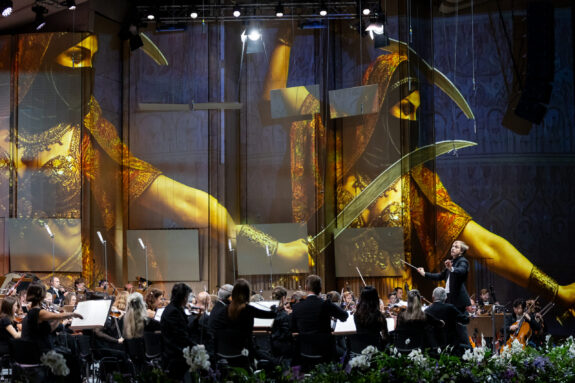
The concert truly came to life after the interval with Rimsky-Korsakov’s exotically colourful Scheherazade – the immediate impression was as if a different ensemble were playing. An extra dimension was the AI visual presentation of the One Thousand and One Nights projected behind the orchestra – this was the work of Carmen Lidia Vidu, whose work would be seen throughout other events during the festival. Under the direction of Vasily Petrenko, this performance was simply magnificent, a startling transformation from the Rachmaninov piece earlier, and so much so that I cannot recall such an impressive performance of this ever-popular work. Every department was allowed to affirm its virtuosity with magical contributions from the woodwind, especially the flute, clarinet, and bassoon. Yet it was the ravishingly vibrant solo passages from the first violin that gave a different dimension to this evening. Vasily Petrenko gave an inspired interpretation of this work and succeeded in winning over his listeners.
This was an excellent introduction to the musical scene of Bucharest and to the Enescu International Festival, where on every street corner and avenue are decorated by giant posters advertising the festival events and ensuring appreciative support for this world-class festival.
Gregor Tassie
Featured Image: Vasily Petrenko conducts the Royal Philharmonic Orchestra © Andrei Gîndac