
 United States Various: Ensemble Connect. Carnegie Hall, New York, 26.10.2026. (RP)
Ligeti – Trio for Violin, Horn and Piano
Loeffler – Two Rhapsodies for Oboe, Viola and Piano
Kodály – Serenade, Op.12
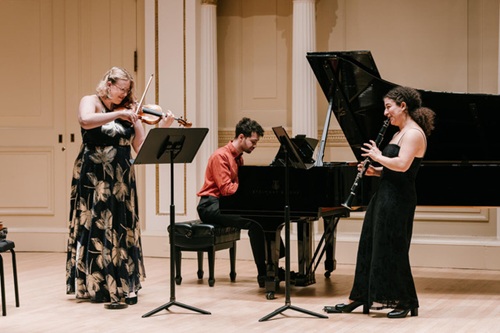
Bartók – Contrasts for Violin, Clarinet and Piano, BB116
Cohesion is a given with Ensemble Connect. Its name suggests as much, as does the ensemble’s singular ability to engage an audience. But the individual virtuosity of its members made its season-opening concert particularly exciting, with works by three 20th-century titans of Hungarian music and one by an unjustly neglected American composer.
György Ligeti was a defining force in postwar modern music. Having survived the Holocaust and later fleeing Hungary after the 1956 uprising, he developed a distinctive musical language that moved beyond traditional tonality and conventional forms, combining micropolyphony and rhythmic complexity with wit and surreal humor.
His Trio for Violin, Horn and Piano bears the subtitle ‘Hommage à Brahms’. As hornist Will Sands explained, the tribute is more limited than the title might suggest as Ligeti disavowed any broader musical debt to Brahms. The connection is nevertheless clear in the combination of instruments, modeled on Brahms’s Horn Trio in E-flat major and his influence on Ligeti’s horn writing.
The first movement featured an engaging dialogue between Sands and violinist Laurel Gagnon, whose playing combined tonal allure with wistful lyricism. Pianist Joseph Vaz propelled the aptly titled Vivacissimo molto ritmico, while Sands added aural exuberance with his horn’s bell pointed upward. In the final movement, the trio shaped a haunting landscape of shifting textures and intensifying emotion around a descending lament motif. Particularly striking was the purity of tone Gagnon and Sands brought to the exposed, sustained notes, lending the music an almost otherworldly stillness.
A twist came with Charles Martin Loeffler and his Two Rhapsodies. Born in Germany, Loeffler immigrated to the United States but remained a Francophile. He served as assistant concertmaster of the Boston Symphony Orchestra for more than two decades. Though rarely programmed today, his music was highly regarded in his lifetime for its rich harmonies, impressionistic colors and evocative, often mystical moods.
The Two Rhapsodies were inspired by poems by French Symbolist Maurice Rollinat, whose macabre, dreamlike imagery suited Loeffler’s sensibilities. The first, ‘L’Étang’ (The Pond), evokes an eerie, otherworldly landscape; the second, ‘La Cornemuse’ (The Bagpipe), conjures the haunting wail of bagpipes through modal melodies and open fifths. Oboist JJ Silvey read the poems in English translation before each work.
In ‘L’Étang’, Vaz created shimmering pools of sound over which Silvey and violist Abby Smith exchanged lyrical phrases, casting an evocative, ambiguous spell. Silvey’s plangent tone contrasted with the depth and richness Smith drew from the viola. Vaz again established a mysterious atmosphere in ‘La Cornemuse’, where the two players created a shared soundscape rather than engaging in direct dialogue. The oboe suggested the distant wail of bagpipes, while the viola contributed a dark, plaintive color. At the close, Silvey’s subdued playing and Vaz’s delicate touch produced an ending as gorgeous as it was haunting.
Zoltán Kodály (1882–1967) is arguably better known for the music education method bearing his name, which uses folk songs to teach pitch, rhythm, sight-reading and musical literacy, than for his compositions. A close friend of Béla Bartók, he pioneered the systematic study of Hungarian folk music with him. As a composer, Kodály drew on these traditions to create a melodic, folk-rooted language distinguished by adventurous harmonies.
His Serenade for two violins and viola combines Hungarian folk vitality with a distinctive interplay among the three instruments. The first movement opens with a burst of rhythmic energy, followed by an eloquent melody from Smith’s viola over lively pizzicato from the violins, with Ensemble Connect alum Rubén Rengel partnering Gagnon. The slow second movement stood out for the expressive dialogue between Gagnon and Smith over the second violin’s tremolo. All three joined in the energetic folk–dance rhythms of the Vivo, with Gagnon delivering particularly fiery playing, capped by a brilliant violin flourish.
Bartók was one of the most influential figures in 20th–century music, incorporating the rhythms, modes and melodic contours of Hungarian and neighboring folk traditions into his compositions. Contrasts, commissioned by jazz clarinetist Benny Goodman, is a virtuosic trio for clarinet, violin and piano that transforms the vitality and earthiness of folk idioms into sophisticated chamber music.
Clarinetist Anoush Pogassian joined Gagnon and Vaz, matching the violinist in exploiting the wide range of colors Bartók created for their instruments. She impressed with her vibrant tone and stylistic versatility, moving effortlessly between jazz inflections and the slides, trills and elaborate cadenzas of Hungarian-inspired passages. In the mysterious middle movement, she and Gagnon engaged in precisely coordinated counterpoint while Vaz provided a sparse but atmospheric foundation.
In the concluding Sebes (Fast Dance), Gagnon switched to a specially retuned second violin, whose harsh, raw sonority evoked a folk fiddle, while Pogassian played a different clarinet. These changes heightened the movement’s contrasts in color and character. Gagnon brought the performance to a close with a brilliant cadenza, capping a concert marked from the outset by style, energy and flair.
Rick Perdian