 United States Various: Iestyn Davies (countertenor), Oliver Wass (harp). Cal Performances, Hertz Hall, University of California Berkeley, 25.10.2026. (HS)
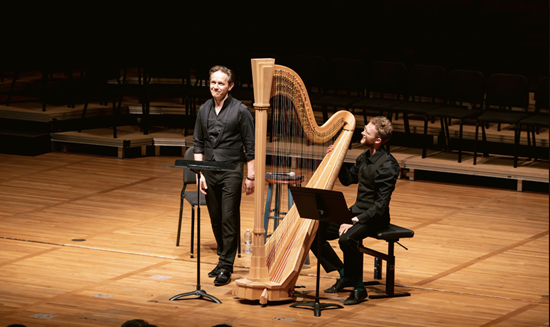
Countertenor Iestyn Davies was not feeling quite up to par and had canceled two performances earlier in the week on the East Coast due to a cold. But he muscled his way through his recital Sunday at Hertz Hall in Berkeley without any obvious trouble except for a couple of minor program changes to give himself a bit more rest.
To that end, his recital partner, the astonishingly adept and expressive harpist Oliver Wass, sprinkled instrumental solos throughout the program – and all but stole the show. He wasn’t even playing his own instrument. He could not travel with his on a U.S. tour that stretched from Hawaii to New York so he borrowed a harp from San Francisco Symphony principal Katherine Siochi. He was impressed with it, and so was I.
Davies, a Baroque and Early Music specialist, and Wass, Professor of Harp at the Royal College of Music, are from England. The second half of the afternoon included music by modern-day British composers and a set of English songs arranged for Davies by the contemporary American composer Nico Muhly.
The first half was not your usual tame Early Music recital. We began in 17th-century Italy with the harp in Trabaci’s Toccata Seconda & Ligature per l’arpa, setting a delicate tone as Wass presented a cushion of sound. Vocal pieces by Monteverdi, Frescobaldi and Cavalli all leaned toward melancholy, even Cavalli’s minor-key ‘Delizie contente’. Purcell’s ‘Strike the Viol’ perked things up, with Wass’s silky touch and Davies’s polished tone making the music float.
Debussy’s Claire de lune, transcribed for harp by Wass (as was all the music not originally composed for harp), stopped time with a stately pace and subtle handling of soft dynamics. Davies returned to bring wry seriousness to the six brief comic songs in Poulenc’s La Bestiaire in impeccable French. Especially appealing was the swaying waltz of ‘Le dauphin’.
Three of Schubert’s lesser-known songs brought the first half to a close. Subbing the harp for piano might have taken the crisp edges off ‘Seligkeit’ and shifted the tragedy of ‘In Frühling’ into sweetness, but the falling scales in ‘An den Mond’ made an especially lovely effect.
Beethoven’s ‘Adelaide’, subbing for Amy Beach’s ‘Ecstasy’ on the updated program, started the second half with beautifully articulated words and music that fit well for both voice and harp. The duo also created an appropriate feeling of uncertainty in Anna Meredith’s ‘Fin like a flower’. Wass followed with a brilliant and virtuosic ‘Spanish Dance” from de Falla’s La Vida Breve (arranged by Marcel Grandjany from Fritz Kreisler’s version for violin and piano).
Rested, Davies dived into Muhly’s Four Traditional Songs with gusto. The seemingly bland title does not signal the nasty undertones of the songs. The tortured lass in ‘A Brisk Young Lad’ and the questionable love match in ‘Searching for Lambs’ are examples, but the kicker was ‘The Cruel Mother’, an unexpectedly multi-murderous tale. The set finished with the cautionary narrative of ‘The Bitter Whithy’. Davies delivered all these rather morbid songs matter-of-factly against Muhly’s jaunty accompaniments.
Wass, who said he rated Britten’s 1969 Suite for Harp as a true treasure for harpists, reveled in the Baroque-style overture, toccata, nocturne and fugue, their 20th-century harmonies and other departures from the form. His passion for this piece (played here without the hymn finale) shone through in his expressive, virtuosic playing.
Two dramatic Handel arias concluded the program. After Davies demonstrated his comic acting prowess as well as pinpoint Baroque singing in ’Sento amor’ from Partenope, Wass inserted a lovely account of the famous harp interlude between stanzas of ‘O Lord, whose mercies numberless’ – both aria and harp solo from the oratorio Saul. It made for a satisfying finale.
For a harp encore, Wass found the syncopation, swing and wit in his own arrangement of the pianist Fazil Say’s Alla Turca Jazz, with its increasingly bouncy riffs on Mozart’s Turkish March. Joking that he would respond with ‘some blues from the 1600s’, Davies gave Dowland’s ‘Flow, My Tears’ a wistful cast.
Harvey Steiman
Solo harp:
Trabaci – Toccata Seconda & Ligature per l’arpa
Debussy – Clair de lune
Britten – 4 movements from Suite for Harp Op.83
de Falla – ‘Spanish Dance’ from La Vida Breve (arranged by Marcel Grandjany from Fritz Kreisler’s version for violin and piano)
Voice and harp:
Monteverdi – ‘Laudate Dominum in sanctis eius’
Frescobaldi – ‘Se l’aura spira tutta vezzosa’
Cavalli – ‘Delizie contente’ from Il Giasone
Purcell – ‘Strike the Viol’ from Ode on the Birthday of Queen Mary II
Poulenc – Le Bestiaire
Schubert – ‘Im Frühling’, ‘Seligkeit’, ‘An den Mond’
Beethoven – ‘Adelaide’
Anna Meredith – ‘Fin like a flower’
Nico Muhly – Four Traditional Songs
Handel – ‘Sento amor’ from Partenope; ‘O Lord, whose mercies numberless’ from Saul
Encores: Fazil Say – Alla Turca Jazz (arr. for harp by Wass); Dowland – ‘Flow, My Tears’