
 Hungary Mozart, Don Giovanni: Soloists, Dance Ensemble of Iván Fischer’s Opera Company, Students of the University of Theatre and Film Arts, Budapest Festival Orchestra / Iván Fischer (conductor). MŰPA, Budapest, 9.9.2025. (AK)
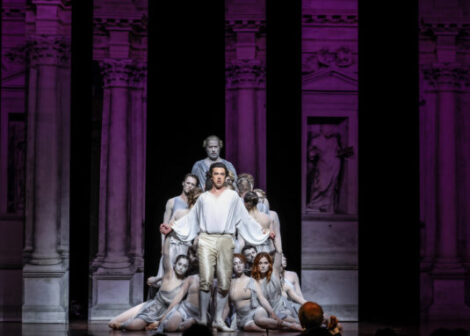
Iván Fischer’s opera productions have won the public vote. All three recent performances of his Budapest Don Giovanni as well as the open dress rehearsal were sold out months before the dates, filling the 1656 capacity MŰPA hall to the brim. My Hungarian friends and colleagues envied me for being able to get to a performance, as they tried in vain. Furthermore, all forthcoming performances of this production at the Vicenza Opera Festival (in the Teatro Olimpico) have also been long sold out.
Fischer is a conductor, composer and by now also an experienced opera director. As in concert halls with his Budapest Festival Orchestra, Fischer always presents something innovative, something new. And, by conducting as well as staging his opera productions, he eliminates, or at least minimalises, any clash between the musical ingredients and the stage.
The Budapest performances seem to have required either thorough knowledge of the opera or fluency in Italian or Hungarian. The singers sang in Italian and we had surtitles in Hungarian. I wondered about visitors from Europe (other than Italy) and further apart from the United States and similar. The musical performance as well as the stage offered plenty to the whole audience, so I am hoping that one way or the other, all understood Da Ponte’s text.
MŰPA’s stage is a concert stage, not envisaged to be an opera stage. Admittedly, opera performances can be staged here with enough technical know-how and good will but, on this occasion, I wished for the stage as well as for the ground level orchestra pit to be a little larger. All performers delivered with consummate skill – evidently there is nothing Fischer’s orchestra cannot cope with – but, speaking as an ex-performer, I would have felt more comfortable with a little more space both on the stage as well as in the pit: Fischer’s large number of performers seemed at times a little bit squashed.
Fischer’s stage includes a statue park where the statues can come to life, move around, re-group and part-take in the action or just freeze to be tables, window- or picture frames and so on. I am not sure if these statues are meant to be having a meaningful relationship with the Commendatore who in the final part of the opera is a statue but they intensify the drama and are credible interpreters of librettist Da Ponte’s sentiments.
Fischer’s current staging has been long in the making. He first presented it, also at MŰPA, in February 2010. They then moved the production to the Rose Theatre, New York, largely with the same cast. Another outing, that is double-outing, with a different cast, followed in Edinburgh and New York in 2017 and finally now in 2025: this time the cast was entirely different but the group of statues – freezing, dancing, singing – remained pivotal. By now Fischer and his troupe are fluent Don Giovanni interpreters, on stage as well as in the pit.
Fischer’s solo singers were top-class international singers, fully immersed in Mozart’s style. My favourites were Giulia Semenzato (Zerlina) and Luca Pisaroni (Leporello) but I might have been influenced by their roles in the plot. I was also much impressed by the strength and artistic dignity of the only Hungarian solo singer, Krisztián Cser (Commendatore). Fischer conducted without a baton and with immense sensitivity. His musical approach mirrored his views as the stage director: Don Giovanni was more to be pitied than condemned – even though he ended up in Hell – as he was an addict rather than a heartless man.
Fischer’s orchestra is mind-blowing in all dimensions. Their partaking in the drama as members of the stage band was as virtuoso as dramatically hilarious. Thanks to Fischer’s sensitive orchestral dynamics and staging, for once I was able to hear all notes of the obligato solo cello in Zerlina’s aria (‘Batti, batti o bel Masetto’, Act I) and all notes of the mandolin as well as the pianissimo singing in Don Giovanni’s Canzonetta (Act II). Mozart was careful with his orchestral writing, he clearly wanted all those cello and mandolin notes to be heard. However, in practice, they are rarely heard in opera houses.
Full marks and thanks to all who implemented and presented this production: it will be a yardstick by which to measure all other Don Giovanni productions.
Agnes Kory
Featured Image: Iván Fischer Opera Company’s Don Giovanni (end of Act I) © Judit Horváth
Production:
Director – Iván Fischer
Lighting and Set designer – Andrea Tocchio
Costume designer – Anna Biagiotti
Movement director– Georg Asagaroff
Movement coach – Fanni Cvikli
Cast:
Don Giovanni – Andre Schuen
Donna Anna – Maria Bengtsson
Leporello – Luca Pisaroni
Donna Elvira – Miah Persson
Don Ottavio – Bernard Richter
Zerlina – Giulia Semenzato
Masetto – Daniel Noyola
Commendatore – Krisztián Cser