 Romania George Enescu International Festival 2025 [5] – Poulenc, Ravel: Braşov Philharmonic Orchestra / David Molard Soriano (conductor). Tudor Cucu-Dumitrescu (MC), Oana Berbec (narrator), Grégoire Pont (artist/illustrator), Odeon Theatre, Bucharest, 14.9.2025. (GT)

Poulenc – L’Histoire de Babar, le petit éléphant, FP 129
Ravel – Ma mère l’Oye, M.60
The venue for this matinee, the Odeon Theatre, was built in 1911 as part of a single architectural ensemble designed by Grigore Cerchez with the theatre looking onto Victoria Street, surrounded by the Majestic Hotel, stores, and apartments. The building opened on Christmas Day 1911 and was known as the Giulesti Theatre for many years, receiving its current name, the Odeon Theatre, only in 1990. In 1945, the theatre was damaged by Allied bombing.
Since its reconstruction in 1946, it has been one of Bucharest’s main repertory theatres, with a staff of 35 actors, as well as directors and staff, and an auditorium that seats 300, along with a smaller studio theatre. For many years, the company has toured worldwide with its productions of Shakespeare, as well as contemporary plays for both adults and children. The theatre presents a popular programme for young people with educational programmes and outreach programmes for schools.
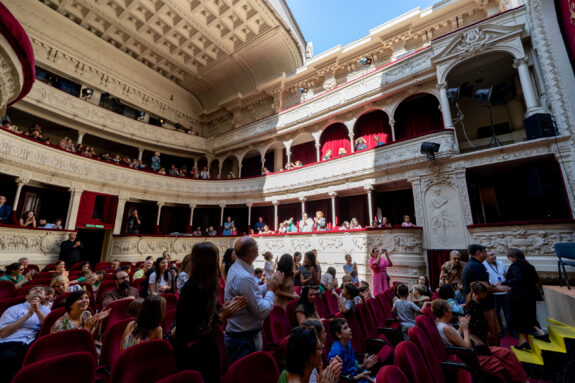
The Odeon Theatre boasts a beautifully clear acoustic and classical nineteenth-century architecture, located in the city’s old town. The entrance hall benefits from a great piano keyboard and a giant violin, impressively and colourfully decorated, which entertained the children before and after the concert.
The programme of attractive French pieces was introduced by the master of ceremonies, Tudor Cucu-Dumitrescu, dressed gloriously in green and red attire and a top hat. His engaging words were followed by the narrator, Oana Berbec, who charmingly prepared the children for what was to come. The orchestra immediately showed their musicality, especially in the woodwind group, with evocative strings colourfully evincing all of Poulenc’s harmonies in this orchestration by Jean Françaix. This orchestra from the regional centre of Braşov toured the United Kingdom three years ago as the Romanian National Orchestra. The standard of playing on that occasion convinced audiences that their musicality is of a high international level.
The stage set by Theodor Niculae behind the orchestra was a bizarrely decorated mansion with a van selling confectionery or ice cream. The playing by the musicians from the Braşov Philharmonic was beautifully romantic with all the vibrancy evinced in Poulenc’s magical score. Each movement was introduced succinctly by Berbec. From the opening berceuse, both strings and harp were stunning in their beautiful playing, while the woodwind revealed their virtuosity in the valse-musette. While in the wedding march, the woodwind and strings were delightfully evocative, and in the polka, the piccolo and flute were vibrantly ebullient. The entries by the first violin were eloquent and graceful. Lyricism prevailed in the nocturne with a reflective passage on the violin.
In Ravel’s orchestration of 1911, the elegiac opening Pavane de la Belle au bois dormant featured particularly colourful woodwind playing, and in Petit Poucet, we heard evocative clarinet playing and especially by the cor anglais balanced by beautiful strings rising in emotion – as the superb piccolo and flute revealed exotic colours – and closing ever so gently. In Laideronnette, impératrice des pagodes, there was fine harp playing and from the flutes in the main theme. Then xylophone and the horns returned to the plaintive flute idea and then the quirky, magical ending. Les entretiens de la belle et de la bête, was distinguished by graceful clarinets, and magical intonations on the flute, darkness emerged from the contrabassoon and a fine solo passage by the first violin led to a reprise by the flute. Le jardin féerique, emerged like sunrise on the strings, in an elegant and peaceful passage, again, the first violin and flute revealed virtuosity in creating a hushed sound, yet the spell was broken by horn calls, and the percussion closing brightly to the glorious finale.
Ravel’s colourful music was distinguished especially by Grégoire Pont’s illustrations. The French artist Grégoire Pont took his place among the orchestra with his drawings projected onto the screen above the orchestra. The marvellously drawn creations of the characters in the music – seen as the musical themes emerged – were astonishingly skilful and wonderfully inventive. They emerged with the musical themes, white colour against the black backdrop, with bright colours portraying nature and the animals. Pont produced amazingly attractive illustrations in creating a visual and musical picture making the musical performance more real for the audience of children.
At the finale, the children were asked by the master of ceremonies to raise their hands aloft to create a magical moment, and suddenly the sunbeams streamed into the auditorium – and a coup de théâtre – the Odeon Theatre is one of a small number of venues that can open its ceiling. This was a charming concert, both for children, and for some adults too; it was a fine way to spend an hour on a Sunday morning.
Gregor Tassie
Featured Image: Braşov Philharmonic Orchestra at the Odeon Theatre © Alex Damian