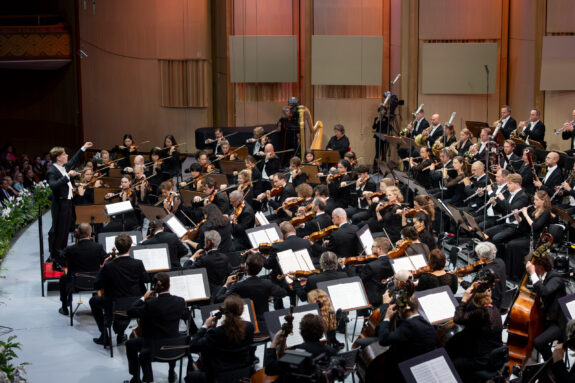
 Romania George Enescu Festival 2025 [8] – Schubert/Berio, Mahler: Royal Concertgebouw Orchestra / Klaus Mäkelä (conductor). Palace Hall, Bucharest, 20.9.2025. (ES-S)

Schubert/Berio – Rendering
Mahler – Symphony No.5 in C-sharp Minor
It has become something of a tradition for the Enescu Festival to close with performances by the Royal Concertgebouw Orchestra. Klaus Mäkelä, soon to become the orchestra’s chief conductor, paired Berio’s Rendering with Mahler’s Fifth Symphony in the first of two concerts – a program that set fragments of Schubert refracted through a twentieth-century lens against one of Mahler’s monumental symphonic journeys. The juxtaposition spoke both to the festival’s adventurous spirit and to Mäkelä’s interest in reframing canonical works.
From Schubert’s sketches for a Symphony in D major (D.936A), Luciano Berio fashioned Rendering, a work that openly accepts its unfinished state. Rather than completing it, he offered what he called the ‘restoration of a fresco’: Schubert’s fragments remain intact, while ethereal textures – the celesta’s cool shimmer above all – mark the voice of another century. There is no attempt to disguise the seams. Under Mäkelä, the piece became more than a musicological exercise: Schubert’s lyricism glowed warmly, the Concertgebouw’s strings and winds played with luminous delicacy and Berio’s interjections hovered with otherworldly transparency. What might have seemed fragmentary emerged instead as a dialogue across time – not a reconstruction but a meditation on loss, memory and the persistence of unfinished art
Mahler’s Fifth Symphony, by contrast, is an edifice of sound that resists containment. From the stern funeral march to the exuberant finale, it demands brilliance in detail and a commanding sense of trajectory. Mäkelä’s reading offered much to admire though it also raised questions about his conception of the larger architecture.
The opening Trauermarsch began with Omar Tomasoni’s trumpet solo, played with a burnished clarity that set a tone of nobility rather than anguish. Mäkelä chose a deliberate tempo, grave but not ponderous, and the Concertgebouw answered with a darkly glowing sonority. Rather than dwelling on pathos, he emphasized inexorability: the march moved with the tread of fate, brass anchored yet never overbearing, strings lending the rhythm a sculptural solidity.
The second movement erupted in violent contrast, propelled with ferocious energy. Strings attacked with biting articulation while brass blazed in searing climaxes. Mäkelä highlighted the music’s volatility, letting collapse and resurgence follow in quick succession. The result was less linear development than obsessive circling, the Stürmisch bewegt trapped in turbulence yet repeatedly finding the strength to surge forward. Here the Concertgebouw’s precision met raw force, producing a sound at once disciplined and unrestrained.
The Scherzo shifted the symphony into a brighter register though its scale made it no less demanding. Mäkelä drove the rustic dance rhythms with restless energy, eschewing gemütlich charm for muscular vitality. Under Katy Woolley’s commanding leadership, the horns gave the music a buoyant center, their calls ringing out with thrilling power. Yet for all its brilliance, the episodic character remained exposed: exhilarating in detail but never fully cohering into a single sweeping arc.
The Adagietto offered the most inward-looking moment of the evening. Mäkelä avoided sentimentality, letting the strings unfold their lines as a private confession rather than a public display. They responded with refinement, phrasing supple and unforced, the sound luminous yet restrained, harp lines glistening delicately against the hush. In the improved but still imperfect acoustic of the Palace Hall, this dialogue of delicate sonorities at times veered toward froideur.
The Rondo-Finale burst forth with contrapuntal exuberance, winds darting playfully and brass crowning the sound with brilliance. Mäkelä pressed ahead with buoyant momentum, the Concertgebouw’s virtuosity making the intricate textures sound effortless. Mahler’s conclusions are never straightforward victories: the jubilant interplay of voices, for all its radiance, carries a tinge of irony, its affirmation hard-won and fragile. At his young age, Mäkelä brought unflagging energy to the score, but he did not fully convey the nature of Mahlerian journeys – never direct, always meandering. The result was exhilarating, shaded less by ambivalence than by a bright, forward-leaning confidence
Still, this was another concert that affirmed Mäkelä’s promise.
Edward Sava-Segal
Featured Image: Klaus Mäkelä conducts the Royal Concertgebouw Orchestra © Andrei Gîndac
It’s interesting to read this review and to contrast Mr. Sava-Segal’s perspective with the much harsher review from Mark Berry a few weeks back of the same program by the same artists in Salzburg. Obviously the performances were not exactly the same, or at least one assumes that the two performances weren’t exactly the same. At the very least, it’s refreshing to read different perspectives, and to know that people care. It would almost be the worst scenario if no one cared either way.