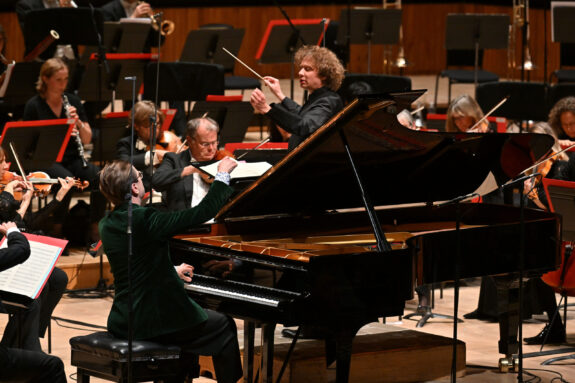
 United Kingdom Ortiz, Beethoven, Saint-Saëns: Víkingur Ólafsson (piano), Olivier Latry (organ), Philharmonia Orchestra / Santtu-Matias Rouvali (conductor). Royal Festival Hall, 25.9.2025. (AV-E)

Gabriela Ortiz – Si el oxígeno fuera verde (UK premiere)
Beethoven – Piano Concerto No.3
Saint-Saëns – Symphony No.3 in C minor, Op.78, ‘Organ’
The world-renowned Philharmonia Orchestra commemorated its 80th Anniversary at a packed Royal Festival Hall and which witnessed the launching of ‘Philharmonia Social’ to ‘celebrate their audiences and commit to growing the next generation’ and ‘to explore how composers forge their identities through music’, and proclaiming: ‘Music is not what we do. It’s what we are.’
Gabriela Ortiz is the Philharmonia’s Grammy-winning Featured Composer, and if ‘music’ is ‘what we are’, then I had no idea what music Ortiz’s was. For in her mish-mash medley, Si el oxígeno fera verde (If Oxygen Were Green), I had heard Leonard Bernstein, Oscar Lorenzo Fernández, Heitor Villa-Lobos (and a touch of Glass). But I could not hear Ortiz forging her identity here. Despite only lasting 15 minutes, this cut-and-paste postmodern pastiche felt even longer than an eternity! When it did finally come to an end, of sorts, the audience gave it a lukewarm to mildly cold reception.
The much celebrated and highly venerated Víkingur Ólafsson lacked presence in his perfunctory performance of Beethoven’s Piano Concerto No.3 coming across as disinterestedly detached. The Largo was taken far too slow and sounded fussy, mannered and dragged out and simply fell apart. The concluding Rondo – Allegro – Presto was rather clangourous and heavy-handed, but an apparently uncritical audience lapped it all up and Ólafsson was awarded the Royal Philharmonic Society Gold Medal and gave a courteous address. However, the Philharmonia under Santtu-Matias Rouvali were in perfect form throughout playing with elf-like elegance so suited to the work at hand.
The opening movements of Saint-Saëns’s Organ Symphony were perfectly paced by Rouvali and expressively played with pointed woodwinds and punctuating brass with the organ smouldering away. The highlight of the entire evening was easily the serene string playing in the Poco adagio with the organ seamlessly integrated: this was poignantly moving.
Sadly, the concluding Maestoso – Allegro lacked any sense of forward thrusting momentum and was badly let down by organist Olivier Latry and timpanist Dominic Hackett who sounded so effete and lacklustre, lacking verve and attack. For the closing passages, the organ and timpani should sound overwhelmingly ferocious but was sadly underpowered; and to make matters worse, conductor Rouvali abruptly clipped the closing bars, thus robbing the music of its excessive ‘over the top’ concluding exuberance. Afterwards I imagined how the legendary Andy Smith, principal timpanist with the Philharmonia for 42 years, would have played this movement.
And in conclusion, there was a certain poignancy to this concert as it was the first by the Philharmonia at the Royal Festival Hall since Christoph von Dohnányi died aged 95 on September 6, 2025. He had been the orchestra’s principal conductor for 11 years from 1997 to 2008, before becoming their Honorary Conductor for Life. His recent Philharmonia obituary (here) notes that he conducted over 200 performances with the orchestra and during this 80th anniversary season there will be a concert dedicated to his memory as a celebration of his life and legacy.
Alexander Verney-Elliott
Featured Image: The Philharmonia and pianist Víkingur Ólafsson conducted by Santtu-Matias Rouvali © Philharmonia Orchestra/Mark Allan
Trust me, there were quite a few people in the audience, myself included, who absolutely did not lap up that Beethoven. Good review, thanks. It was a long, and frankly boring, evening.
I had mixed feelings about this concert too. I wasn’t sure what to make of the Ortiz piece. It couldn’t seem to make up its mind what it wanted to be; one moment it reminded me of second hand Stravinsky and then it segued into some semi Mexican jazz piece. The orchestra played beautifully but it’s 15 minute length dragged.
Some competent playing from Ólafsson but very little magic and the slow movement almost came to a halt. It’s a shame as it’s one of my favourite pieces of piano music and I don’t hear it live that often. (Try Murray Perahia with Haitink and the Concertgebouw).
The finale of the Saint-Saëns was disappointing but the slow movement brought tears to my eyes. That was worth the price of admission.
What a shame that people misinterpreting tempo indications in this ever-faster moving world where one has to apologise if classical music isn’t played higher, louder and faster. I particularly thought this Beethoven was genius and an utter calm point between a revolutionary First movement and a celebratory Third movement.
I’m grateful to have been in the concert and more grateful to the Philharmonia to open my eyes to a different world of classical music which obviously comes across as boring for some.
Sad that certain societies are slowly but surely getting ‘dumbed down’ by cheap superlatives.
Oh… I believe the organ was loud enough where I was sitting.
Also, not sure how quick production can move the something changes within 2 weeks. The programme may have been printed way before …at least that’s my theory and not a lack of knowledge by the orchestra…
But of course nowadays everything goes with a snap of fingers, right?!?
JP for S&H: The tendency is towards far too any Anonymous comments. Names and (genuine) emails are requested and are not recorded but it prevents those with something to say staying in the shadows. This comment – while Anonymous – makes some interesting observations worth adding to the review.
My experience of this concert was very different – I enjoyed the Ortiz (which seemed to get a warm reception from where I was sitting) and felt Ólafsson’s approach to the Largo was mesmerising, anything but detached. In the Saint-Saëns, for once I liked Santtu’s choices of tempi (I often don’t!) and had no problem with the final movement that for me managed to maintain a real sense of nobility by not going OTT.
Horses for courses, I guess, and the world would be a duller place if we all agreed. [edited]
We must have been at a different concert? Our group of six all thought it to be fabulous.