 United Kingdom Wagner, Der fliegende Holländer: Soloists, Saffron Opera Group Chorus (inc. Saffron Walden Choral Society, chorus masters: James Davey and Quintin Beer), Saffron Opera Group Orchestra / Michael Thorne (conductor). Saffron Hall, Saffron Walden, 14.9.2025. (JPr)
Cast:
The Dutchman – Simon Thorpe
Senta – Mari Wyn Williams
Erik – Charne Rochford
Daland – Andrew Greenan
The Steersman – Andrew Henley
Mary – Yvonne Howard
Conductor Michael Thorne wrote in the programme how Wagner – is supposedly to have – changed the location of the story of his Der fliegende Holländer from Scotland to Norway because of ‘a turbulent sea journey along the Norwegian coast’ and how Wagner subsequently wrote about the hurricane he, and his first wife Minna, endured; ‘how relieved I was to behold that far-reaching rocky coast, towards which we were being driven.’ It was something like that for me as I drove back after the opera through a horrendous storm – if not towards a rocky coast thankfully, but Wickford in Essex – since the rain and spray made it all rather hazardous.
Thorne’s was one of two interesting contributions which informed the Saffron Hall audience something about the opera they were about to hear without any mention about which of the various extant versions of Wagner’s 1843 opera it was. Why does this matter? Well, we were not told that this Holländer was Wagner’s 1860 second thoughts with its Tristan-style ‘redemption’ ending to the Overture and final bars of the opera (the original 1843 ending was rather bleak even though Senta, of course, still sacrificed herself for the Dutchman). Also, a one-act Holländer is more often the norm as Wagner’s thinking was intervals would halt the work’s dramatic impulse, and his wishes should really be adhered to if possible. Saffron Opera Group did have an excuse for their 30-minute interval before a 30-minute third act as the refreshment outlets at Saffron Hall needed the business, some of the audience benefited from a ‘comfort break’, and it gave much-needed respite to a valiant orchestra not used to playing for 2½ hours straight through.
That Saffron Opera Group Orchestra seemed a little short of numbers in certain sections, and the horns have had better days, but they played with their usual whole-hearted commitment for the mercurial figure of Michael Thorne on the podium. He amazingly managed to hold things together when the ensemble threatened to fracture on a few occasions. There was impressive volume even if atmosphere and excitement was limited at the start of the opera: I made more noise wheezing to get to my seat than the wind machine managed and so we never really experienced the howling winds or rolling and tossing of stormy seas which Wagner demands. However, as if refreshed by the break, the orchestra brought the opera to a tempestuous close that I will remember for a long time.
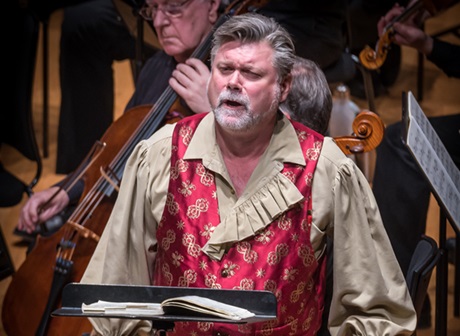
Elaine McKrill’s concert staging had several appropriate entrances and exits and saved us from singers seated behind music stands. Props were limited to a small ‘Dutchman’ portrait and there was an attempt at different costumes for their characters by some singers. Daland (Andrew Greenan) had something of the sea captain (Birdseye?) about him and Erik (Charne Rochford) indeed might initially have been a hunter. However, the Dutchman (Simon Thorpe) – perhaps picking up on Caroline Galwey’s suggestion in the programme that he is ‘a Byronic figure’ – looked rather odd in a frilly shirt and shiny, red, patterned waistcoat. Senta and her nurse Mary, failed, by the look of it, to get the costume memo and were in almost matching, elegant evening gowns with some bling. Finally, while duetting at the end of Act II the Dutchman and Senta were kept too far apart on the concert platform.
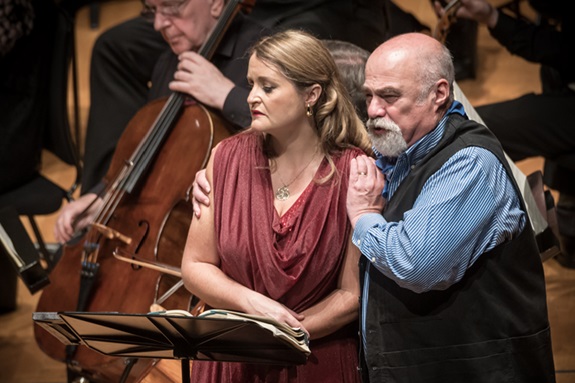
Mari Wyn Williams was the undoubted star of this performance and the sole singer inside her role and totally freed from the score in front of her, because she had sung Senta in her Opera North debut this year. Okay there was not actually much sense of a young girl’s single-minded preoccupation with the Dutchman legend, but Williams’s bright soprano was seriously impressive with its warm tones and high notes attacked fearlessly.
Simon Thorpe did not make a dramatically convincing Dutchman in my opinion, I did not experience the character’s pain, anguish and suffering. Nevertheless, Thorpe’s baritone voice – when it was not occasionally failing him – had a rich vibrancy and conviction, though more suited to Daland or Rocco (Beethoven’s Fidelio) than the Dutchman. Bass Andrew Greenan was an appropriately worn and grizzled Daland. I found myself appalled – more than I have ever been? – by the opera’s misogyny as Daland negotiates a price in gold and jewels for marrying off his daughter Senta: 2025 sensibilities, perhaps?
Charne Rochford (who returned in Act III simply in black shirt and trousers) was her hapless suitor Erik; when he sang tenderly it was quite affecting but when angry he tended to oversing and it was all much too loud. Completing the cast was the experienced Yvonne Howard as a characterful Mary and Andrew Henley sounded a heroic tenor voice to watch out for though as the Steersman he was consigned to the upper reaches of Saffron Hall – had he annoyed someone?
The augmented Saffron Opera Group Chorus sang uninhibitedly and vigorously throughout, though some effort should have been made to distinguish the Dutchman’s ghostly crew from the others near the end: either vocally (because they were far from frightening) or even somehow visually. Nevertheless, at this point in Holländer the music cannot fail and it could hardly have been more compelling from the combined forces of the Saffron Opera Group as Wagner’s denouement had everyone joining in the unfolding tragedy, that 1860 ‘redemptive’ ending notwithstanding.
Jim Pritchard
For more about Saffron Opera Group click here.
Featured Image: Mari Wyn Williams (Senta) and Andrew Greenan (Daland) © Roger King