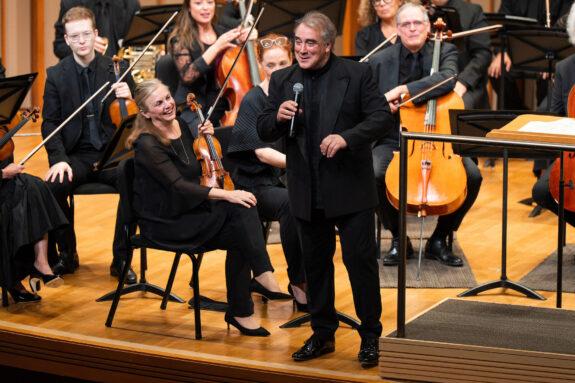
 United States ‘A Musical Genesis: Martín + Altstaedt + Schumann’: Nicolas Altstaedt (cello), Los Angeles Chamber Orchestra / Jaime Martín (conductor). The Wallis, Beverly Hills, 15.9.2025. (LV)

Haydn – Symphony No.83 in G minor, Hob.I No.83, ‘The Hen’
R. Schumann – Cello Concerto in A minor, Op.129
Beethoven – Symphony No.5 in C minor, Op.67
For its season opener at The Wallis, the Los Angeles Chamber Orchestra programmed Haydn to entertain, Schumann for falling in love and Beethoven’s Fifth to stir the blood.
Haydn’s Symphony No.83 (‘The Hen’) opened the season brightly and in earnest. The nickname, supposedly earned from a clucking figure in the violins or a pecking one in the oboes, turned out to be apt: the first movement strutted about cheerfully, full of sudden pecks and squawks. Martín and the orchestra leaned into the humor with sharp accents and brisk pacing though the polish sometimes slipped. The slow movement, by contrast, had warmth and weight that showed Haydn’s gift for lyric surprise, with woodwinds adding gentle color. The minuet was sturdy rather than elegant but the finale made up for it, racing along with quick wit and a light touch. If not every joke landed, the symphony still reminded us that Haydn could fill a hall with invention, charm and the occasional barnyard cackle.
In Robert Schumann’s Cello Concerto, Nicolas Altstaedt – swashbuckling in presence and purpose – kept the line clean and direct, with an amatory intensity that never sagged into overstatement. In the slow movement, his communion in hushed double-stops with the first stand of cellos was transcendent, and the handoff into the finale, with the full cooperation of Martín and the orchestra, was taut, theatrical and decisive.
As the last movement charged ahead ferociously, the blistering pace occasionally relented to accommodate lyrical glances or the angles of the main theme. Still, the through-line held and Altstaedt’s playing – impulsive and sometimes rough when pressed – was exhilarating and alive.
For his well-earned encore, Altstaedt played the Sarabande from Bach’s Cello Suite No.3 on his 1749 Guadagnini and retracted the endpin (‘I never play Bach with the endpin’ he told me). He played the first halves exquisitely straight with minimal vibrato and then colored the repeats in French-baroque fashion – soft strokes, whispered ornaments, faintly implied harmonies – yielding a poised, symmetrical calm. It hushed the room.
Beethoven’s Symphony No.5 after intermission was preceded by Martín delivering a rambling discussion of historical performance practice and metronome markings, even pointing to specific bars in the slow movement (99 and 107) as examples of inner detail worth hearing and ending with a ringtone quip. The larger issue, though, is not only what Beethoven wrote but what he intended. Audiences at the premiere would not have known the musical dams that would continue breaking after those first iconic fermatas; for the last century, however, most listeners do, which must inform how suspense is built. Treat the fermatas as strictly in tempo and you risk losing the dramatic potential they contain.
After the opening ‘dams’ broke, it was clear that Martín’s Fifth would be long on strict tempo and short on dramatic arc. The fermatas carried little danger or stretch – more observant than suspenseful. The orchestra’s sonority never fully settled, and the foundation lacked weight: fewer double basses (three) than cellos (four) was an odd choice in music where, as with Haydn, the composer wanted more ballast – and more double basses. The slow movement was shapely enough, the Scherzo’s violin grace notes skittered oddly like something from The Sorcerer’s Apprentice and the finale marched forward determinedly but without cumulative reckoning.
Laurence Vittes
Featured Image: Jaime Martín talks about Beethoven at the opening of the LACO season © Elizabeth Asher