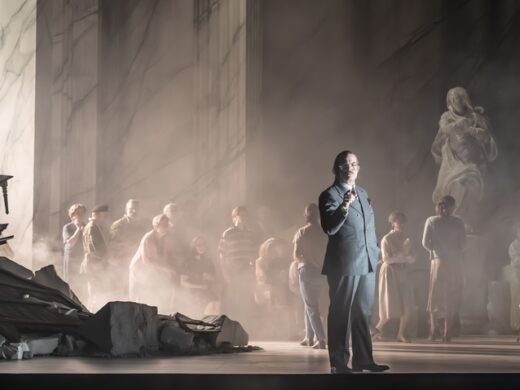
 United Kingdom Puccini, Tosca: Soloists, Chorus, Children’s Chorus and Orchestra of the Royal Opera House / Jakub Hrůša (conductor). Filmed (directed for the screen by Peter Jones) at the Royal Opera House, Covent Garden, in September 2025 and broadcast to Cineworld Basildon, Essex, 1.10.2025. (JPr)
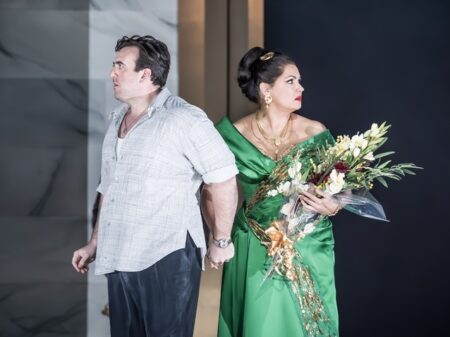
It is probably more apocryphal than not, but like London buses you can wait for one star-studded Tosca to come along and then there are two. After reviewing the 665th performance of Margarethe Wallmann’s 67-year-old production (review here) I wondered could this new Tosca from The Royal Opera match such an excellent performance. That it certainly – and for me, unexpectedly – did! Oliver Mears is Director of Opera at Covent Garden and his new Tosca replaces Jonathan Kent’s 2006 production which was serviceable enough and matched the libretto of Puccini’s opera whilst having some issues, notably a very cluttered Act I. With Mears and his set designer Simon Lima Holdsworth, we are no longer spending one day in Rome in 1800 but are now in the second half of the twentieth century with Cavaradossi helping renovated a church which has suffered damaged from some shelling. Indeed, during the ‘Te Deum’ clergy and worshippers seem to be taking shelter from the sounds of bombing in the distance. Much of this is at odds, of course, with all the talk of Napoleon, Melas and Marengo we will hear about.
Tosca is about art and politics and this new production had accreted enough of that for reasons I won’t worry about here, apart from it involving Anna Netrebko’s return to singing at Covent Garden for the first time since April 2019. This was enough not to have Mears’s Act I set in Ukraine and what conflict has caused all this destruction is not entirely clear now. There is enough of the white marble walls, impressive columns and arches of a church shown to allow Act I to play out oddly traditionally.
A Roman church it might have been in Act I – albeit Sant’Ivo alla Sapienza apparently and not Sant’Andrea della Valle – but for the second act we are certainly not in Scarpia’s Pallazzo Farnese apartment. Scarpia appears to have requisitioned some government building with (again) plain marble walls with a clock on high and huge bronze doors. The walls allow Fabiana Piccioli’s lighting to cast some foreboding shadows. There is little else apart from a couple of chairs, one with wheels that Scarpia glides around on (eating his takeaway meal from a tin foil tray), a central long, bare marble plinth, a TV so Scarpia can watch executions and an ash tray on a tall stand (more about that later). The clock shows the time moving from past 11pm towards midnight but is it enough time for all that goes on in this act, such as the search for the escaped prisoner Angelotti, Cavaradossi’s torture and Scarpia forcing himself on Tosca?
For Act III we are no longer on the Castel Sant’Angelo ramparts but in a starkly-lit, enclosed room in the headquarters of the secret – or not so secret – police who carry out Scarpia’s orders. Through the window it looks like St Peter’s Basilica. A prisoner enters to hand over his belongings, then sign his life away before being summarily shot against the tiled wall with the resulting blood spatter mopped away before Cavaradossi is brought in. It is somewhat at odds with Scarpia saying there needs to be an ‘execution’ as it is all carried out in such privacy. In one corner there is a CCTV camera and surely Tosca and Cavaradossi might be being watched and overheard as they plan their getaway. Admittedly Scarpia possibly told his minions not to disturb him and Tosca, but I (always) wonder why it takes so long to discover he has been killed. Here Tosca takes a chair, smashes a window and plunges out.
In my recent Vienna review I wrote how it would not be the last time I would mention how a memorable Tosca requires three singing-actors to create believable characters to draw you into the very – very – familiar story through their vocal strength and dramatic artistry, making you feel you are watching the opera for the first time. It got that in Vienna from a Russian soprano, Chilean-American tenor and French baritone and in London we had a different Russian soprano, British-Italian tenor and Canadian bass-baritone!
More about The Royal Opera’s new Music Director, Jakub Hrůša, later but the wonderful performance was marred just a little by him indulging his singers and allowing them to hold onto their top notes for an eternity, as well as stopping for applause. Freddie De Tommaso was very impressive in his can belto fashion, ‘Recondita armonia’ was rather declamatory, whilst Cavaradossi’s ode to Tosca’s dark eyes had a real sense of poetry and throughout there was great chemistry between him and Netrebko’s Tosca which led to this pair of lovers being even more affectionate than we sometimes see, Madonna or no Madonna. Later, you could certainly see why the full-on assault Tosca suffers from Scarpia needed an ‘Intimacy director’. De Tommaso hung on inordinately to the top note (A-sharp?) of ‘Vittoria! Vittoria!’ but a beautifully phrased ‘E lucevan le stelle’ had absolutely the right amount of despair and regret.
Gerald Finley’s moustachioed Scarpia was a sweaty, unattractive, sexually frustrated, unlovable man who could only make women do his bidding by coercing them through force and the threat of violence. This Scarpia looked more a grey (matching his double-breasted suit) bureaucrat than chief of police but his total authority came from his position in the hierarchy of the regime in power. He doesn’t get his hands dirty himself (and he frequently wipes them on a handkerchief anyway) so it is Spoletta who wraps his tie round the Sacristan’s neck to make him talk. Finley brought little of the air of civility either in voice or demeanour – we know is only pretence – which some singers bring to the role. His Scarpia was compellingly sung and acted despite being something of a caricature; part- Basil Fawlty (John Cleese) and Jim (Mark Heap) in Friday Night Dinner.
It would be too easy to say Netrebko was playing herself – when she swanned in stilettoed with a black veil and wearing a stunning red dress – because when you think of a ‘traditional diva’ in 2025 her name might be top of the list. This was despite her image as Tosca coming straight from Italian films of the 1950s and 60s. It was impressive how Netrebko never stepped out of character throughout the opera and Tosca was a creature of passion, happy to be in love, and just not as jealous or insecure as some can be. Netrebko’s voice took a little time to warm up (nerves would be understandable) but rose from contralto-like depths to its resplendent top of thrilling power and brilliance. The showstopping ‘Visse d’arte’ was suitably prayerful and revealed considerable sorrow about Tosca’s plight.
Now about that pedestal ashtray, well, there was no stabbing and Tosca’s bludgeoning of Scarpia with it was impressively staged before the coup de grâce with her jewelled hairpin. Netrebko spat out Tosca’s words ‘E avanti a lui tremava tutta Roma!’ bitterly, but there was some forgiveness as she put his jacket on his body along with the bouquet she initially brought in at the start of the act. In the final scene Netrebko’s Tosca is totally deluded and while she believes there will be a happy ending for her and Cavaradossi, De Tommaso’s face reveals he knows this is only her self-delusion.
An excellent ensemble – though with perhaps not enough British singers – saw splendid vignettes from Ossian Huskinson’s fleeing Angelotti, Alessandro Corbelli’s grumbly, fussy, gluttonous Sacristan, Carlo Bosi’s fearfully compliant Spoletta and Esmae Froud’s plaintive Young Shepherd.
How was the performance overall then? In the words of Oliver Mears: ‘You should be on the edge of your seats; you should be gripped. It should be visceral, powerful and it should get you in the guts, that’s what I need Tosca to be.’ And that’s what it indeed was …and did!
Jakub Hrůša – who was conducting performances of Tosca for the first time – spoke about how ‘Everyone working in the house is tremendously talented, but my role is to bring those talents together, to unify them in a very cooperative way to inspire them to give their best.’ That he definitely did too, whether soloists, chorus or orchestra. What we heard sounded fresh, vivid and exciting and everything you would expect from Puccini’s ‘shabby little shocker’.
Jim Pritchard
Featured Image: Gerald Finley (Scarpia) in Tosca Act I © Marc Brenner
Creatives:
Director – Oliver Mears
Set designer – Simon Lima Holdsworth
Costume designer – Ilona Karas
Lighting designer – Fabiana Piccioli
Movement and Intimacy director – Anna Morrissey
Chorus director – William Spaulding
Cast:
Floria Tosca – Anna Netrebko
Mario Cavaradossi – Freddie De Tommaso
Baron Scarpia – Gerald Finley
Spoletta – Carlo Bosi
Cesare Angelotti – Ossian Huskinson
Sacristan – Alessandro Corbelli
Sciarrone – Siphe Kwani
Gaoler – Olle Zetterström
Young Shepherd – Esmae Froud
Actors – David Galea, Suleiman Suleiman, James Unsworth, Charlie Venables, Addis Williams
The nationality of the cast is irrelevant. The performance is everything.
Jim for S&H: I have no idea of the ‘relevance’ of the first sentence. Nationality is of great ‘relevance’, firstly where are the Italian singers these days of these important operas, and like most opera companies throughout the world at least the minor roles at Covent Garden should be an opportunity to promote homegrown talent.
I fully enjoyed this Tosca and thought the whole cast were in great voice and the acting was wonderful.
Netrebko continually impresses me with her bravery in face of the unjustified abuse she has suffered.
She is also called a traitor in Russia for speaking out against this stupid war which makes the present situation a Catch-22.
Now however, only the New York Met continues her ban and will do so as long as Gelb is in charge there.