 United Kingdom Liadov, Shostakovich: Royal Liverpool Philharmonic Orchestra / Vasily Petrenko (conductor). Bristol Beacon, 16.10.2025. (CK)
Liadov – Baba Yaga
Shostakovich – Symphony No.7, ‘Leningrad’
I first encountered Shostakovich’s colossal Leningrad Symphony in what was then the Colston Hall, in January 1974, performed by the Bournemouth Symphony Orchestra and their Chief Conductor Paavo Berglund (seated: I think he was recovering from an accident). Very pleasing, then, to hear it again half a century later in the same hall, transformed into the Bristol Beacon, under leading Shostakovich exponents of our own day. Vasily Petrenko performed the work back in March with his current orchestra, the Royal Philharmonic, as part of the Southbank’s Multitudes Festival: here he was reunited with the orchestra with which he recorded a much-praised Shostakovich symphony cycle between 2008 and 2014.
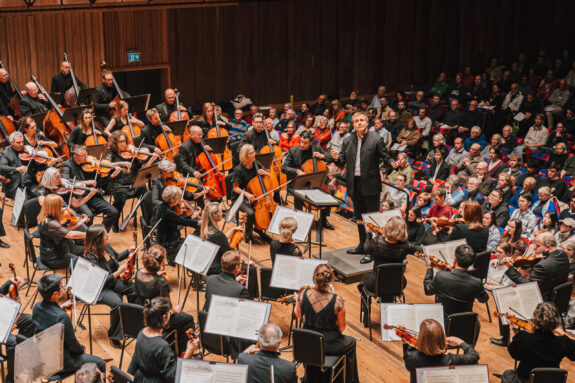
Colossal it certainly is, with a full brass section almost doubled by extra players in a long row at the front of the choir seats: with nine horns, seven trumpets, seven trombones and tuba we were a single horn short of the brass complement required for Gurrelieder. Or to put it another way, we had the same number of brass players as there are in Janáček’s Sinfonietta. Yet the outstanding thing about this performance was the clarity that Petrenko achieved with his players: even when the notorious march in the first movement reached its deafening climax the music never degenerated into noise. Perhaps it was for clarity rather than theatre (it achieved both) that Petrenko spread the three side-drummers: one behind the double basses on the right, one behind the harps and piano on the left, one in the choir with the extra brass.
When the symphony’s purposeful opening turns pastoral there was some exquisite playing from the strings, and from that piccolo curvetting gracefully in the air – the last sound we hear before the ominous side-drum tattoo begins (almost inaudibly: we had to strain to hear it). Eloquent, too, were the clarinet and mournful bassoon that are the only sounds in the empty wreckage that the pulverising march leaves behind. Think Gaza.
It is tempting to hear the ensuing Moderato as an interlude, a necessary relief, an emotionally numb or neutral buffer zone before battle is rejoined: rather like the second movement of Shostakovich’s Fourth Symphony, or of Suk’s ‘Asrael’ Symphony. But in this performance its lithe, catlike tread was immediately arresting; and its central section, introduced by a rudely Mahlerian E-flat clarinet – a passage which in another context would sound upbeat, even cheerful – here sounded disorienting, jarring. As we know from other symphonies, humour in Shostakovich is rarely straightforward. When the music quietened, the bass clarinet solo – against a sinister tolling of harps – sounded ominous rather than consolatory.
The woodwind choir’s noble but cheerless chorale, with horns and harps, launched the Adagio (for me, the symphony’s finest movement) with power and a sense of vast and barren space: the massed violins answered them with sounds that gleamed and cut the air like swords. The haunting flute solo was beautifully played; and the exciting central episode in triple time – in which we again heard the extra brass, especially the heroically aspiring horns – thrilled with a sense of victory glimpsed but not yet achieved. The finale contains the symphony’s least convincing music, but Petrenko kept us steadily on course until we reached the peroration: itself no more convincing than that of the Fifth Symphony, perhaps, though it scores over that much-disputed ending through the sense of struggle that accompanies the Leningrad’s assertion of victory right up to the final bars.
Nobody in the audience could have felt short-changed in terms of visceral excitement, but the great quality of this performance – achieved through the players’ excellence and Petrenko’s long-range vision and sovereign control – was its clarity, and, in the quieter parts of the score, an extraordinary delicacy. The euphoria of the reception threatened to rival the decibels of the performance itself: yet it was entirely fitting that the loudest cheer was for that woodwind choir. The concert left me wanting to hear this conductor and orchestra in Shostakovich’s next, and greater, symphony: the Eighth.
It was a nice idea to preface the symphony with Liadov’s tiny tone-poem Baba Yaga: beginning with a shriek (a midget version of the howl that opens Shostakovich’s Fourth Symphony), sounding very modern, and making me regret that Liadov left us so little music.
Chris Kettle
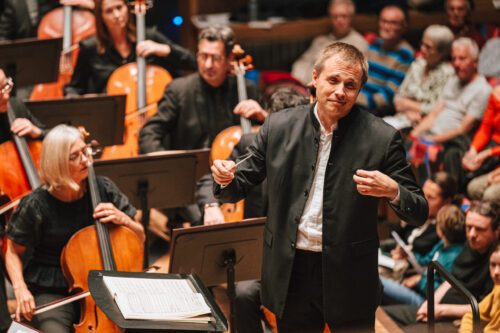
Featured Image: Vasily Petrenko conducts the RLPO © Giulia Spadafora/Soul Media
I and a friend heard the whole concert yesterday in Liverpool. It was wonderful having Petrenko back. He gets intensity and not merely volume out of the RLPO which I don’t tire of. The whole thing was a tour de force, an afternoon I won’t forget. I need to know more about Shostakovich. And the cello solo was beautiful and got the reception it deserved. Terrific afternoon.