
 United States Various: Conrad Tao (piano). San Francisco Performances, Herbst Theatre, San Francisco, 17.10.2025. (HS)
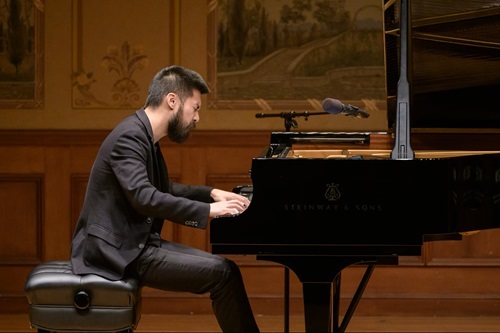
Conrad Tao hatched a great idea for a piano recital: exploring connections between Rachmaninoff’s piano music and the popular music of the first half of the twentieth century. It works both ways. The composer fled the Russian Revolution in 1918 to arrive in the United States at the dawn of the Jazz Era, and it is fair to say he absorbed some ideas from Tin Pan Alley, Broadway and early jazz pianists into his own late-Romantic music. Popular composers returned the favor by stealing some of his best tunes, and jazz pianists echoed (in their own way) his expansive, florid writing for the piano.
For this program, which he has been performing in various locations for almost two years now, Tao constructed sets putting Rachmaninoff’s piano music side-by-side with pieces by Irving Berlin, Stephen Sondheim, Harold Arlen and Billy Strayhorn (whose collaborations with the pianist-composer-band leader Duke Ellington rank among the great jazz standards). He also applied his own techniques to some of Rachmaninoff’s music in the same way a jazz artist might present ‘jazzed-up’ versions in a program of standards. The most obvious example was his full-on improvisation of Variation 15 from Rhapsody on a Theme of Paganini. Tao recalled that in practicing the work one summer as a student, he liked to riff on the music before getting down to mastering it for performance with an orchestra. He turned Rachmaninoff’s fluttering but exacting Più vivo scherzando into a torrent of finger-breaking pianistic extravagance.
To be fair, that improvisation as played in San Francisco was especially wild and far-out when compared with his arrangements of the other works. But it also exemplified my only quarrel with Tao’s performance: although he could play the softer parts tenderly and with supple textures, too much of the evening was overly forceful and just plain loud.
What was missing was the dazzling, intricate side of others’ music. And not just Rachmaninoff. Tao’s transcription of Art Tatum’s famous 1953 solo piano improvisation of Arlen’s ‘Over the Rainbow’ captured it note for note, but where Tatum swung breezily through his genius decorations on the popular tune, Tao went loud. It was not an improvement.
The best set to my ears was the gentlest, beginning with a piano-only version of Rachmaninoff’s song ‘Daisies’, followed by a zephyr-like arrangement of Strayhorn’s ‘Day Dream’. Rachmaninoff’s melancholy Étude-Tableau in C minor, with its jazz-like chords and deliberate tempo, reflected elements in Strayhorn’s piece. This was a welcome change-of-pace after several sets aimed at excitement.
The first set was straightforward, beginning with the florid flurries of three Preludes, which Tao chose as reflections of what the composer might have heard in the United States. Immediately following was Strayhorn’s ‘Take the A Train’. Tao’s demeanor changed for the jazz piece, bobbing his head, rocking his body and stabbing at chords in a nod to Ellington’s playing of this piece. Tao can indeed get into a jazz player’s rhythmic groove.
The next set began with ‘In Buddy’s Eyes’ from Sondheim’s Follies and ‘Auf einer Burg’ from Robert Schumann’s Liederkreis, both songs about lovers dealing with hidden losses. Tao’s arrangements gracefully enhanced the original vocal scores for piano, and the harmonies of Rachmaninoff’s Étude-Tableau in A minor (from Op.39) did indeed reflect the other songs, especially on the final quiet chords.
The next set centered on the ‘Over the Rainbow’ transcription. Preceding it was a Tin Pan Alley version of Irving Berlin’s ‘All by Myself’, followed by the improvisation of the Variation 15. A florid arrangement for piano alone of the well-known Variation 18 (sans orchestra) did show some jazz influence. It made sense to finish the set with Strayhorn’s plush harmonies in ‘Lush Life’.
After the intermission, Tao launched into Symphonic Dances, Rachmaninoff’s last work, in fellow pianist Inon Barnatan’s solo piano arrangement. It is a tough assignment to translate a big orchestra sound to a single piano. Tao emphasized loud dynamics and seldom softened its edge, something Rachmaninoff was able to do with the various colors in his orchestration (and Barnatan on piano in his recording.) Tao’s damn-the-torpedoes approach seldom summoned the clarity to make it sing.
For an encore, Tao sang and played ‘Full Moon and Empty Arms’, for which Buddy Kaye and Ted Mossman stole the big tune from Rachmaninoff’s Piano Concerto No.2. It was an appropriate choice to finish the concert, and one can admire Tao’s willingness to expose his untrained voice, but a cabaret singer he is not.
Harvey Steiman
Rachmaninoff – Prelude in C major, Op.32 No.1; Prelude in A-flat major, Op.23 No.8; Prelude in G major, Op.32 No.5; Étude-Tableau in A minor, Op.39 No.2; Rhapsody on a Theme of Paganini, Variation 18; ‘Daisies’; Étude-Tableau in C minor, Op.33 No.3
Rachmaninoff/Tao – Improvisation on Rhapsody on a Theme of Paganini, Variation 15
Rachmaninoff (arr. Inon Barnatan) – Symphonic Dances, Op.45
Strayhorn/Tao – ‘Take the A Train’; ‘Lush Life’; ‘Day Dream’
Sondheim/Tao – ‘In Buddy’s Eyes’ (from Follies)
Robert Schumann/Tao – ‘Auf einer Burg’ (from Liederkreis)
Berlin/Tao – ‘All by Myself’
Arlen/Tatum – ‘Over the Rainbow’ (1953 recording – transcribed by Tao)