 United States Stravinsky, Bartók, Boulez: L.A. Dance Project (choreographer: Benjamin Millepied), New York Philharmonic / Esa-Pekka Salonen (conductor). Wu Tsai Theater, David Geffen Hall, New York, 9.10.2025. (ES-S)
Stravinsky – Octet for Wind Instruments
Bartók – Concerto for Orchestra
Boulez – Rituel in memoriam Bruno Maderna
Esa-Pekka Salonen’s second subscription week with the New York Philharmonic continued where the first left off. Once again, the program marked Pierre Boulez’s centennial by pairing his works with those of modern composers who shaped his compositional outlook. And, once again, it revealed Salonen’s programming inventiveness – the very quality that contributed to making his tenures as music director in Los Angeles and, more recently, San Francisco so distinctive.
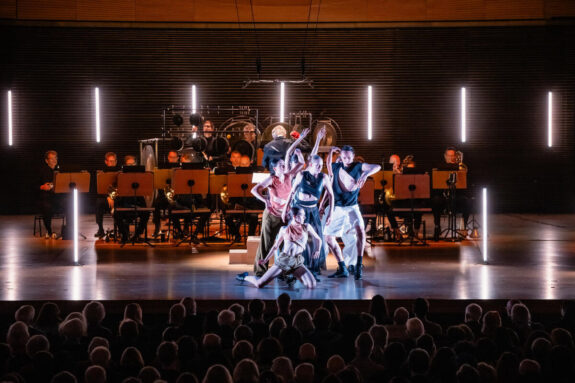
The high point came in the second half, with Rituel in memoriam Bruno Maderna, Boulez’s 1975 tribute to his friend and fellow modernist. Premiered in Paris and refined in Los Angeles before reaching New York, this collaboration between Salonen and choreographer Benjamin Millepied brought new corporeality to a work long regarded as an emblem of abstraction. Boulez conceived Rituel as a spatial processional: eight instrumental groups, each led by its own timekeeper, unfold in slow antiphony, their sequences of calls and responses forming a vast, solemn architecture of remembrance. Its timbres – dominated by gongs, bells and metallic percussion – evoke the hieratic sonorities of East and Southeast Asian ritual ensembles: ceremonial yet restrained. Salonen shaped this structure with a sculptural sense of proportion, percussion strokes landing with deliberate gravity, brass and winds entering in layered counterpoint, the sound expanding and contracting like breath.
The three-dimensional approach was essential to the work’s impact. Only three of the eight groups were positioned on the stage, the others placed high on the balconies, turning the Wu Tsai Theater into something like a resonant polyhedron of sound. The separation created both distance and dialogue – antiphonal exchanges unfolding not only across the orchestra but through the space itself.
The vacant center of the stage became a site of movement: six dancers, completing Boulez’s design as a kind of ninth ensemble, occupied that space, aligning their gestures with the directional flow of the music and occasionally threading among the instrumentalists. Angular pivots followed percussion volleys, slow extensions traced sustained brass chords, sudden dispersions answered the fading echoes of wind and gong. At times they gathered in tight clusters that mirrored the instrumental groupings, as if forming temporary sound bodies of their own before dissolving again into the wider space. Millepied’s choreography emerged as a visual analogue to Boulez’s structural thinking – clarity of line, independence of gesture and a precise balance between tension and repose. The dancers’ presence softened the formality of the layout, introducing a sense of breath and risk; they seemed to listen as much as move, their responses shaped by rhythm rather than by counting beats. Essentially, it was a choreography – precise, lucid and alive to every fluctuation of sound – that used an idiom in full synergy with Boulez’s own.
Salonen, meanwhile, seemed both central and self-effacing. Dispensing with the baton, he cued each group through small gestures, limiting himself to indicating the entries rather than shaping the phrasing. His fingerless gloves – one red, one bluish – improved visibility for the distant players but also introduced a touch of mischief, a subtle acknowledgment that even in ritual precision there is playfulness. His jacket, sporting what seemed to be a slit back, echoed the dancers’ costumes – fluid garments meant to reveal flashes of movement beneath. It seemed the conductor himself was visually part of Millepied’s design – a discreet but telling gesture that underscored the continuity between form and flexibility, motion and sound, choreography and conducting.
If Rituel offered a striking embodiment of Boulez’s legacy, the first half of the program traced its genealogy. Stravinsky’s Octet for Wind Instruments and Bartók’s Concerto for Orchestra – two works Boulez admired for their clarity of design and disciplined inventiveness – served as antecedents in spirit. Both were exemplary in their forging of order from reinvention: Stravinsky through neoclassical transparency, Bartók through organic transformation.
The Octet for Wind Instruments opened the concert with crisp elegance. Salonen approached its neoclassical idiom with affectionate precision, drawing a bright and generally well-balanced sound from the Philharmonic’s winds. The playing had buoyancy without caricature: rhythmic edges clean, phrasing supple, articulation taut yet unforced. Tempos were steady rather than biting, trading Stravinsky’s acerbic sparkle for structural clarity. In the central variations, the musicians found a fine equilibrium between rigor and wit, their interplay conversational but never glib. Salonen highlighted the counterpoint’s transparency – every line audible, every accent intentional – allowing the composer’s design to speak with the architectural lucidity Boulez would later pursue by other means. If the rhythmic balance was ideal, the timbres were less evenly matched – a veritable challenge in Stravinsky’s not-always-homogeneous blend of wood and brass winds. Beneath its polished surface, the performance revealed the discipline and proportion that would later find a different, more austere voice in Boulez.
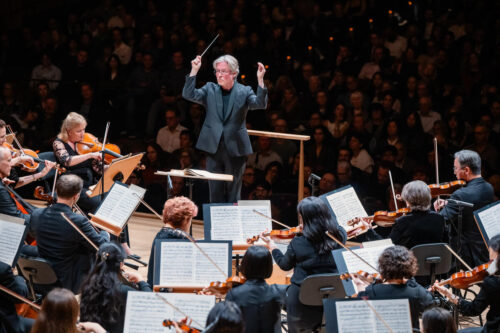
Bartók’s Concerto for Orchestra followed with larger forces but comparable refinement. Salonen emphasized clarity, shaping the opening Introduzione as a slow emergence rather than a display of orchestral mass. The textures were meticulously layered – strings taut and luminous, winds phrasing with chamber-like precision and the brass entering as sculpted color rather than force. The Giuoco delle coppie was notable for the elegance of its wind pairings, each duo tracing its canon with poised articulation and balanced tone. The Elegia – a typical example of Bartók’s ‘night music’ – unfolded in long, arching lines, its harmonic shadows deepened by muted strings and burnished horn timbres. In the Intermezzo interrotto, irony remained understated, Salonen resisting caricature and letting Bartók’s parody dissolve almost immediately into lyricism. The rhythmic propulsion of the Finale felt cumulative rather than explosive, the energy tightly coiled within the framework. An emphasis on structure over impulse revealed a Bartók aligned less with folkloric exuberance than with the structural modernism Boulez would later extend into abstraction.
Edward Sava-Segal
Featured Image: The NY Phil with members of the L.A. Dance Project © Brandon Patoc