
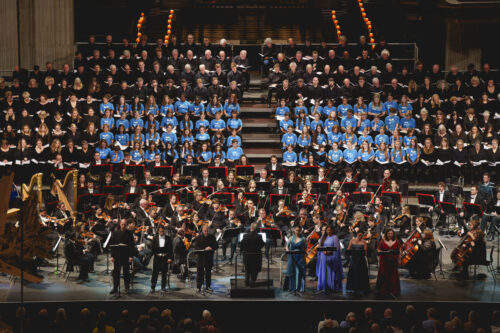
 United Kingdom Mahler, Symphony No.8 ‘Symphony of a Thousand’: Soloists, The Bach Choir, London Youth Choir Cambiata Girls, Philharmonia Orchestra / David Hill (conductor, chorus music director). St Paul’s Cathedral, London, 9.10.2025. (JR)
Soloists:
Magna Peccatrix – April Fredrick
Una Poenitentum – Zoë Jackson
Mater Gloriosa – Caroline Bourg
Mulier Samaritana – Hanna Hipp
Maria Aegyptica – Hayley Meth
Dr Marianus – Brenden Gunnell
Pater Ecstaticus – Josef Jeongmeen Ahn
Pater Profundus – Derek Welton
What a spectacular way for The Bach Choir to launch the 150th anniversary season, a fine performance of Mahler’s monumental and uplifting Eighth Symphony, in the glorious surroundings of St Paul’s Cathedral. Often referred to as ‘The Symphony of a Thousand’ because of the massive forces it requires: in this performance I counted 222 singers of The Bach Choir, over 100 orchestral players plus the eight soloists, organ and offstage instruments.
The symphony, at times, makes a huge noise and that proved a problem in the cavernous acoustic of the cathedral. Churches and cathedrals are designed for smaller forces making spiritual sound, whilst concert halls were designed for large-scale symphonies; Mahler’s works come off best in the Royal Festival Hall, and the larger symphonies fare even better in the Royal Albert Hall where the giant organ can add superb sonority.
Part One of the symphony is a blazing invocation and the opening two organ chords followed by an exclaimed ‘Veni, Creator Spiritus’ from the choir blew us out of our seats. A pity then that, after that, the music sounded woolly and reverberant, the sound drifting up into the huge dome of the cathedral and into the side naves. Individual voices, instruments and the sections of the choir all blended into one echoey and soupy mess, rather like a very old recording. The children’s chorus was often drowned out, their words sadly unintelligible. Mahler’s Eighth symphony is not a work for beginners; its huge scale can be incomprehensible to many. A pity then that the choir chose to sell (rather than give away) its concert programme, as many in the audience choose not to buy one and then they are totally at sea, with no idea who is singing what and why. This symphony in particular is all then just a big noise, which listeners may find difficult, even if you are fluent in German and learned Latin in school.
The Philharmonia Orchestra were on top form but the only instruments which one could really hear with ease were the brass, of course, the organ, the bells and the cymbals (unless brushed, then inaudible). The choir was impressive across all sections, the tenors and sopranos hitting all their top notes with accuracy and power, their combined volume phenomenal. Diction was fine throughout.
A large part of Part Two focusses on the soloists. The choir was very fortunate to have hired the services of eight very fine singers, none of whom disappointed and three stood out. The tenor Brenden Gunnell excelled, volume, intonation and German diction exemplary. It helped that the acoustics did less harm in Part Two where orchestral textures are less thick, the sections quieter in nature, although the bells of St Paul’s striking eight o’clock were an odd interjection.
Korean baritone Josef Jeongmeen Ahn was strong in tone, with clear German words (he graduated in Munich). Australian bass-baritone Derek Welton has a dark low register, perfect for the part of Pater Profundus. He too has sung a great deal in Germany and Austria, and we heard the text clearly. His ‘Erleuchte mein bedürftig Herz!’ was most uplifting. To conclude the male line-up, American tenor Brenden Gunnell (known to me from my years in Zurich) stood out – he does have the advantage of the most prominent and one of the most beautiful parts of the work, but he impressed with the high notes, with intonation, with volume (not easy in this huge venue) and with stage presence. He was the only soloist who looked engaged and telling a story.
Of the female singers, I was much taken by English soprano Zoë Jackson’s sweet yet powerful voice, sparkling when accompanied by mandolin in ‘Neige, neige’, thrilling top notes in ‘Vom edlen Geisterchor’. Polish mezzo-soprano Hanna Hipp was the best of the bunch, rich in tone lower down the register, as in her concluding ‘Űberflüssig, ewig helle, rings durch alle Welten fliesset’. The appearance of Chicago-born soprano Caroline Bourg at the far distance of the top of the choir was visually apt but sonically disastrous, as she was barely audible, even to those close to the stage.
The chorus were most impressive in their final section, from the hushed beginnings of ‘Alles Vergängliche’ to the thrilling conclusion ‘Das Ewig-Weibliche zieht uns hinan’ with full organ threatening to bring down any loose masonry. David Hill, the choir’s music director for the last 27 years, had the grasp of the structure and detail of the work.
The remainder of the choir’s anniversary season will include performances of Duruflé’s Requiem (19th March), and unsurprisingly two of Bach’s greatest works, his Mass in B Minor (26th May) and the St Matthew Passion (8th March), both in the Royal Festival Hall.
The orchestra’s Patron, King Charles III, sent a letter of warmest good wishes to the members of the choir. Here’s to the next 150 years and beyond.
John Rhodes
Featured Image: The Bach Choir, Philharmonia Orchestra, London Youth Choir Cambiata Girls and soloists at St Pauls Cathedral performing Mahler’s Symphony No.8 © Andy Paradise
I would generally agree with this review but disagree that having a programme was necessary for the performance.
Personally, I find that following the words on a programme during a performance distracts from the sublime immersive experience of this symphony.
It is true that the acoustics of St Paul’s were challenging but its setting for such a majestic symphony made this a concert not to be missed.
About my tenth Mahler 8 concert and one I thoroughly enjoyed.
I had a seat in the dome area of St. Paul’s, and generally agree with the reviewer about the acoustical issues. Any competent acoustician would have predicted such difficulties, and I would guess this advice was given as the concert was planned. Given the acoustics there was no way this concert could have been recorded successfully.
I also agree with commenter Chris Hall’s observations about the applicability of ‘following the words’ while the music is performed. This is especially true of Mahler 8. Translation of the Latin and German into English or other languages doesn’t do much to improve the understanding of the music in real-time. And the page turning is annoying for the audience.
This was my second Mahler 8; the first in New York in 2009 at the retirement of Maestro Lorin Maazel. I invited a colleague from the BBC to attend with me this his first Mahler concert. The experience so changed him that he soon became a reliable ‘Mahlerite’, and he soon became a Londoner with a thirst to hear all of Mahler’s works. With his musicality awakened, he also became a chorister with the Bach Choir and was present on stage for this event. I came to ‘close the loop’ with his Mahler experience and flew from Chicago for the event.
Congratulations to my (unnamed) friend and the Bach Choir for this spectacular event.