
 United States J. S. Bach, Six Partitas: Jeremy Denk (piano). Board of Officers Room, Park Avenue Armory, New York, 8.10.2025. (ES-S)
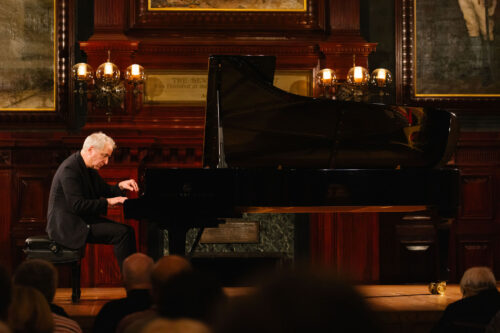
Park Avenue Armory’s Board of Officers Room is an ideal home for Johann Sebastian Bach. Its close, wood-lined acoustic favors clarity over bloom, offering a setting where music grounded in inner balance rather than outward projection can speak with unforced intimacy. It was to this special space that Jeremy Denk brought the complete cycle of Bach’s six Partitas BWV 825–830, a compendium of preludes, dances and other courtly pieces (‘anderen Galanterien’) published in 1731 as Clavier-Übung I, which Bach described as being ‘for music lovers, to refresh their spirits’. Of course, Bach would not have imagined the modern Steinway that now carries his music, yet its range of color and dynamic nuance makes it a compelling medium for this repertoire, even if it occasionally sounded too forceful despite Denk’s limited use of pedal.
He approached the suites with a novelist’s sense of pacing and an orator’s feeling for rhetoric, shaping each movement as part of a broader narrative rather than a chain of miniatures. The performance was both exacting and deeply felt, less an act of pianistic endurance than an exploration of character and form – a meditation that joined intellect with calm expressiveness.
Denk prefaced and interspersed his playing with a series of charming commentaries, both general and specific, often tied to a particular suite or movement. He spoke about the ‘pan-European’ nature of Bach’s endeavor, with dances of diverse character, and about the suites’ shared features. He described the introductory movements as ‘calling cards’ for each key and mood and alluded to what he called ‘bonus tracks’. He also reflected on the origins of the Sarabande, the central dance in every Partita, and expressed particular admiration for Bach’s Gigues, marveling at their blend of exuberance and learned counterpoint.
From the first movement of the Partita No.1 in B-flat major, Denk revealed his sense of proportion and flow. Small gestures and the occasional clin d’œil drew the public’s attention to moments of particular wit or meaning. The Praeludium unfurled with unhurried grace, every ornament placed for the sake of musical syntax rather than sparkle. The Allemande moved conversationally, its lines shaped by subtle shifts of weight; the Sarabande was poised, its suspensions resolved with natural timing. In the closing Gigue, rhythmic lift and translucent voicing foreshadowed the restraint that would govern the entire cycle.
The C minor Partita No.2 brought a darker temperament. As in the first suite, repose and motion seemed to depend on one another – a yin-yang equilibrium built from silence as much as sound. As he would throughout the evening, Denk revealed how pauses could be structural: caesurae shaping syntax, giving breath to thought, or allowing lightness to yield to shadow.
The Sinfonia opened with a certain austerity – grave chords released into the air, followed by an Andante that maintained pulse but not rigidity. Denk avoided monumentality; instead, he emphasized continuity, allowing melody and bass to breathe together. In the fugue that closes the first movement, articulation remained lucid and the counterpoint distinct in the densest textures. Among the succeeding dances, the Sarabande stood apart as the suite’s meditative center, its gentle chromatic turns rendered with inward calm.
Played next, the G major Partita No.5 felt like a release of light. Its Praeambulum glistened; ornaments flickered like quicksilver; phrasing retained an elegant buoyancy. Denk’s rhythmic precision here, and throughout, reminded the listener that these are dances as much as keyboard studies.
As the recital unfolded, the balance between ludic and austere tilted toward the former, and the Partita No.3 in A-minor, played after the interval, made this clear. Denk captured the music’s nimble humor through articulation alone, the Burlesca and Scherzo dancing lightly on their feet. His control of color was exemplary – pedal used sparingly, touch adjusted for clarity, phrasing attentive to every harmonic shift. He kept the pulse supple, revealing Bach’s rhythmic invention without exaggeration, even if the dynamic range at times felt overly uniform.
Following the relative intimacy of the A minor Partita, the D major Partita No.4 expanded the scale again. The French-style Overture projected a noble energy, its dotted rhythms crisp but never pompous. Denk’s transition into the fugal section was seamless, tension building through the interplay of lines rather than through sheer volume. The succeeding dances – a refined Allemande, an Aria of vocal grace, a deeply centered Sarabande – displayed his ability to make each movement distinct in character yet part of a continuous design. The Gigue closed the work with jubilant contrapuntal clarity.
The cycle culminated with the Partita No.6 in E minor, the most substantial and introspective of the six. The Toccata began almost as improvisation – free gestures gathering into the architecture of a fugue. Denk built its tension patiently, lines crossing and converging until the music seemed to argue with itself. The Sarabande, taken at a deliberately restrained tempo, revealed its poignancy through control: dissonances left to hover, silences held just long enough. The concluding Gigue, with its double fugue, achieved inevitability through precision, its momentum grounded, once more, in exact rhythm rather than volume.
In the stillness that followed the final note, applause felt almost intrusive. Denk’s traversal of the Partitas traced not only Bach’s inexhaustible imagination but also the inward discipline that sustains it. What lingered was less a sense of completion than of continuation – the feeling that Bach’s music, endlessly self-renewing, had simply paused to breathe.
Edward Sava-Segal