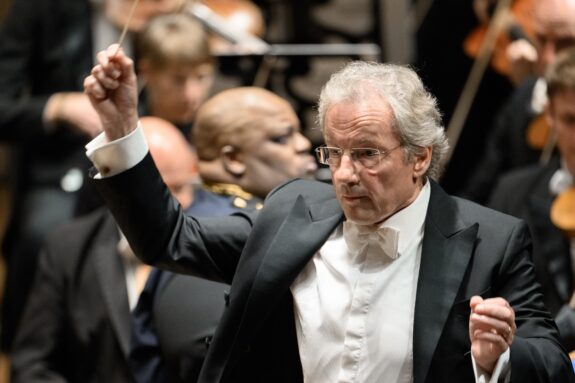
 United States Honegger, Mahler: Limmie Pulliam (tenor), Iurii Samoilov (baritone), Cleveland Orchestra / Franz Welser-Möst (conductor). Mandel Concert Hall at Severance Music Center, Cleveland, 3.10.2025. (MSJ)

Honegger – Symphony No.3, ‘Symphonie Liturgique’
Mahler – Das Lied von der Erde
Though he is known for his reserve, Franz Welser-Möst can come out swinging punches when required. And so it was for a rare and welcome performance of French/Swiss composer Arthur Honegger’s Third Symphony, a harrowing wartime narrative written in the mid-1940s that speaks eloquently in the current age of worldwide chaos. Experiencing the madness of war firsthand, Honegger depicted both destruction and resilience in this music. Whether framed by the violence of wars in the Middle East or the Russian invasion of Ukraine or by so many nations’ modern equivalent of what Honegger called ‘the morass of barbarism, stupidity, suffering, machine-mindedness and bureaucracy’, the music has much to say to us now.
Part of Honegger’s creative signature is a colorful but dense orchestral sound, often punctuated by an orchestral piano. Such textures are tricky, but Welser-Möst did outstanding work balancing the blend so that details could be discerned without sacrificing the urgent forward press of the music. The first movement pulled no punches, yet made its impact through sheer concentration, not mere decibels. The orchestra’s full roar didn’t appear until later in the work, first in the despairing slow movement, then again in the keening finale. Principal cellist Mark Kosower’s solo in the latter movement’s coda was the first warm, humane voice to appear in the work, and its burning glow was moving.
Pairing the Honegger with Mahler’s The Song of the Earth was unexpected in terms of orchestral sound, Honegger’s thick impasto being so different from Mahler’s deftly aerated textures. But the contrast worked fantastically to point up the sheer tenderness of the Mahler. The first movement of the Honegger parallelled the turmoil of Mahler’s opening ‘Drinking Song of the Earth’s Sorrow’, and that aforementioned cello solo from the Honegger could have come right out of the second theme group of ‘The Lonely One in Autumn’, but the main impression was that these two masterpieces speak with equally shattering voices although their perspectives are very different. Honegger speaks in the voice of the artist documenting the human and social disaster of his time, while Mahler speaks in the personal voice of a creative soul watching his life disintegrate. Honegger spoke of World War II, and how that nightmare impacted his life; Mahler spoke of the personal loss of health, career and loved ones but caught a reflection of the nervous unease of a society on the verge of World War I. Both works resonate frighteningly today, and hearing them together was unforgettable.
More than half the battle of putting on a good Das Lied is finding soloists who can soar in this technically challenging yet emotionally heartfelt music. Happily, Welser-Möst nailed the casting with tenor Limmie Pulliam and baritone Iurii Samoilov, two of the most promising rising stars in vocal music. What I thought of this performance can be summed up efficiently by saying that this triumvirate at work in Das Lied needs to record it in a proper studio recording not just a live relay, because this is an interpretation of note.
Limmie Pulliam was magnificent here in Cleveland two years ago in a semi-staged production of Verdi’s Otello, and the Cleveland audience clearly hadn’t forgotten it, erupting in cheers as soon as Pulliam stepped through the stage door. His contribution to Das Lied was no less vibrant: he has that rare quality of combining the strength of a dramatic tenor voice with the golden sheen of a lyric tenor. I am not kidding when I say that I have not heard a tenor voice of such quality in this work since Fritz Wunderlich in the Otto Klemperer recording from over fifty years ago. Pulliam was able to soar above the turbulent music of the first movement, abetted by Welser-Möst’s deft dovetailing of dynamics. The conductor dipped in and out of passages with surgical detail, allowing orchestral heft sometimes even for just a beat or two between the tenor’s phrases, then erupting between the singer’s paragraphs. Pulliam was vibrant in ‘Of Youth’ and careening in ‘The Drunken Man in Spring’, skillfully matching Welser-Möst’s fleet speeds.
The tenor songs were outstanding, but what makes or breaks a performance of Das Lied are the three songs for medium voice, usually heard sung by a mezzo-soprano. Mahler did, however, allow the songs to be sung by a baritone. Once rare, this option has become more popular in recent years, though it still tends to lag behind the choice of a female voice. Iurii Samoilov could change that. I will be honest, not even the great Dietrich Fischer-Dieskau had previously convinced me that a baritone Das Lied was worthy to stand beside the mezzo-soprano accounts by the likes of Christa Ludwig or Janet Baker. Samoilov bears the honor of being the first male singer worthy of standing with those masters.
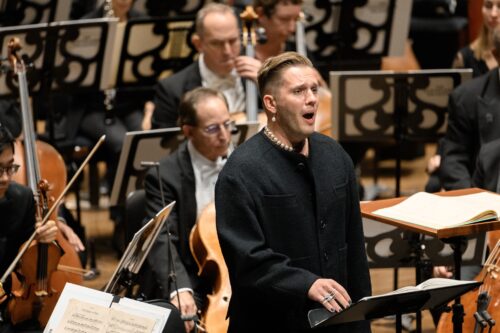
Samoilov has the vocal heft and handsome strength to match Fischer-Dieskau in the declamatory parts of the medium-voice songs, but he also delivered many passages with a melting tenderness that Fischer-Dieskau could only dream of. Part of this creative breakthrough came from Samoilov’s willingness to break old social norms of masculine deportment. The medium-voice songs, particularly the epic closing ‘Der Abschied’ – as long as the other five movements combined – require levels of vulnerability that past baritones have simply been too afraid to unleash. Samoilov has such confidence in his supple voice and so much knowledge of how to effectively deploy it that he had no fear in showing vulnerability. He topped off that challenge to masculine bravado by accenting his skatepunk-chic couture with a strand of pearls and an earring, and he still came across as both virile and vulnerable. Until this performance, I largely dismissed the baritone option, but no more: Samoilov proved the baritone version can match the mezzo-soprano one.
Part of what made Samoilov so effective was his close coordination with Welser-Möst. Far too many performances of Das Lied misfire in ‘The Lonely One in Autumn’, when the surge of warmth near the end of the movement suddenly seems to come out of nowhere, unmotivated. Here, conductor and singer had carefully figured out where smaller surges of warmth precede it but are pulled back by sudden chill. Without those urgent yearns, the final surge fails to land, but they were so skillfully identified and deployed in this performance that I can honestly say I have never heard it done better. ‘Of Beauty’ came off at a flowing tempo, with Samoilov nailing the breathtaking galop in the middle of the movement. That passage was the subject of a famous clip, much shared in recent years on social media, where mezzo-soprano Christa Ludwig is seen growing exasperated at Leonard Bernstein’s fast tempo as they rehearse the piece with the Israel Philharmonic. Samoilov kept up with confidence here and, if anything, Welser-Möst’s tempo for the galop exceeded Bernstein’s.
I don’t mind performances that take a little more time with ‘The Farewell’ because it can handle it, but the concentration and commitment kept this performance riveting without feeling rushed. The dark passages were chilling, but something interesting happened with the contrasting warm sections. In the early 1980s, conductor Carlo Maria Giulini recorded Das Lied with the Berlin Philharmonic. There was some controversy about how much Giulini sped up during the contrasting warm passages, but a look at Mahler’s score showed that the composer did, indeed, mark those passages to go at a fleeter pace. In Giulini’s performance, though, it sounds more dutiful than committed. What Welser-Möst demonstrated in this performance was not that Giulini was too fast, but that he wasn’t fast enough. Welser-Möst leaned into the new tempo, and it felt like a warm gentle breeze stirring through the previously chilled, shadowy landscape. That sudden, flowing warmth was more devastating than any solemn plod through the passage could ever be. It brought home the emotional immediacy of the work and capped an unusually tender rendition.
This performance was marked by outstanding playing, particularly by the woodwinds, including key solos from Frank Rosenwein on oboe and Joshua Smith on flute. The strings displayed glowing beauty, and the brief but critically important contributions from brass and percussion were powerful and trenchant. The only instrumental complaint I could note (other than the player who fell a bar behind in the first movement for a few measures) was that the mandolin was almost inaudible in ‘Der Abschied’. Granted, many performances draw too much attention to that rare visitor to orchestral textures, but it was so buried here that I could barely catch it at all.
In short, this was an outstanding concert, one of the best in recent years. And that is saying something, because the orchestra came out of the Covid crisis five years ago with a renewed sense of purpose, as has its music director, who is recovering this season from health challenges. As the world around us roils, the Cleveland Orchestra is speaking ever more eloquently.
Mark Sebastian Jordan
Featured Image: Franz Welser-Möst conducts the Cleveland Orchestra in Mahler © Human Artist Photography/TCO