
 United Kingdom Beethoven, John Adams: James Ehnes (violin), London Philharmonic Choir (chorus director: Madeleine Venner), BBC Symphony Chorus (chorus director: Neil Ferris), London Philharmonic Orchestra / Edward Gardner (conductor). Royal Festival Hall, London, 8.11.2025. (CK)
Beethoven – Violin Concerto
Adams – Harmonium
What can I usefully write about the greatest of all violin concertos played by a prince among violinists? It seems churlish to say that I admired and enjoyed the long first movement as if from a distance: that James Ehnes’s playing was almost too refined, to a degree that I at times mistook for blandness. It was certainly refreshing after the previous performance of the work I had heard, a while ago, in which the soloist had played Beethoven almost as if he was Tchaikovsky: but I feared initially that it might be a non-event, like Isabelle Faust’s performance of the Brahms Violin Concerto with Simon Rattle in the Barbican nigh on two years ago. It never really took off.
Edward Gardner got some vividly pointed playing from the orchestra; and Ehnes’s cadenza had lively personality, with a light touch and some eloquent double-stopping. When the orchestra rejoined him one sensed a genuine depth of feeling (partly down to some expressive playing from Jonathan Davies’s bassoon). The Larghetto was beautiful, Ehnes’s playing sweet and light, his tone fined down sometimes almost to nothing; he launched the finale as the most light-footed of dances – fairy music, almost – and delighted us with his filigree playing all the way to the dance’s end. There was more airy, Apollonian grace in his encore, the Prelude from Bach’s Partita for Solo Violin No.3.
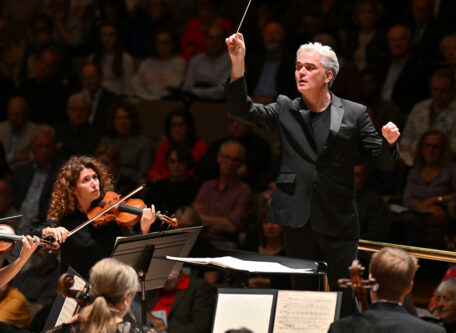
After the interval John Adams’s breakthrough work Harmonium was given a viscerally thrilling performance, Gardner driving his choral and orchestral forces with a fiercely propulsive clarity in Adams’s setting of Donne’s knottily opaque poem Negative Love. It put me in mind of Adams’s explanation of his method in a long interview with Thomas May: ‘The formal idea with my music is that something appears on the event horizon, and then it increases in importance as it begins to dominate the screen, and then it passes you and it’s gone. Meanwhile, several other events have arisen and are at various stages of moving towards you. I think that is the essence of how I compose and it’s the way I experience my own music.’
Watching a movie? Playing a video game? Whatever. We are dealing with the man whose Chamber Symphony is inspired equally by Schoenberg’s Chamber Symphony Op.9 and the music of Bugs Bunny cartoons: a man who organises his musical influences not hierarchically but democratically. It is about the direction of travel: in Negative Love we are flying out from a pre-verbal beginning in search of a Love beyond human forms, a Love that cannot be constrained by definition. Adams again, in his book Hallelujah Junction: ‘I saw in the poem the suggestion of a soaring arrow, a vector pointing upward, its ascent impelled by ever-increasing rhythmic and sonic energy’. That is exactly what we got in Gardner and the London Philharmonic Orchestra’s performance.
The pace slows hypnotically for Emily Dickinson’s well-known Because I could not stop for Death, the music deliberately monotonous as the poet observes her life from the horse-drawn hearse as it passes in leisurely parade. It reaches a point of rest – an idyllic place, a gentle murmur of cowbells – before the next great crescendo sweeps us up and sends us hurtling into Wild Nights: ecstasy followed by fulfilment and calm.
Gardner calls Harmonium a secular cantata; at the risk of pretentiousness, I might call it a Hymn to Eros and Thanatos. It demands a large and fearless chorus: the London Philharmonic Choir, augmented by fifty voices from the BBC Symphony Chorus, were superb, the women’s voices blazing tirelessly in their taxing ecstasies and bringing a soft lambency to the calmer sections. Gardner has described Adams’s word-setting as ‘almost Brittenesque’: I am beginning to see that, but we recognise also his Minimalist pleasure in using words as sounds to be modified subtly over long spans with irresistibly sensuous effect. His orchestral writing is kaleidoscopic, whether it is four flutes and a harp over a glowing chord on the strings, a trumpet solo emerging from the haze over quietly chugging pizzicatos on cellos and double basses, or an oceanic crescendo cresting in gong crashes and pitching us into the dazzling, bell-filled brightness of Wild Nights.
Orchestra and Chorus surpassed themselves, but Gardner was the hero of the night. He fully deserved the solo bow the orchestra insisted on him taking.
Chris Kettle