
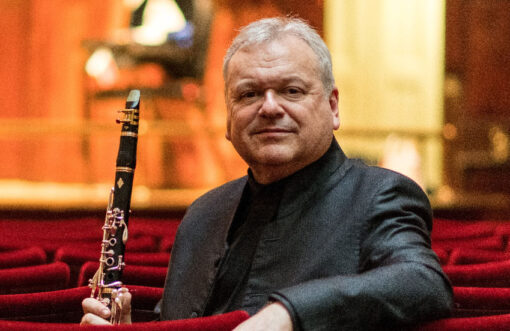
 United Kingdom Mozart, Saint-Saëns and Poulenc: Wigmore Soloists: Michael Collins (clarinet), Alberto Menéndez (horn), Fiona Kelly (flute), Olivier Stankiewicz (oboe), Robin O’Neill (bassoon), Michael McHale (piano). Wigmore Hall, London, 9.11.2025. (CSa)
Mozart – Quintet in E-flat for piano and winds, K.452
Saint-Saëns – Caprice sur des airs danois et russes, Op.79
Poulenc – Sextet for wind quintet and piano
Wigmore Hall’s Sunday morning Coffee Concerts have been an established feature of London’s musical landscape for 45 years. For the price of a ticket -currently a modest £18 – seasoned afficionados of chamber works and curious newcomers can enjoy a 70-minute post-breakfast infusion of sweet music, a shot of dry sherry and a jolt of coffee before embarking on the rest of the day. This particularly energising programme featured the legendary clarinettist Michael Collins and fellow members of the comparatively recently formed Wigmore Players performing works for wind by Mozart, Saint-Saëns and Poulenc.
The recital began with Mozart’s radiant Quintet for Piano and Winds in E-flat, K.452. Written in 1784 – the same year as six of his greatest piano concertos (numbers 14-19), the quintet shares with these large-scale works, the same bright instrumental textures and sparking dialogue between players. From the first notes of the courtly Largo introduction, the Wigmore’s Own demonstrated perfect cohesion bringing joyful elegance to the ensuing Allegro. Who knows how these musicians each a distinguished soloist or orchestral principal in his own right find the time to meet, rehearse and achieve such unity of expression while preserving their individual voices? In the Quintet, Michael McHale’s precisely articulated, softly fluid pianism led the way. But he was simply the first among equals, presenting the theme and initiating a witty, five-way conversation in which the four winds empathetically responded. Balance was all. In the second movement Larghetto followed, Alberto Menéndez Escribano’s mellow horn and Olivier Stankiewicz’s plangent oboe subtly interwoven with Robin O’Neill’s impish bassoon and Michael Collins’s velvety clarinet combined to pierce the work’s most tender heart. With scarcely a pause for breath the five embarked on the final Rondo, a joyful, good humoured musical exchange played with vivacity, sensitivity and intelligence.
The second musical dish on this delicious three-course musical menu was Camille Saint-Saëns’ Caprice sur des airs danois et russes Running for about 12 minutes and written in 1887 for four wind players and a pianist at the Paris Conservatoire it celebrated the marriage of a Danish princess to the Czar Alexander III of Russia. Combining Danish and Russian national folk tunes, this dazzling piece is scored for piano, clarinet, oboe, bassoon and flute. During the horn’s absence, the celebrated flautist Fiona Kelly took the opportunity to excel. It is always invidious in a piece like this to single out a particular player, especially when, like Mozart, Saint-Saëns treated all the parts with equal importance. Suffice it to say, the composer’s genial Parisian repartee was played by the entire ensemble with elegance, clarity and wit.
Francis Poulenc’s Sextet for wind quintet and piano was the last item on the programme. Inspired by Mozart and Saint-Saëns, its combination of twentieth-century neoclassical clarity, lyricism and gallic wit made it a fine choice with which to end the concert. The Players swung into syncopated action within the first jazzy bars of the opening Allegro, the chattering winds evoking the bustle and flurry of Paris boulevard, while the Divertissement was wistful and gently nostalgic – more reminiscent of a half-empty ‘30’s French café. The Final e- a quicksilver Prestissimo – was executed with sparkling virtuosity and pitch perfect comic timing, bringing broad smiles of pleasure to the faces of many in the capacity audience. And all this before the sherry had even been served!
Chris Sallon