
 Ireland Puccini, Madama Butterfly: Soloists, Chorus and Orchestra of Irish National Opera / Fergus Sheil (conductor), Bord Gáis Energy Theatre, Dublin, 8.11.2025. (RB)
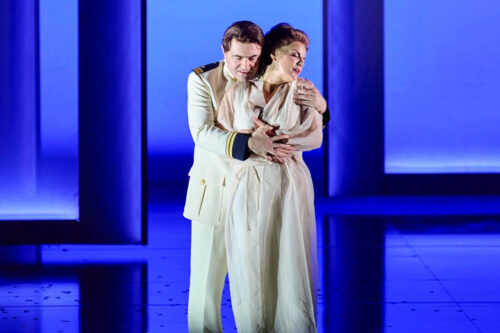
Irish National Opera’s new production of Madama Butterfly, a co-production with Scottish Opera, is framed as a memory play seen through the eyes of Butterfly’s grown-up son, Sorrow. The curtain opens at Pinkerton’s funeral in 1990. His elderly wife Kate stands beside their son and she carries a lifetime of guilt because of a secret she has shielded her son from for decades. She leads him to a box of Japanese objects and leaves him to piece together the extraordinary story of his true mother, Cio-Cio San (the ‘Butterfly’ of the title).
Daisy Evans’s new production was a visually lavish affair which allowed the audience to plumb the depths of this emotionally charged work. Evans’s objective was to ensure that Butterfly is seen not as a victim but rather as a mother driven by a sense of purpose who succeeds in securing her son’s future while falling under the wheels of fate. Celine Byrne’s Butterfly emerges as a rather more assertive character than the shy 15-year-old ingenue we see in other productions. She brings a dignity and bearing to the character which never wavers as she finds herself increasingly at the mercy of external events. Having the audience witness these events through the eyes of the older Sorrow reinforces the emotional power and impact of the work. At various points in the production, we see the older incarnation of Sorrow interacting with his younger self. There are moments of unalloyed joy as we see the two of them playing together. As the opera darkens, we see the older Sorrow trying to protect his younger self from the tragic web of events unfolding before his eyes.
Kat Heath’s set consisted of Japanese sliding panels which opened and contracted as the opera progressed. The moving panels framed scenes in a cinematic way creating striking camera effects. The panels were diaphanous at various points so one could see characters leaving or emerging. Jake Wiltshire illuminated the set with pastel colours creating exquisite visual backdrops before moving to angry red colours as the tragic momentum began to build. Cherry blossoms decorated the set at key moments and towards the end of Act II a cascade of flower petals fell from the ceiling. It was one of the most exquisitely beautiful operatic sets I have seen.
Butterfly is one of Celine Byrne’s signature roles and she gave a towering performance. She portrayed Cio-Cio San as a determined and resilient character, able to withstand being ostracised by members of her own community while at the same time showing resourcefulness and a steely determination. Byrne brought a rich, opulent tone, powerful top notes and moments of exquisite ethereal beauty to the vocal line. She was mesmerising in the great love duet at the end of Act I. She sang ‘Un bel di’ with an increasing sense of rapture and intensity while probing the melancholy undercurrents of the aria. Georgian tenor, Otar Jorjikia, was also very impressive in the role of Pinkerton. He brought considerable vocal heft and a ringing tone to the early scenes. He was superb in the Act I Love Duet, creating enormous warmth and breadth of sound and soaring up to Puccini’s top notes. He was dramatically convincing in the scenes with Bryne’s Butterfly and there was clearly great chemistry between them. I wondered if there was scope for him to show us more of the callow and opportunistic side of Pinkerton’s character.
The rest of the cast acquitted themselves well. Iurii Samoilov was impressive in the role of the principled Sharpless. He brought clarity and depth of sound to the vocal line, and he showed great sensitivity and an increasing sense of concern for Butterfly. Hyona Kim’s Suzuki seemed to find just the right balance between emotional support for Butterfly while at the same time trying to warn her of the impending dangers. She clearly has a very powerful voice which she used to great effect, and she was beautifully expressive in the famous ‘Flower Duet’. John Molloy made a forceful and dramatic impact in the role of Bonze in Act I. He was dressed all in black and his arrival almost seemed like a portent of impending doom. The rest of the cast all did themselves well too, as did the chorus. The ‘Humming Chorus’ was sung with a gentle serenity that was tender and haunting.
Fergus Sheil did an excellent job ensuring the orchestra, soloists and chorus remained on track. The orchestra provided a lush, exotic and richly coloured backdrop to the singers. Sheil’s pacing of the material was exemplary as the opera moved from blossoming romance to moments of high drama, domesticity and tragedy. Sheil and his orchestral partners were excellent in integrating and synthesizing Puccini’s unfolding web of leitmotifs. The balance of sound between the soloists and orchestra was well managed.
Overall, this was another exceptional production from Irish National Opera featuring an exquisitely beautiful set and a powerhouse performance from Celine Bryne.
Robert Beattie
Featured Image: Irish National Opera’s Madama Butterfly © Ros Kavanagh
Production:
Director – Daisy Evans
Set design – Kat Heath
Costume design – Catherine Fay
Lighting design – Jake Wiltshire
Chorus director – Richard McGrath
Cast:
Cio-Cio San – Celine Byrne
Pinkerton – Otar Jorjikia
Sharpless – Iurii Samoilov
Suzuki – Hyona Kim
Goro – Peter Van Hulle
Bonze – John Molloy
Yamadori – Paul Grant
Kate Pinkerton – Imelda Drumm
Cousin – Caroline Behan
Aunt – Deirdre Higgins
Mother – Sarah Luttrell
Yakusidé – Matthew Mannion
Imperial Commissioner – Michael Ferguson
Registrar – Maksym Lozovyi
Sorrow (Adult) – Michael Mullen
Sorrow (Child) – Ewan Caster