
 United States Puccini, La bohème: Soloists, Chorus and Orchestra of the Metropolitan Opera, New York / Keri Lynn-Wilson (conductor). Recorded live (directed by Gary Halvorson) at the Met on 8.11.2025 and seen at the Everyman Cinema, Chelmsford, Essex. (JPr)
The late Franco Zeffirelli spoke in 1981 about his then-new La bohème (‘the Met’s most-performed opera’ according to Live in HD host Matthew Polenzani): ‘[The opera] it’s the Romeo and Juliet of Puccini, it’s the story of young people, the story of a tragic live … I like to design my own set … it is always a big dilemma, do you do what the author wanted or do you try another experiment which is what I always try to come up with … how would he conceive it today and how would Puccini like to see his piece staged today … I designed a dream of a past civilisation, a past culture but perfectly understandable to the audience of today. For instance, the idea of the small garret where four hungry kids live in the Paris of the early nineteenth century was never [before] fully achieved on a large opera stage … so all the gestures, all the things that happen in the garret have to be larger than life, but the story basically has to be acted very simply in a small space. The Met is this miraculous great theatre where first of all, four or five stages that can come in and go out … and the human element in this stage is quite remarkable, apart from the technical skill they have and experience.’
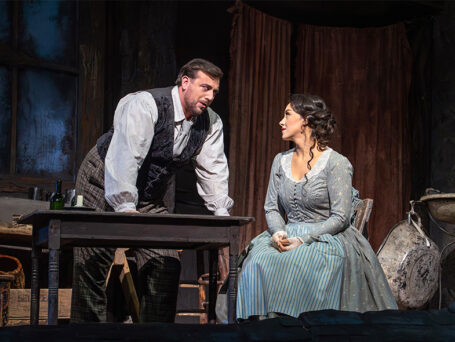
Zeffirelli’s sets are memorably hyper-realistic, and much fun is had by all watching – during pauses between the acts – the stage being cleared and prepared. Fascinatingly, it still revealed how over-manned (literally because there are very few women seen) the backstage crew at the Met are with – despite everything that is involved – many standing around doing not particularly very much at all. The sets are showing their age but then again in the vintage film of Zeffirelli they – surprisingly – didn’t look much better. The quartet’s ‘small garret’ is hidden amongst the rooftops across which the bohemians rather uncertainly lark about at the start of the last act; there is a snowy wonderland for Act III, and the Latin Quarter second-act scene has equally detailed – and monumental – representations of building façades and the Café Momus’s interior. Extras (or ‘supers’ as they are called) mingle with the similarly traditionally-costumed double chorus and children’s chorus – who look if they are straight off a vintage Christmas card – and fill every available bit of space across the vast Met stage. Let’s not forget the donkey, Wanda, and Lorde the horse who brings Musetta on!
Often La bohème can endure and even transcend – because of Puccini’s genius – even a less-than-wonderful musical performance because we rarely fail to feel the emotional connection with the characters’ woes because it is such a timeless story. However, for the umpteenth Zeffirelli revival (given a new lease of life in 2025 by Mirabelle Ordinaire) and broadcast live to a worldwide cinema audience, there was an exceptional cast of young – or youngish – singers, headed by Armenian soprano Juliana Grigoryan (the First Prize winner at the Operalia World Opera Competition in 2022 and alumna of the Met’s Lindemann Young Artist Development Program) and British-Italian tenor Freddie De Tommaso.
Grigoryan revealed how her second-act costume dated from at least 1997 which made it older than she is. Her age combined with that of De Tommaso makes them only 15 years older than the Zeffirelli production itself. When British singers are often absent from the Covent Garden stage, at the Met there was the American quartet of Heidi Stober (Musetta), Lucas Meacham (Marcello), Sean Michael Plumb (Schaunard) and Gregory Warren (Parpignol). The principal cast was completed by South Korean Jongmin Park (Colline) and the veteran Scottish baritone Donald Maxwell as Benoît and Alcindoro (he had sung these roles the last time I saw Zeffirelli’s La bohème in 2014).
For her age Juliana Grigoryan gave a remarkable performance as Mimì that was complete both vocally and dramatically. However, Grigoryan is still a fairly light soprano and – as heard through the quality sound reproduction at Chelmsford’s Everyman Cinema – sounded initially more Butterfly than Mimì. In the personality she brought to Mimì, Grigoryan made her more a girl of 2025 than ‘the early nineteenth century’. Whilst totally manipulative – blowing her own candle out for instance – Grigoryan brought to Mimì a near-perfect combination of reticence and sensuality. This worked well for her interpretation of Mimì’s superficial modesty barely disguising her deep inner desires over what she would like to get up to with Rodolfo, even though they had only just met. All of this – and much else besides – was revealed in Gary Halvorson’s impeccable close-up camerawork for the screen.
De Tommaso’s ardent, open-faced, playful Rodolfo who with all his youthful energy and use of Puccini’s music to express his character’s heart-on-sleeve emotion, reminded me of another great Rodolfo, Luciano Pavarotti. De Tommaso really makes us care that in a very short time he will win and then lose a woman he genuinely loves, and he leaves us believing at the end that should he find love again, he will never find another like Mimì. I heard the Italian sun more in De Tommaso’s Rodolfo than in his recent Cavaradossi (review here). There was a potent – and utterly believable – chemistry between De Tommaso and Grigoryan from a resplendent ‘O soave fanciulla’ right until the last heart-wrenching minutes of the opera.
The twisted antics of the off-on-off-on lovers Musetta and Marcello came across strongly through the performances of Heidi Stober and Lucas Meacham. Yes, Stober made Musetta a proper diva but ultimately proved she was much more than simply an impetuous women capable of doing a few good deeds. Often coquettish and comical, Stober sang so unaffectedly that it allowed her winning personality to radiate through Musetta’s ‘Quando me’n vo’. We totally understand why Meacham’s hot-headed Marcello loves her; we accept Musetta is rather fickle but there is a caring side which makes her help Mimì when she discovers she is dying. Meacham gave a rounded portrayal of a Marcello happy to play the field until Musetta comes back into his life, but I thought Meacham believed his character was on an equal level with Rodolfo and Mimì when for me less would have been more. As a result, both Sean Michael Plumb’s personable Schaunard and Jongmin Park’s stoic Colline (impressive in his ‘Coat Aria’) seemed rather in Meacham’s shadow. As good as it was to see Donald Maxwell’s vignettes as Benoît and Alcindoro he seemed to lack the ease and confidence of earlier times.
It would be difficult for any conductor to spoil Puccini’s La bohème and Keri Lynn-Wilson’s account was idiomatic, with a certain panache and sensitivity to the drama, as well as an innate comprehension of opera’s narrative structure. Occasionally there was just the impression she was indulging – or maybe confusing – the singers, speeding up here, slowing down there, but these moments were fleeting.
I’ll conclude by writing how it is not the first time I have ever felt that a La bohème – an opera I have seen innumerable times – has seemed as fresh and emotionally compelling as the current one: a credit to all concerned, the genius of Puccini and the Met’s wonderful 42-year-old staging.
Jim Pritchard
For more about The Met: Live in HD click here.
Featured Image: [l-r] Heidi Stober (Musetta), Sean Michael Plumb (Schaunard), Jongmin Park (Colline), Lucas Meacham (Marcello), Juliana Grigoryan (Mimì) and Freddie De Tommaso (Rodolfo) © Karen Almond/Met Opera
Cast:
Mimì – Juliana Grigoryan
Musetta – Heidi Stober
Rodolfo – Freddie De Tommaso
Marcello – Lucas Meacham
Schaunard – Sean Michael Plumb
Colline – Jongmin Park
Benoît / Alcindoro – Donald Maxwell
Parpignol – Gregory Warren
Production:
Production and Set designer – Franco Zeffirelli
Costume designer – Peter J Hall
Lighting designer: Gil Wechsler
Stage Director – Mirabelle Ordinaire
Chorus director – Tilman Michael
Live in HD Host – Matthew Polenzani
Also with innumerable La bohèmes under my belt, I attended a cinema showing for just the lift it provided. De Tommaso and Grigoryan were so charming and sang so deliciously, my heart sang with them. My only counter-note to the review is Lucas Meacham’s performance, which I particularly enjoyed and in no way felt it should have bowed more to De Tommaso’s Rodolfo. Neither singer nor character was diminished by his work.
Jim for S&H: I hope I made it clear that I too appreciated Lucas Meacham’s performance but it was clear from the close-ups for the cinema audience on the stage – and off it – that there was, maybe for me only?, the impression that he felt he was a senior singer amongst youngsters.
Total agree on Lucas Meacham’s performance, he was brilliant and brought a life and humour to Marcello’s character that I haven’t seen before.
Saw it on the big screen at Cinemark. It was terrific!
How one could write that Juliana was playing a 2025 Mimì … At the moment she is as playful and believable to the audience as was Clara Petrella in 1950s. Italians for her acting put Petrella above Callas. I am also putting Juliana above Callas …but in 2025. [edited only for clarity]