
 United Kingdom CBSO and CBSO Youth Orchestra: ‘Side by Side’: Joshua Weilerstein (conductor). Butterworth Hall, Warwick Arts Centre, Coventry, 2.11.2025. (CP)
Shostakovich – Festive Overture; Symphony No.7 ‘Leningrad’
Catherine Arlidge, a year into her appointment as Director of Artistic Planning has built an extremely talented team to form the CBSO Youth Orchestra. Awarded an MBE in 2016 for services to music education, she was a long-standing member of the CBSO string section and has proved to be an innovator and one not to shy away from a challenge! She was brave to ask the 100plus young musicians to tackle the longest and toughest challenges of all Shostakovich’s symphonies
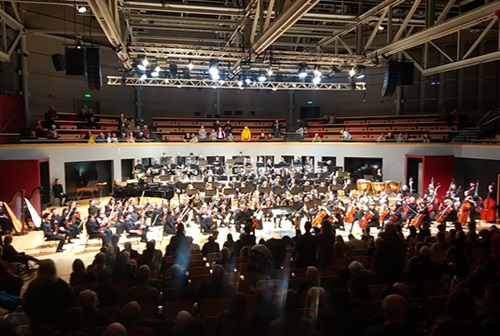
Butterworth Hall’s extended platform was filled to the limit accommodating a total of one hundred and twenty-three musicians, including a sprinkling of those from the professional ranks in this ‘Side by Side’ venture, for the delivery of the most moving of all Shostakovich’s symphonies, his Seventh, the ‘Leningrad’. This work is a challenge to many an orchestra. Under the lively direction of Joshua Weilerstein, this piece was expertly delivered to an audience who were on their feet within seconds of the last climax to applaud thunderously, many in tears.
At a pre-concert talk, violinist Clarice Ngo, one of a quartet of young musicians, spoke enthusiastically about ‘feeling locked in’ with the ‘solid professionals’ interspersed amongst most sections. ‘Learning by osmosis’ was another important message to emerge from this discussion. Catherine Arlidge has worked wonders in developing such a successful mentoring opportunity. Rehearsals during the previous week were led by the highly regarded, Tess Jackson, whose work with the National Youth Orchestra continues to inspire those brilliant young performers. She will soon turn her attention to work on two performances of La traviata at Garsington Opera this coming summer. Her success with the CBSO Youth Orchestra last week was monumental.
The Leningrad Symphony is full of messages and stories; the first performance was broadcast by loudspeakers into the German camp in August 1942, thereby confirming in those minds that they could not win. Sadly, members of the brass section passed out from the starvation they suffered. CBSO’s young players were constantly reminded of the meanings behind the work. Another of the quartet marvelled at how the first movement depicted the story of how the siege developed. The fifteen minutes of relentless snare drum playing portraying a sinister and powerful image, often referred to as the ‘invasion theme’, later proved heroic.
Joshua Weilerstein’s performance was a revelation. Popular with CBSO at Birmingham’s Symphony Hall, his first performance at Butterworth Hall was something to be treasured. He spoke with perfect diction as he introduced the work, reminding his audience that 100,000 people died each month during the winter of 1941/42. He reminded everyone how the Seventh Symphony is ‘an example of resistance to tyranny everywhere; this is the greatest theme for an artist’. Goodness me, Joshua certainly had an impact on the thinking of his young charges.
Thundering strings open the work with a theme soon to be echoed by the wind sections with piercing piccolo and exquisite solo oboe by Luke Cutler, another of the four talking earlier. Plaintive flutes and delightful pizzicato strings brought a sense of urgency to the movement. As the pace quickened, we were treated to some astonishingly fine bassoon playing. A lyrical scherzo is the lasting memory of the second movement with further fine solo oboe efforts. There was a very different mood to this movement, angry and bitter, with only the harps, making a first appearance, offering some hope.
CBSO Youth portrayed the third movement as one with less anger but the same degree of passion, it remains a tragic long lament of the catastrophic siege. Long flute solos merge cleverly with pizzicato strings before we are reminded of the horrors of the earlier movements. The extraordinary power and discipline of the vast brass sections, a total of nine horns and ranks of trombones and trumpets was a thrilling reminder of the competence and capabilities of this ‘Side by Side’ initiative. The finale arrived without a break with a flurry of string playing in a march-like manner. Cello and double basses add to the tension with pizzicato playing, the momentum driven by a comprehensive percussion section which exhibited some extraordinarily active xylophone playing. It appeared that all one hundred and twenty three musicians were involved in the build-up to a remarkable climax in one way or another with the brass sections producing a level of noise seldom experienced at the Butterworth! An audience on its feet within seconds was a well-deserved response.
It would be remiss not to give space to a short review of the opening work, the Shostakovich Festive Overture. Legend has it he composed the work within three days as a commission for the Bolshoi Theatre in 1954. Sensational fanfares opened and closed the work with half a dozen trombones and trumpets positioned behind the choir stalls to add volume and excitement to the work. With six minutes of the most vivacious brass and string playing imaginable, this hugely successful CBSO Youth Orchestra initiative began very well.
Clive Peacock