
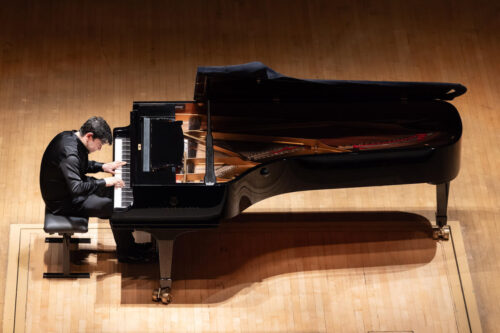
 United States Various: Behzod Abduraimov (piano). Orchestra Hall, Symphony Center, Chicago, 2.11.2025. (ZC)
Brahms – Four Pieces for Piano, Op.119
Czerny – Variations on a Theme by Rode
Liszt – Après une lecture du Dante: Fantasia quasi Sonata
Debussy – Suite bergamasque
Stravinsky – Three Movements from Petrushka
When Beatrice Rana withdrew from the Symphony Center Presents series earlier this autumn, the organizers called upon Behzod Abduraimov to fill this prominent slot in the season. And that decision proved fortuitous for those who attended his recital on Sunday afternoon.
Abduraimov is no newcomer to the international circuit. His victory at the 2009 London International Piano Competition launched a career that has proceeded steadily upward since then. Now 35, the Uzbek-born pianist has established himself among the premier keyboard artists of his generation. He has performed twice at Ravinia and appeared in Symphony Center’s piano series in 2019. His Chicago Symphony Orchestra debut, delayed by the pandemic, finally materialized in 2024.
The program Abduraimov assembled for the recital suggested a particular sensibility. It opened with Brahms’s Four Pieces for Piano and closed with Stravinsky’s Three Movements from Petrushka. Between these poles came a Carl Czerny curiosity – Variations on a Theme by Rode – as well as Debussy’s Suite bergamasque and Liszt’s Après une lecture du Dante: Fantasia quasi Sonata (‘Dante Sonata’). The selections pointed toward a pianist more interested in refinement than spectacle, in expressivity rather than overwhelming virtuosity.
That impression proved accurate. What the recital lacked in pyrotechnics, it offered instead in delicate phrasing and tonal sensitivity. Abduraimov’s approach to the Brahms resisted the autumnal cliché that attaches itself to the composer’s late piano works. Instead, his playing captured the sense of music that simultaneously looks backward and forward, nostalgia inflected with uncertainty. The phrases emerged with careful attention, each gesture weighted but never heavy.
Debussy’s Suite bergamasque, which opened the second half, poses its own challenges, particularly in its famous third movement, ‘Clair de lune’. The piece’s popularity has made it vulnerable to sentimentality, and even mediocre performances can satisfy an audience predisposed to affection for it. Abduraimov’s reading avoided that trap. His touch produced a sound both hazy and clearly articulated, achieving the paradoxical quality that Debussy’s best interpreters manage; music that shimmers without losing its outline.
Liszt’s ‘Dante Sonata’ which closed the first half received similar treatment. The work demands considerable technical resources, and Abduraimov certainly possesses them. But his interpretation emphasized the score’s lyrical passages, lavishing care on Liszt’s melodic writing in ways that provided contrast with the more turbulent sections. The result was a performance that balanced hellish drama with moments of genuine tenderness, the shifts between them rendered without exaggeration.
The Czerny Variations, which is less frequently encountered in recital programs, offered a glimpse of early nineteenth-century virtuosity. Though the work itself lacks the depth of its neighbors on the program, Abduraimov navigated the technical demands with ease. The piece served its purpose as a diversion, a reminder of the tradition from which the more substantial works emerged.
The recital’s second half belonged to Stravinsky. Three Movements from Petrushka is notorious for its difficulties – a transcription that asks the pianist to simulate orchestral textures while maintaining rhythmic vitality. Abduraimov attacked it with mechanical precision, his playing taking on a more urgent character than anything that had preceded it. Yet, even here, his refined touch and attention to color were evident. The cascading passages sparkled without becoming brittle, the folk melodies embedded in the score emerged clearly from the surrounding complexity.
When he finished, the audience rose immediately. They recognized, perhaps, that what they had experienced differed from what they might have expected from Rana, whose performances often emphasize muscular virtuosity. But the afternoon proved no less satisfying for that difference. Abduraimov returned for two encores: Rachmaninoff’s Prelude No.5 in G major and Liszt’s ‘La campanella’. The latter, with its leaping intervals and glittering passagework, finally gave those who had come seeking fireworks their satisfaction. But it was the quieter pleasures of the afternoon that lingered, the sense of a musician who understands that poetry and precision need not exclude each other.
Zach Carstensen
The Sunday afternoon piano recitals at Orchestra Hall always feature a exceptional pianist. Thank you for explaining what made Abduraimov’s performance beyond exceptional.
Thank you for the comment John!