 Austria Debussy, Pelléas et Mélisande: Soloists, Vienna State Opera Chorus and Orchestra / Alain Altinoglu (conductor). Broadcast live (directed by Ella Gallieni) from Vienna State Opera, 2.11.2025. (JPr)

I have only seen Debussy’s Pelléas et Mélisande twice in the opera house and not since one of my last visits (don’t ask) to Opera Holland Park which was in 2010. The 1902 opera has eluded any great popular acceptance and on hearing it once more it confirms for me how more strongly it is influenced by Wagner’s epic music dramas than some commentators are – and even the composer was himself – willing to admit. Even though Debussy exclaimed Pelléas was ‘after Wagner’ and not inspired by him it appears he was, at least initially, a passionate Wagnerian who – like many of us – made repeated ‘pilgrimages’ to Bayreuth. Though undoubtedly remaining – also like many of us – anything but uncritical.
While seeking to emulate the German master, although in a French manner, Debussy was clearly under the spell of Tristan und Isolde and Parsifal when he wrote his masterpiece. The libretto for Pelléas, his only completed opera, was a five-act prose drama by Maurice Maeterlinck, a work inherently rife with symbolism, even if it is not entirely clear exactly what the symbols represent here and there. Thoughts on this are beyond the scope of this review and best left to another occasion; perhaps let us concern ourselves more with how Debussy unravels his simple, sombre and downbeat tale much too slowly, occasionally testing the listener’s patience.
The widower Golaud, father of the young Yniold and son of old King Arkel d’Allemonde is lost in the woods. He stumbles across a girl, Mélisande, sobbing by a pool of water in which she has lost her golden crown. Golaud never finds out much more about her except that she was, apparently, severely abused in the past. (This is a theme director Marco Arturo Marelli develops when a pregnant Mélisande is later physically abused and almost raped by Golaud and when she suffers the unwanted attentions of Pelléas’s father and Arkel too.) Golaud marries Mélisande but she seems far happier in the company of her husband’s younger half-brother, Pelléas. The relationship between stepbrother and his new wife seems mostly chaste but it [spoiler alert] eventually drives Golaud to fratricide. The only physical manifestations of Pelléas and Mélisande’s feelings for each other are in the opera’s most memorable scene, in which – according to the libretto – she tosses her long golden tresses from a tower for Pelléas to caress erotically; and then when they eventually kiss. When Mélisande dies after giving birth to a daughter, the tortured Golaud is left literally holding the baby … but whose child is it?
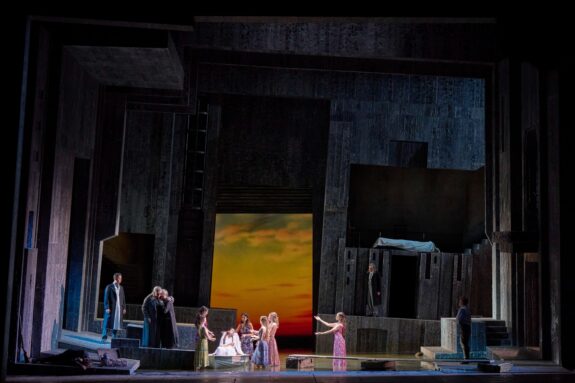
Marco Arturo Marelli’s production (he was also responsible for the set and lighting) premiered in 2017 but has not been seen in Vienna since that initial run of performances. The Vienna State Opera’s website suggests the following about what you see: ‘Debussy made water a characteristic feature of Pelléas et Mélisande. At the same time, all the characters are portrayed as being internally enclosed, lonely and isolated. Director and set designer Marco Arturo Marelli responded to this with a stage space reminiscent of a bunker flooded with water, a secluded retreat full of diffuse depth that reflects all the shades, refractions and reflections of Debussy’s musical language. But there is hope for the light, hope for a new tomorrow. A utopian horizon towards which Mélisande drifts in the end.’
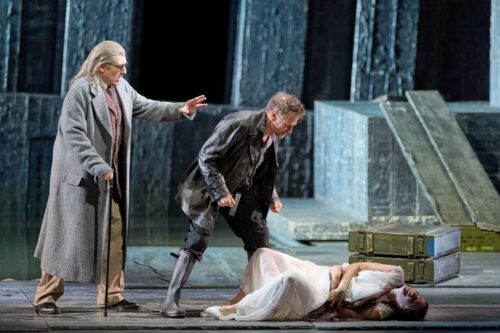
Indeed, the imposing, geometrically shaped walls of the rarely changing set are uniformly grey and there is indeed a lot of water; several planks for characters to negotiate crossing it from one side to the other; as well as an almost ever-present boat. Mélisande is discovered by a suicidal Golaud on it; she encourages Pelléas whilst the boat is on trestles (rather than from a window); she paddles along in it (pulled by Pelléas lying in the water!); and dies in the boat before (almost literally) sailing off into the sunset surrounded by several mourning ladies, rather like King Arthur’s final voyage to Avalon. The boat also is used as a ladder up to Mélisande’s room for Golaud and Yniold to spy on her and Pelléas.
Marelli appears to be showing us a family in crisis for one reason or another, similar as you those you might encounter in, for instance, the works of Strindberg, Ibsen or Turgenev, or the films of Bergman. Not featuring in the original libretto is Pelléas’s father shown apparently gravely ill at the start yet who later recovers, plus some henchmen for Golaud who will be seen threatening Pelléas at one point. The costumes created by the director’s wife, Dagmar Niefind-Marelli, have Mélisande simply dressed in a white shift-like dress, while other characters are in muted colours until the final scene. Debussy believed opera should have ‘mobile scenes’ and accused some of having too much singing, as a result the five acts of Pelléas comprise several short confrontations in scenes divided by interludes frequently utilising a black iris-like solid front ‘curtain’ to close the stage off. The performance therefore had a start-stop-start quality to it.
Debussy’s dreamlike, atmospheric, and often angst-ridden music is impressionistic to the degree that it is often reminding you of other composers: notably of course Wagner from the fleeting hint of the Rheingold E-flat opening in the cellos as Pelléas begins, soon there is the Forest Murmurs and the ascent to Brϋnnhilde from Siegfried. Pelléas’s wandering through the castle and the interludes will have you thinking of Parsifal and while Mélisande’s death brings Tristan Act III to mind there is more that will remind you of Violetta in Verdi’s La traviata. You will also think about Wagner because of the water, the boat (Lohengrin), the ring (Mélisande drops in the water), the significance of light (Tristan again), the widower (though Golaud is not childless as Hans Sachs is), the love-triangle and a possible inappropriate relationship (here not between siblings but Melisande and her husband’s brother), and finally Pelléas getting struck down with a sword (Golaud’s and not Melot’s as in Tristan).
Alain Altinoglu returned to conduct this staging after eight years and – with the support of the incomparable Vienna State Opera Orchestra – it was a darkly-dramatic, extremely coherent account of Debussy’s music with its seemingly natural ebb and flow. This was exactly what the composer intended with his score so dependent on the natural speech rhythms of the French language. As heard through loudspeakers, Altinoglu proved sensitive to his cast and I suspect if you were a French speaker almost every syllable of Maeterlinck’s text would have been clear to you, despite there being only one French singer in the cast.
The wonderful mezzo-soprano Kate Lindsey was Mélisande and was near perfect as the mysterious girl found weeping. Finding the decaying dynasty she has married into stifling and sometimes threatening Mélisande yearns to break free and Pelleas offers that chance of escape. Lindsey with fine control and singing plaintively throughout had her finest moment – among many fine moments – with her truly unforgettable, whispered sigh of love for Pelléas (‘Je t’aime aussi’)’. Because of the differing energies they brought to their roles there wasn’t a lot of chemistry between Lindsey and Rolando Villazón’s sappily romantic, dysfunctional, overgrown schoolboy-like Pelléas. Villazón was … well, his very familiar charismatic self. If Villazón was not exactly the singer of old it was wonderful to hear him – as perhaps a baritenor now – singing such a long role so ardently and securely, even if occasionally he was a little shouty. Also returning from 2017 was veteran Sir Simon Keenlyside who was another undoubted star of this Pelléas as the grizzled, haunted and volatile Golaud. Clearly a bully to his ‘trophy wife’ even though he appeared to care for her. Keenlyside’s Golaud was quick to anger even though Mélisande was distraught about the missing ring, and he lost the plot when catching the younger ones in a compromising situation. Throughout, Keenlyside used a still lyrical baritone – though now with just a hint of gravel – assuredly, expressively and with vocal authority.
Minor roles were taken admirably by sonorous French bass Jean Teitgen as the initially ailing Arkel. (He begins in a wheelchair and attached to a drip, yet recovers rather like Pelleas’s father.); by Zoryana Kushpler as Geneviève and, especially by the confident – somewhat older than her character is supposed to be – young soprano Hannah-Theres Weigl as Golaud’s high-spirited, if somewhat traumatised son, Yniold who saves Golaud from killing himself at the end of the opera.
Jim Pritchard
Featured Image: Vienna State Opera’s Pelléas et Mélisande (final scene) © WS/Michael Pöhn
Cast:
Arkel – Jean Teitgen
Geneviève – Zoryana Kushpler
Pelléas – Rolando Villazón
Golaud – Sir Simon Keenlyside
Mélisande – Kate Lindsey
Little Yniold – Hannah-Theres Weigl
Doctor – Dohoon Lee
Pelléas’s father – Frédéric Machto
Production:
Director, Set designs & Lighting – Marco Arturo Marelli
Costumes – Dagmar Niefind-Marelli
Chorus master – Jozef Chabroň