
 United Kingdom Wagner, Howard, Berlioz: Jess Gillam (saxophone), Bournemouth Symphony Orchestra, Mark Wigglesworth (conductor). Bristol Beacon, 6.11.2025. (CK)
Wagner – Overture, Das Liebesverbot
Dani Howard – Saxophone Concerto
Berlioz – Symphonie Fantastique
It would take a very expensive firework display to match the excitement generated by these performances by Mark Wigglesworth and the Bournemouth Symphony Orchestra, with the additional presence of Jess Gillam, one of the brightest, most popular and most accessible stars in the classical musical firmament. A repeat of the previous evening’s programme in Poole (where Dani Howard’s Saxophone Concerto had had its UK premiere), it had delight and discovery written all over it.
There used to be a programme on BBC Radio 3 called The Innocent Ear: Robert Simpson would withhold the composer’s name until the end of a piece, and we all had fun guessing. I would never have attached Wagner’s name to the Overture to his early opera Das Liebesverbot (Hidden Love): an Offenbach galop, perhaps, though ominous sounds from the heavy brass brought a whiff of Berlioz. It is a playful, exciting piece, devoid of the portentousness Wagner’s music was soon to acquire. I am very glad to have had the opportunity to hear it – especially as it provided immediate evidence that Wigglesworth and the BSO were at the top of their game.
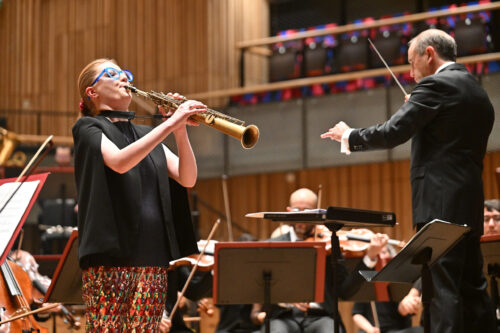
Dani Howard is the BSO’s Celebrated Composer for this season. An exciting pairing: I well remember her spectacular Ascent, played in January last year by 17 French horns of the National Youth Orchestra in the Barbican as a prelude to Richard Strauss’s Alpine Symphony. Her Saxophone Concerto, commissioned jointly by the BSO and the Royal Stockholm Philharmonic Orchestra, was written for the irrepressible Jess Gillam: who, I have no doubt, will delight audiences all over the world with it, as she delighted us.
In three movements and lasting a little under twenty minutes, scored for a reduced but still colourful orchestra (woodwind and brass in pairs), the concerto purports to sketch and celebrate the achievement of the saxophone’s inventor Adolphe Sax – his creativity, his struggles, his legacy: it also fits Gillam’s personality like a glove. In the first movement a recurring three-note figure has her diving and then soaring while the orchestra surrounds her with bright clouds of sound; the mellow-toned marimba, played with hammers or with a violin bow (sometimes two), seems to act as a sonic soulmate for the solo instrument. In her programme note Howard writes of ‘spirited exchanges’ expressing ‘exploration, playfulness and determination’: it was all there in the music, Gillam’s most dazzling leaps and runs expressive of energy, personality, heart, never merely display.
In the second movement Gillam’s virtuosic cadenza was accompanied by flying woodwind, supported by a gentle groundswell in the strings, making its way through contrasting sonic landscapes before coming to rest above soft timpani and a dark haze from cellos and double basses. The finale was an explosion of rhythmic energy, slapped strings, freewheeling virtuosity: an unmistakable and infectious expression of joy. The orchestra clearly loved Gillam (we all did): she paid warm tribute to them, and to Mark Wigglesworth, whom she remembered as kind and supportive at the Final of the 2016 BBC Young Musician of the Year, before playing one of the pieces she had performed then. In a world that seems to be growing darker, we should be grateful for people like her.
If I had any lingering doubts about Wigglesworth’s rapport with the orchestra, or whether he has lost some of the fire with which he was conducting twenty years ago and more (I remember a couple of London Turangalîla Symphonies, a Die Meistersinger at Covent Garden, a Lady Macbeth of Mtsensk at English National Opera), the performance of Berlioz’s Symphonie Fantastique after the interval put them permanently and emphatically to flight. There was an appreciative tapping of bows on music stands as Wigglesworth appeared; the performance that followed was sensational.
Conducting from memory, he inspired such precision and intensity from the strings in the first movement that it already sounded like music on the edge: passionate, convulsive, powered by extraordinary sounds from the double basses. I have never heard it so enthrallingly performed. The waltz followed immediately, with no time for us to adjust: the music’s beauty – the row of four harps as seductive to the eye as to the ear – had just the right hallucinatory quality. The pastoral Adagio brought balm, and melancholy too, with the lovely cor anglais solo over a barely audible tremolo in the violas (gorgeous sounds from them and the cellos in this movement). Pathos was tinged with menace as the cor anglais returns but the oboe that had responded earlier disappears, ominously replaced by muffled thunder.
The last two movements are as thrilling as anything in the orchestral repertory, and Wigglesworth and the orchestra delivered. The heavy brass and percussion came into their own, and (one tiny trumpet fluff aside) they played magnificently. The wonderful Beacon acoustic, which had imparted such depth and bloom to the string playing in the earlier movements, enabled us to appreciate in particular Berlioz’s imaginative writing for his quartet of bassoons (led by Tammy Thorn); and it gave extra vividness to the music’s visions of grotesquerie and horror, maximising the ferocity of the playing right up to the final cataclysm, with bellowing tubas and those implacable bells sounding from offstage.
An evening of enthralling music and world-class playing: the finest I have heard from Wigglesworth and the BSO. I can hardly wait for an opportunity to hear them again.
Chris Kettle
Hopefully, there will be a recording of this which will be available in the near future.
The overseas fans of Jess would be forever grateful.
Gaston