
 Germany Wagner, Das Rheingold: Soloists, Gürzenich-Orchestra / Marc Albrecht (conductor). Cologne Opera, 6.11.2025. (DM-D)
Director Paul-Georg Dittrich’s central idea for this new production of Das Rheingold were intriguing. The titular gold was not a heap of matter, but a group of children. The characters of the opera, Wotan and the gods of Valhalla, Alberich, Mime and Erda, initially arose from those children’s collective imagination. They were thus dressed in very brightly coloured costumes (wittily designed by Mona Ulrich). Their characters’ environments, also as imagined by the children, were equally colourful, like pop-ups in fairy-tale books.
Scene 1 established this framework, with the children accompanying the Rhinemaidens and Alberich, one child lip-synching each text sung by the singers, who were dressed in contemporary black formal outfits, as if appearing at a concert performance. Four pillar-like screens showed colourful videos of different bodies of water. While for this first scene the stage was vast and empty, using the entire stage space for the second scene zoomed in on the gods in their colourful pop-up environment, with curtains drawn in such a way as to reveal the action in a space that had the shape of an eye. Against a blue background of clouds, Wotan sat on a moon sickle, Donner and Froh were cartoon characters, Fricka resembled a queen, Freia a petulant princess, Fasolt and Fafner arrived on a mini-digger, wearing dollar medals on gold chains, and Loge appeared on stage through a door with a flame painted on it, dressed accordingly in a flame-coloured three-piece suit, a kind of conferencier/show-master.
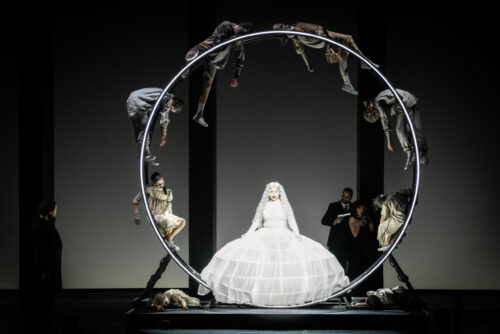
The children later became Alberich’s slaves and were seen arranged on a giant wheel (the ‘ring’), as if broken by it. When Erda appeared, they sought shelter and protection under her huge petticoat. The gods’ entry into Valhalla was represented in videos of dystopian content on the screen pillars. I expect the subsequent parts of the Ring cycle will reveal whether the suffering and exploitation of the children was in fact part of their game, of their imagination or of having to leave a sheltered childhood as part of growing up.
In the spatial arrangement with the orchestra on the same level as the front row of the stalls and only slightly lower than the stage, both orchestra and conductor were in full view of the audience at all times. Marc Albrecht led the orchestra with visible joy. In musical terms, the overriding impression was, suitably in line with the visual framework, one of playfulness. A group of children, of course at the levels of adult expertise, explored the score, relished it full blast, savoured subtle nuances, discovered new things, revelled in moods, listened intently to their peers, and developed the different Leitmotifs and their variations with intellectual rigour. They did all this with an awareness, at all times, of their interaction with the singers.
The cast members had one major thing in common: their voices were all very much on the lighter, slimmer, leaner side of the potential spectrum, especially for Wagner. Please note that I did not say ‘weaker’! The orchestra took heed not to dominate, let alone drown out their voices. The musicians relished their interplay with the voices. Mauro Peter was Loge. He had sung Loge this role under Nagano in an historically-informed Ring (review here). Most recently he sang Tamino to great acclaim (see reviews here and here). His was a very lyrical rendition, a fresh interpretation compared with many character tenors who often sing this part. Jordan Shanahan gave his role debut as Wotan. He emphasised more gentle aspects of his character, made him come across as thoughtful, pained by some of his earlier decisions, not quite serious with some of his pronouncements, genuinely impressed by Erda, and relieved to enter Valhalla. Shanahan’s voice was strong, mellifluous, pliant, well aware of the beauty of the long arcs of music Wagner composed for Wotan in Rheingold, and able to sustain them technically very well without obvious intakes of breath, for example in ‘Zu mir, Freia…’ and ‘Abendlich leuchtet der Sonne Auge’.
Daniel Schmutzhardt sang Alberich with a good transition from harmless-lyrical beginning in his interplay with the Rhinemaidens to his dramatic cruelty later on. Martin Koch presented Mime with a firm, even and thus ultimately very pleasant voice, bringing out the beauty of the music written for him, rather than, as is often the case, seeking to demonstrate the character’s suffering with an unpleasantly whining voice. Christoph Seidl and Sami Luttinen brought their strong voices to Fasolt and Fafner, respectively, suitably representing the initial double act with their banter, which got out of control once the impact of the ring took hold. Seidl’s slightly lighter voice was appropriate for the lovesick giant, while Luttinen’s more sonorous singing did full justice to Fafner. Miljenko Turk and Tuomas Katajala gave reliable support in their respective roles of Donner and Froh.
Bettina Ranch as Fricka captivated the audience with the clarity and radiance of her voice. Emily Hindrichs sang Freia with youthful abandon and a good amount of the petulance of a spoilt princess. Adriana Bastidas-Gamboa impressed with her resonant mezzo-soprano. Both visually and vocally, this was a young and attractive character, contrary to a more common decision to have Erda as an older woman, or an ageless creature. Giulia Montanari, Regina Richter and Johanna Thomsen were both playful and dignified as the Rhinemaidens, singing with a strong sense of the architecture of the music.
In conclusion, this intriguing production of Das Rheingold should allow for the three remaining parts of the Ring to develop in equally meaningful ways: there is certainly a sufficient number of ideas to pick up on. This Rheingold lays the foundations but imposes no restrictions.
Daniel Meyer-Dinkgräfe
Featured Image: Emily Hindrichs (Freia), Tuomas Katajala (Froh), KS Miljenko Turk (Donner), Bettina Ranch (Fricka), Mauro Peter (Loge), Jordan Shanahan (Wotan), Lucas Singer (Fafner) and Christof Seidl (Fasolt) © Matthias Jung
Production:
Director – Paul-Georg Dittrich
Set design – Pia Dederichs, Lena Schmid
Costume design – Mona Ulrich
Videos – Robi Voigt
Lighting design – Andreas Grüter
Movement coach – Paolo Fossa
Dramaturgy – Svenja Gottsmann
Cast:
Wotan – Jordan Shanahan
Alberich – Daniel Schmutzhard
Loge – Mauro Peter
Fricka – Bettina Ranch
Freia – Emily Hindrichs
Erda – Adriana Bastidas-Gamboa
Donner – Miljenko Turk
Froh – Tuomas Katajala
Mime – Martin Koch
Fasolt – Christoph Seidl
Fafner – Sami Luttinen
Woglinde – Giulia Montanari
Wellgunde – Regina Richter
Flosshilde – Johanna Thomsen
Child extras – Maja Besikci, Marie Blank, Zoë Camara, Minay Demirel, Anton Egbers, Frederick Egbers, Hanna Frössler, Neva Mergen, Lily Oppat, Paula Passavanti, Luisa Ruson, Marie-Claire Tenten, Noah von Laufenberg, Helene Wörenkämper, Firat Yücel, Paulo Zdebel, Pino Zdebel