
 Romania George Enescu International Festival 2025 [1] – Mozart, Die Zauberflöte: Soloists, Chorwerk Ruhr, Deutsche Kammerphilharmonie Bremen / Tarmo Peltokoski (conductor). Romanian Radio Hall, Bucharest, 7.9.2025. (ES-S)
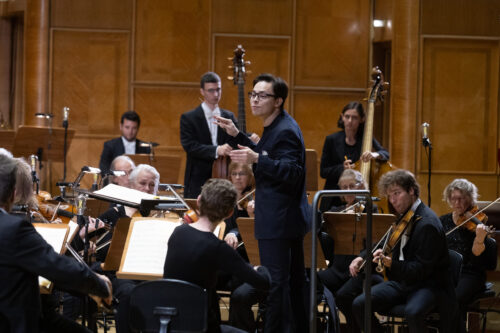
In a 2024 interview, Tarmo Peltokoski recalled that the first work he ever conducted, at just fourteen, was Mozart’s Die Zauberflöte. ‘It is a work I love to this day’, he added. That formative bond seemed to shape this performance at the Romanian Radio Hall, one brimming with youthful passion and musical clarity.
The semi-staged format came with the inherent advantages and limitations of the genre: in principle, it encouraged the audience to listen with undivided attention to the score, while forgoing the rich imagery of a full production. In practice, there were moments of distraction, ranging from the suggestive to the superfluous, in the mise-en-scène credited to director Romain Gilbert and lighting designer Hervé Gary.
The opening tableau was conceived with wit and imagination: Tamino faced a snake whose mirror head and body were formed by the Three Boys. The creature was dispatched by the Three Ladies, each pulling one boy by the ear and hauling him offstage. Other interventions successfully highlighted the comic side of Die Zauberflöte, such as the inventive use of flashlights and bulbs or the conductor briefly taking over Papageno’s Vogelflöte and Glockenspiel. On the other hand, while most of the group movements were both coherent and suggestive, Peltokoski’s joining in a dance with Monostatos’s acolytes – baton clenched between his teeth – crossed into the ridiculous.
The absence of supertitles left much of the Romanian audience – likely unfamiliar with the plot’s intricacies – struggling to follow the narrative. As a substitute, several passages, particularly Papageno’s lines, were delivered in English, a solution of doubtful effectiveness further weakened by gratuitous quips about Romanian food and wine.
Although often treated as a singspiel hovering on the edge of opera buffa, Die Zauberflöte is far more than light amusement. Its comic surface – Papageno’s jokes, the enchanted instruments, the playful duets – coexists with an allegorical depth that reaches toward Enlightenment ideals of reason, brotherhood and moral trial. Beneath the fairy-tale trappings lies a score that balances innocence with solemnity, humor with transcendence, and it is precisely this equilibrium that makes the work so challenging to bring off convincingly. This semi-staged production tilted more toward entertainment than allegory: tellingly, it was Papageno, not Tamino, who took the final bow. Afterward, Peltokoski was called on the stage and, in turn, he invited the flutist – Tamino’s musical alter ego – to join the soloists, a gesture that gracefully shifted the focus back to the music.
From the first bars of the overture, the Deutsche Kammerphilharmonie Bremen projected a high degree of well-controlled energy. With only three double basses – placed behind the cellos on the left and the second violins on the right – the orchestra achieved an uncommon transparency and balance. Tempi were brisk without feeling rushed, rhythms had both snap and lift and textures remained lucid. The strings played with springy elegance, the woodwinds spoke with conversational ease, and brass and timpani added brilliance without ever covering the singers. Above all, Peltokoski breathed with his cast: arias unfolded with lyrical space, most touchingly in Pamina’s ‘Ach, ich fühl’s’, while ensembles retained dramatic urgency. His alert and responsive direction turned what might have been a static concert into living theatre. ChorWerk Ruhr contributed with equal discipline, their blended sound giving weight to the ritual scenes and nobility to the opera’s closing vision of harmony.
Kathryn Lewek confirmed once more why she is regarded as today’s reigning Queen of the Night. She made a clear distinction between the two arias which resemble each other only on the surface. In ‘O zittre nicht’, addressed to Tamino, her voice combined crystalline accuracy with an unexpected warmth that lent the Queen’s pleas a deceptive tenderness, almost a maternal solicitude. By contrast, ‘Der Hölle Rache’, hurled at Pamina, was all steel: the fearless top notes, incisive coloratura and biting rhythm conveyed unbridled rage rather than mere virtuoso display. Gestures sharpened the contrast – poised and contained in the first aria, explosive and imperious in the second. What impressed most was the dramatic clarity of the opposition: the same technical arsenal put to opposite expressive ends, persuasion turning to fury, brilliance hardening into menace.
Elsa Dreisig brought a luminous sincerity to Pamina that contrasted beautifully with the Queen’s severity. Her voice projected a silvery, pliant line, even across dynamic shifts, and her phrasing had an unaffected naturalness that made the character’s emotions believable. The highlight was ‘Ach, ich fühl’s’, sung with an exquisite balance of fragility and control: the legato line flowed with aching inevitability, each phrase tinged with resignation yet never exaggerated into melodrama. Dreisig conveyed despair not by vocal weight but by expressive transparency, letting the music’s simplicity speak for itself. Barefoot and costumed like Tamino in garments divided between white and black, she embodied the struggle between light and darkness, underscoring the character’s moral testing and the choices set before her.
Prince Tamino, a symbol of the struggle between black and white and of the journey toward enlightenment, was sung with refinement by Mauro Peter. His interpretation was marked by elegance rather than heroic weight. The lyric tenor projected cleanly into the hall, with a bright edge that lent freshness to the Portrait Aria. Phrasing was supple, diction crisp and the line always shaped with elegance. If the role sometimes invites a more ardent presence, Peter’s approach emphasized nobility, blending seamlessly with Dreisig in their duets.
Baritone Äneas Humm brought much more to his interpretation of Papageno than comic flair. His warm, velvety tone gave substance to the birdcatcher’s playful lines, while his natural ease on stage allowed him to engage the audience without forcing the humor. He moved with lightness, let comedy emerge from the situation rather than exaggeration and revealed a touching sincerity in his moments of loneliness. In the duets with Pamina and Papagena, he balanced charm with tenderness, shaping a portrayal that anchored the opera’s fantasy in genuine human feeling.
Bass Manuel Winckhler imbued Sarastro with authority, his low notes anchoring the score’s solemn moments with steadiness and gravitas. Andreas Conrad was a rather undistinguished Monostatos, his portrayal never quite escaping caricature. By contrast, Miriam Kutrowatz was spry and ebullient as Papagena, her light soprano and quick stage presence enlivening every appearance. The Three Ladies – Silja Aalto, Iris Van Wijnen, and Maria Seidler – blended securely in ensemble while maintaining individual characterizations, and the Three Boys sang with clear intonation and youthful brightness. These supporting voices contributed both to the opera’s ritual atmosphere and to the balance between lightness and solemnity that underpins the drama.
This Die Zauberflöte thrived on the cohesion of its interpreters, the refined radiance of the orchestra and Peltokoski’s youthful drive.
Edward Sava-Segal
Featured Image: Äneas Humm (Papageno), Elsa Dreisig (Pamina) and the Deutsche Kammerphilharmonie Bremen © Petrica Tanase
Production:
Director – Romain Gilbert
Lighting – Hervé Gary
Chorus director – Michael Alber
Cast:
Sarastro – Manuel Winckhler
Queen of the Night – Kathryn Lewek
Pamina – Elsa Dreisig
Tamino – Mauro Peterț
Papageno – Äneas Humm
Papagena – Miriam Kutrowatz
Monostatos – Andreas Conrad
Speaker / Second Man in Armour – Marcell Bakonyi
First Lady – Silja Aalto
Second Lady – Iris van Wijnen
Third Lady – Marie Seidler
Second Priest – Maximilian Fieth
First Man in Armour – Martin Loger
The Three Boys – Soloists of St. Florianer Sängerknaben