
 United States Various, ‘Artist Recital Series’: Danish String Quartet: Frederik Øland, Rune Tonsgaard Sørensen (violins), Asbjørn Nørgaard (viola), Fredrik Schøyen Sjölin (cello). Finney Chapel, Oberlin College, Oberlin, 21.11.2025. (MSJ)
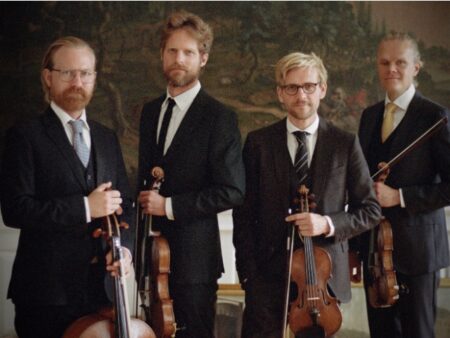
Stravinsky – Three Pieces for String Quartet
Johnny Greenwood – Suite from There Will Be Blood
Beethoven – String Quartet No.16 in F major, Op.135
Arr. Danish String Quartet – original compositions and traditional tunes
You have to hand it to an ensemble that decides to try a new twist while they are waiting backstage before the concert begins. That is what the Danish String Quartet’s Rune Tonsgaard Sørensen announced when the renowned ensemble took the Finney Chapel stage for the latest installment of Oberlin College’s long-running Artist Recital Series. It was time for a mashup.
Backstage, they had decided that instead of performing Igor Stravinsky’s Three Pieces for String Quartet and Johnny Greenwood’s suite from the score for the film There Will Be Blood in succession, they would instead interleave movements from the two works, without announcing which was which. It proved a brilliant idea, the acerbic Stravinsky working in the context of the more colorful Greenwood score because of the uncanny way both works refused to stay in their lane. Stravinsky cited the third movement chorale of his set as the most beautiful piece he ever wrote, while Greenwood shrewdly judged where his cinematic music needed psychological distortion, in places turning it more unsettling than Stravinsky’s spiky harmonies. If they keep the mashup (and they should), I nominate a title: There Will Be Blood-y Stravinsky.
Lest anyone think the quartet only specializes in modern music, they turned in an outstanding performance of Beethoven’s final string quartet, starting off serene and whimsical but loading enough disruptive power in the repeated note stabs of the second movement to ensure that when the repeated notes regrouped and attempted to waylay Beethoven’s defiantly upbeat finale, the battle was visceral. The group played with warmth and tenderness in the lyrical slow movement, changing to chill as the questioning introduction to the finale undermined the serene mood. Through the entire range of the work the Danes played with poise, focus and commitment.
The second half of the concert was given over to original compositions and traditional tunes not credited in the program, perhaps because they were selecting what to play on the fly. The Oberlin audience, which packed the chapel, featured many young music students who clearly know the quartet’s work well. One of them approached the stage at intermission and left a printed request for a particular song from one of the group’s early albums which violinist Frederik Øland took delight in, noting that they hadn’t played it in a long time. He also explained the ensemble’s approach, using traditional music (and sometimes composed music, such as a song from Turlough O’Carolan) from Denmark, Sweden, the Faroe Islands and other northern places as the base for their arrangements. These well-shaped arrangements mix folk fiddling, classical textures and a drive approaching pop dance music, as evidenced by the swaying and head-nodding students.
The momentum was irresistible, and the end of the concert was met with a standing (and stomping) ovation. The quartet responded with a thoughtful and clever arrangement of the Irish folk tune ‘Danny Boy’, which undermined the famous Percy Grainger build-up and took the music off to a more distant realm. An outstanding concert, and we must hope their first visit to Oberlin will not be their last.
Mark Sebastian Jordan