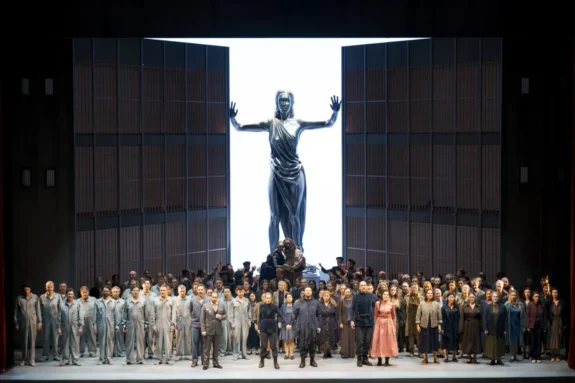
 Austria Beethoven, Fidelio: Soloists, Chorus and Orchestra of Vienna State Opera / Franz Welser-Möst (conductor). Broadcast live (directed by Dominik Kepczynski) from Vienna State Opera, 19.12.2025. (JPr)

The last new Fidelio production at Vienna State Opera – from Otto Schenk with sets by the equally legendary Gϋnther Schneider-Siemssen – premiered on 24 May 1970 and was conducted by Leonard Bernstein and starred James King (Florestan) and Gwyneth Jones (Leonore). It had the last of its over 250 performances 55 years later and as recently as May this year. Whether this new production by Austrian theatre director and puppeteer Nikolaus Habjan will survive for a tenth of this number will, I suspect, depend on the tolerance of Viennese operagoers.
Beethoven lived at the time of the European Enlightenment and the Industrial – and particularly significantly for him – the American and French Revolutions. It is very likely that he was in favour of the ideals of the latter two yet would have deplored the loss of life. French revolutionary leaders had encouraged opera to tell the stories of heroes resisting oppression – so-called ‘rescue operas’ – and Fidelio is one of those. In the composer’s 1802 letter to his brothers, the Heiligenstadt Testament, he writes about deafness, solitude and how he may never fulfil his artistic destiny. Following on from this, Fidelio could be considered Beethoven’s musical ‘testament’ of his personal philosophies about moral behaviour, human freedom, the faithfulness of a woman – Beethoven’s ‘immortal beloved’ – and the struggle against oppression and corruption in society. Just like the Heiligenstadt Testament a few ‘love letters’ – revealing his love and devotion for an unknown woman – were only discovered after Beethoven’s death in 1827. It took Beethoven almost ten years to complete Fidelio and it encompasses everything he believed in and wanted to fight for or against.
Fidelio has its origins in Jean-Nicolas Bouilly’s French libretto Léonore, ou L’amour conjugal telling of Leonore, and her husband, Florestan, who is being illegally held in a prison. She disguises herself as a man, Fidelio, to get a job there in the hope of saving him. In its various versions, it went from three acts to two, the title was changed, and it had four separate overtures. We are left with something one step beyond Mozart’s masterpieces on the operatic road to Wagner; ‘proto-Wagner’, if you will, something confirmed by that composer’s nonsense that he once saw the soprano Wilhelmine Schröder-Devrient as Leonore when he was just 16! Whatever Wagner saw her first in, she was to become his muse and she went on to create a few roles for him.
Nikolaus Habjan’s production (with sets by Julius Theodor Semmelmann) unfolds as the backdrop to a sublime musical performance from the singers and orchestra. It seems to employ every current directorial cliché imaginable, including; an oppressive state controlled by an unremarkable, grey-suited bureaucrat and his back-bereted, armed henchmen, ominous grey walls, nondescript uniforms, a tiled room where the prison warden Rocco’s daughter gathers the belongings of those being incarcerated, and prisoners in 42 individual cells on three levels holding masks suggesting they are faceless. Even more significantly, there are two huge, odd-looking puppets for Leonore/Fidelio and Florestan, with ashen faces and huge hands. There is also Rocco’s cosy sitting room and as he sings his ‘gold’ aria he gets the trinkets he has confiscated from all the surrounding lockers, as well as the fridge, a cushion and as the pull chain on a lamp. There is a room full of the prisoners’ files and for the second act a claustrophobic dungeon for Florestan accessed by a rear staircase, rather like a cistern for John the Baptist in Salome; and indeed the puppet Florestan with lanky, filthy-looking hair and unruly beard, as well as tattered white prison clothes, looked very much like the prophet. This was not mirrored by the singer David Butt Philip who appeared on the stage as if he had just walked into a rehearsal, albeit in rather tattered dark clothes!
Paulus Hochgatterer’s adapted dialogue was shared between singer and puppet(eer) and the large figures were manipulated by the singer and/or one or two puppeteers. Occasionally they mouthed the words sung too. Characters responded to the puppet Fidelio or Florestan while the singer often interacted with their (sort-of) doppelganger. It was rather confusing and distracting and my eyes didn’t know where to settle. It would be quite an interesting staging without the puppets in my opinion, because they sometimes overshadowed the two leading singers. For the celebratory ‘O namelose Freude’ in the restricted space of Florestan’s dungeon – when Florestan has been saved from the tyrannical Don Pizzaro by the deux ex machina arrival of the minister of state Don Fernando – close together are two singers, two puppets and three puppeteers! This cluttering of various scenes happened too often during this new Fidelio.
As suggested above, musically things were an entirely different matter: Franz Welser-Möst is a former general music director of Vienna State Opera and he conducted his exemplary orchestra (with many of the A team on duty) with nuance, refinement, and great attention to detail; every cherished phrase revealing the score’s intrinsic drama. Conducting Beethoven’s Fidelio-in miniature, Leonore Overture No.3, between the Act II scenes virtually ‘stopped the show’ so great was the ovation.
Habjan continues the recent revisionism of how Marzelline is being physically bullied by Rocco’s jobsworth assistant Jaquino into marriage and Kathrin Zukowski and Daniel Jenz sang and acted their roles well. Tareq Nazmi – with an imposing bass voice – was the much put-upon Rocco, a big man but someone scared stiff of what might happen to him if he disobeys orders; though it is patently clear he is not happy with having to help despatch Florestan. Wonderful baritone Christopher Maltman showed Pizzaro to be a small, balding, bespectacled, publicity-conscious man whose power lies in his position and not his physical presence; nevertheless he was evil incarnate and someone you wanted to boo. By contrast, bass Simonas Strazdas gave the bemedalled Don Ferrando great dignity as he orchestrates the opera’s happy ending.
Soprano Malin Byström was an intense, passionate Leonore (a role debut), singing with all the heft, intensity and command this heroine needs. Undoubtedly Wagnerian was the anguished heroic tenor voice of David Butt Philip from his visceral, swelling opening ‘Gott!’ to joining in the rousing ensemble finale involving the chorus (powerful and emotional throughout) and all the other main characters, as they celebrate – with a large bronze statue (of Leonore?) appearing behind them – how justice and conjugal love has triumphed in the end.
Jim Pritchard
Featured Image: Vienna State Opera’s Fidelio (final scene) © Werner Kmetitsch/WS
Cast:
Leonore – Malin Byström
Rocco – Tareq Nazmi
Marzelline – Kathrin Zukowski
Jaquino – Daniel Jenz
Don Pizarro – Christopher Maltman
Don Fernando – Simonas Strazdas
First Prisoner – Daniel Lökös
Second Prisoner – Tambet Kikas
Puppeteers – Manuela Linshalm, Max Konrad, Angelo Konzett, Alexandra Pecher
Creatives:
Production – Nikolaus Habjan
Sets – Julius Theodor Semmelmann
Costumes – Denise Heschl
Lighting – Franz Tscheck
Video – Judith Selenko
Puppets – Bruno Belil
Text editing – Paulus Hochgatterer
Chorus master – Thomas Lang
Couldn’t agree more.
This production is unlikely to survive 5 years, let alone 50. Thing is, if you hire Nikolaus Habjan to direct, you’re going to get puppets. One of his justifications for the puppets is that Leonore is in disguise. So presumably we had Florestan as a puppet for ‘balance’… By that reckoning, Cherubino would be a puppet, Octavian a puppet, and Handel operas would be littered with them.
When Pizarro joined Leonore, Rocco and Florestan in the dungeon, there were TEN people on the stage, including the puppets and puppeteers.
Aside from the puppets which were oversized, grotesque, their ‘singing’ motions like Zippy, distracting and tedious beyond measure, at times excruciating. Other production fumbles included the prisoners not being let out into the light and fresh air – a humanitarian act by Rocco which lands him in trouble with Pizarro – but kept in their cell blocks, negating the huge power of their temporary ‘release’. Rocco’s ‘grave-digging’ involved cracking open bits of the stage floor – this was incredibly clumsy and created a health and safety hazard for the singers.
Famously, Fidelio is the only opera in the canon which celebrates married love – the emotions in it are all deeply human. Therefore to have the characters abstracted with the use of puppets at all was a fatal mis-step.
I felt sorry for the singers, having to interact with these ugly things. Fortunately their performances transcended the production. And Franz W-M’s cueing was exemplary, his conducting of the Leonore No.3 overture with the Vienna Philharmonic was a true highlight of the evening.
The Staatsoper has a clapped-out production of Hansel and Gretel with performances mostly phoned in. That needs replacing too – but please, not with puppets.
The company really needs to do better.
Jim for S&H: Thank you for this considered comment and ‘colouring in’ some other issues with the production that I too had noted but did not include in the review for conciseness reasons.
PLEASE GET RID OF THE PUPPETS! That performance Leonore Overture No.3, conducted by Franz Welser-Möst was the best I have ever heard and the rest was conducted equally well. BUT please simply leave out the puppets.