
 Germany Dupré, Dvořák, Shostakovich: Benjamin Beilman (violin), Jan Liebermann (organ), Berlin Philharmonic Orchestra / Andris Nelsons (conductor). A Digital Concert Hall broadcast from the Philharmonie Berlin, 13.12.2025. (GT)
Marcel Dupré – Cortège et Litanie, Op.19, No.2
Dvořák – Violin Concerto in A minor, Op.53
Shostakovich – Symphony No.10 in E minor, Op.93
This programme comprised music of quite diverse periods and styles; the opening piece by Marcel Dupré commemorates the anniversary of the Berlin Philharmonie organ installed in 1965. The Cortège et Litanie opened on graceful strings, against a noble theme on Jan Liebermann’s organ. The idea from the organ heralded the colourful harmonies of the harp, invoking a beautiful and elegiac mood, and a passage on the horn of Stefan Dohr, followed by a flute solo by Emmanuel Pahud of a more reflective idea, before the whole orchestra assumed the opening theme embroidered in rich harmonies. Another variation of the theme created an exciting rhythm in the orchestra, enhanced by strikes on the timpani and the grand finale. This was a fine introduction to the Philharmonie audiences of the young German organist, as later in the evening, Liebermann was to give a recital of music by J.S. Bach and Widor marking sixty years of the Philharmonie instrument.
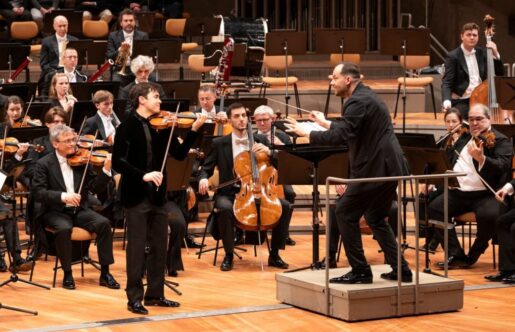
Of his three concertos, the Violin Concerto by Dvořák has never equalled in popularity the splendid romanticism of the Cello Concerto. The Violin Concerto has nevertheless become a staple of the concert repertoire, unlike the more expansive Piano Concerto. It was also another fine introduction, this time to the young American violinist Benjamin Beilman, who has been steadily winning audiences to his virtuosity worldwide. The grand opening unveiled a bohemian folk idea on the violin, repeated by the flute and the clarinet in a spell of beautiful playing, indulgent in Czech melodies, with the slow movement following without a break before the Finale. The mood was bright and upbeat with striking harmonies becoming ever more joyous and happier, with rays of sunshine throughout. The splendidly folkloric idea on the violin was reprised, heralding a triumphant burst from the orchestra ending in a joyous climax. Beilman exhibited marvellous musicality on his ‘Ysaye’ Guarneri del Gesu violin of 1740 and was matched by magnificent playing from Dohr’s horn and Pahud’s flute.
In Leipzig this year, Andris Nelsons led his two orchestras, the Gewandhaus Orchestra and the Boston Symphony Orchestra, in performances of all the Shostakovich symphonies as part of a Festival commemorating the composer’s death fifty years ago in 1975. I was fortunate to attend several of the concerts and was impressed by the mastery of this Latvian conductor in directing symphonies varying from the early avant-garde to the maturity of the later period. The Tenth Symphony is often regarded as one of the finest of the Shostakovich canon, and of twentieth-century symphonism. Written following the death of Stalin, the work is frequently linked to this event; however, I believe this is mistaken. The depth of thought outweighs any temporary or other issues and the philosophical themes and ideas lift the work to the level of the great symphonies of Beethoven, Bruckner, or Mahler.
In the opening of the Moderato movement, the low strings groaned tragically, especially in the bass section as if in profound philosophical reflection, the emotional depth was evinced by fine play from the clarinet of Wenzel Fuchs, before the tension rose on the brass entry and the timpani to an almost agonising pain before a calming theme on the solo horn of Dohr and the repeat of the first idea heralded a muted clarinet solo. There emerged a reflective sequence from the bassoon and woodwind of great moment, and as if in argument, there came a rise in tension with defiant brass and the whole orchestra. This was magnificent playing of such sublime music, philosophical and tragic, yet there emerged – as if from nowhere – an austere beauty from the two piccolos heard against Vincent Vogel’s soft timpani roll.
In the brief second movement (Allegro) Nelsons commanded great intensity from the strings, directing the ominous sounding woodwind against the snare drum in a tour de force of orchestral playing, yet at the end, the woodwind briefly offered a tangible joy and life-affirming promise.
In the third movement (Allegretto) there emerged a tentative theme on the violas as if questioning life itself, before transitioning to the strings in a reflective mood and heralding a beautiful horn solo passage by Dohr which was repeated several times. There emerged a building of tension from the strings and trumpets; and masterminding this performance – Nelsons was almost crouching over the score constantly conducting with his eyes as much as with his baton. The orchestra now adopted an aggressive tempo, abated by the clarinets, yet again a horn solo created a feeling as if listening to a wise old man and then the sequence closed with a violin solo by Daishin Kashimoto as if in reflection.
The finale (Andante-Allegro) opened on the low strings, as the oboe sadly recalled memories of the past, now joined by Egor Egorkin on the piccolo, Pahud on flute, and Fuchs on clarinet, and as the mood transitioned to the whole orchestra, everything now swiftly changed again to a joyous mood, quickly rising in celebration. There came a repeat of the reflective repose on the strings, and now the clarinet intoned darkly, as if recalling a terrible event, and this was emphasised by the strings. Yet, the dark forces were defeated; banished by the upbeat idea, on the piccolo, clarinet, and horns, climaxing in a life-enhancing culmination.
Gregor Tassie
Featured Image: Organist Jan Liebermann (organ) © Frederike van der Straeten