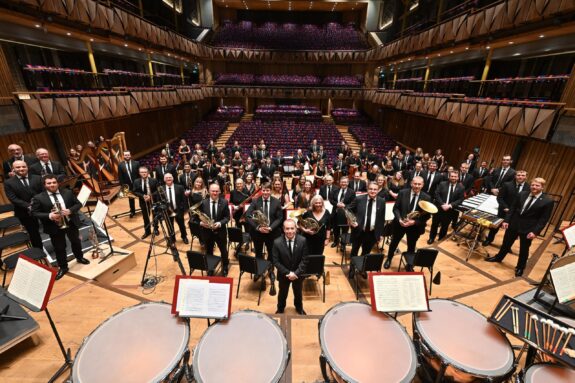
 United Kingdom Johann Strauss I, Johann Strauss II, Josef Strauss, Franz Lehár: Elizabeth Watts (soprano), Bournemouth Symphony Orchestra / Mark Wigglesworth (conductor). Bristol Beacon, 3.1.2026. (CK)

Johann Strauss II – Die Fledermaus: Overture, ‘Adele’s Laughing Song’; Accelerations Waltz; Thunder and Lightning Polka; Artist’s Life; The Blue Danube
Josef Strauss – Dynamiden Waltz; Plappermäulchen Polka
Franz Lehár – The Merry Widow: Overture, ‘Vilja Lied’; The Land of Smiles: ‘Sounds of my Homeland’; Giuditta: ‘My Lips’ Fiery Kiss’
Johann Strauss I – Radetzky March
At least the ladies of the Bournemouth Symphony Orchestra had made an effort: the Beacon’s platform was spangled with their shimmering dresses and beautiful colours (not billowy enough for André Rieu, I am happy to report). Not so the men: no silly hats or seasonal ties. Sobersides to a man. It is the playing that matters, of course; and although the orchestra is taking this programme to five venues around the region, there was no hint of routine.
The centrepiece of each half brought the soprano Elizabeth Watts to the stage: with her personal warmth and sense of fun she is the ideal person to introduce the music and to get the audience simmering nicely. Her rapport with us was instant: mind you, it must be a lot easier to warm up the Beacon’s lively and appreciative audience (half warmed up already by the exhilarating atmosphere generated by the hall itself) than to do it in one of London’s comparable halls. But the fact that she entertained us so successfully with her speaking voice cannot take precedence over the excellence of her singing and her dramatic sense.
She has the power for Wagner and the carefully calibrated delicacy and precision for – I was going to say Mozart, but you know what I mean. Her top register was thrilling, and pingingly accurate: it was a magnificent display of singing. ‘Sounds of my Homeland’ was genuinely touching, and ‘Adele’s Laughing Song’ was so superbly done that we had no need to encourage her by polite tittering. We were in awe. In the second half (in a second dress) she had us humming along to her beautifully sung ‘Vilja Lied’, and her comically steamy introduction to ‘Meinem Lippen’ from Giuditta had us hanging on every word.
What of Mark Wigglesworth, the conductor? Wisely avoiding a cornily theatrical Master-of-Ceremonies act, he was a genial and disarmingly modest host, communicating with us through his love for and understanding of the music. The Overture from Die Fledermaus that opened the concert was splendid; the Merry Widow Overture that opened the second half was even better, from the opening’s rollicking horns to the sweet violin solo near the end. What glorious music this is, he and the orchestra seemed to be saying, and we in the audience were spellbound.
Johann Strauss II’s Artist’s Life was given a glowing performance, opening with a lovely oboe solo, just tinged with melancholy – appropriate, perhaps, in the wake of Austria’s crushing defeat by Prussia the previous year. Even more touching was Josef Strauss’s Dynamiden Waltz: as Wigglesworth explained, Josef was an architect who resisted following the family musical tradition, and his reluctance can be sensed in the music’s hesitant beginning. He must have reconciled himself to it – he apparently wrote 283 pieces. His polkas have fared better than his waltzes, so it was good to hear one of them too – the Plappermäulchen Polka (which translates, I believe, as ‘the little chatterbox’). We also heard a fizzing performance of Johann Strauss II’s Thunder and Lightning Polka, with a cracking rim-shot at the end.
The Viennese Last Rites were scrupulously observed, The Blue Danube beginning with a pianissimo that even the Vienna Philharmonic might admire, the Radetzky March properly rousing (though not repeated). It was a buzzing Bristol audience that headed out into the cold.
Footnote: this season, the BSO are bringing five of their concerts to Bristol Beacon. The LSO are bringing three, with conductors Sir Antonio Pappano and Sir Simon Rattle. Vasily Petrenko and the RLPO come twice, as do the Manchester Collective. Living as I do near Southampton; I would rather travel to Bristol to hear the LSO than to their concrete bunker in the Barbican. Hearing music in the Beacon has reminded me what concert-going should be like.
Chris Kettle
Featured Image: The Bournemouth Symphony Orchestra and conductor Mark Wigglesworth at Bristol Beacon © Mark Allan