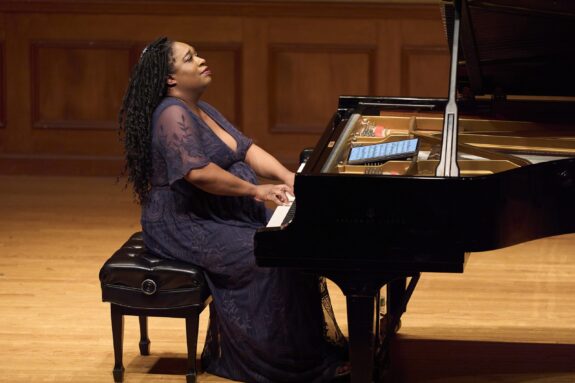
 United States Mandel Opera & Humanities Festival: [1] – ‘The Women of Chicago’s Black Renaissance’: Michelle Cann (piano). Rheinberger Chamber Hall, Severance Music Center, Cleveland, 19.5.2025. (MSJ)

Nora Holt – ‘Negro Dance’ No.1, Op.25
Betty Jackson King – ‘Four Seasonal Sketches’
Florence Price – ‘Fantasie nègre’ No.1 in E minor
Irene Britton Smith – ‘Variations on a Theme by MacDowell’
Margaret Bonds – ‘Spiritual Suite’
Encore:
Liszt – Hungarian Rhapsody No.2 (arr. Hazel Scott)
The Cleveland Orchestra has named ‘reconciliation’ as the theme of the 2025 Mandel Opera & Humanities Festival. It is unlikely that they knew when planning it last year how defiantly such a theme would ring in the shadow of the US regime that took office in January, and they deserve kudos for standing by it. The many programs, in multiple genres of music and events other than music, cover a range of different approaches to the idea of reconciliation, to be capped off with performances of Janáček’s opera Jenůfa.
Is this reconciliation one of necessity as regards this program of long-ignored music by black American composers? Absolutely. But it is also the right thing to do, no matter how much the national administration in Washington rails against diversity, equity and inclusion. Art music has all too often functioned as an exclusive club for elites, despite the fact that nature reminds us again and again that talent and genius can and do pop up anywhere, regardless of the walls and borders gatekeepers attempt to erect.
The program was a valuable primer on the female composers and performers gathered around the upwelling of creative activity in the American Midwest in the 1930s, now known as the Chicago Black Renaissance. This movement included Florence Price, the first African American female to have a major concert work performed by the Chicago Symphony. Forgotten for many years, Price’s music has been recently rediscovered, published and performed, opening a door to a world of music that never received full exposure before it was pushed aside by a postwar avant-garde which favored the sort of abstract music that drove many audiences away from classical music. With the rediscovery of more socially-centered music – like the works on this program – audiences are coming back, and even bringing new faces to try it out, as evidenced by a higher turnout of black audience members than usual. Will they all become regular classical concertgoers? Perhaps not, but you never know: even if turning to classical music changes the life of just one person, it’s worth it.
Our guide for this program could not have been better. Michelle Cann first performed with the Cleveland Orchestra during the summer Blossom Festival in 2021, when she introduced us to Price’s Piano Concerto and played the captivating slow movement from Price’s Piano Sonata as an encore. She is a vibrant performer, capable of communicating depths of emotion through her playing while delivering impressive virtuosity. In her lecture/recital format, she also demonstrated that she is a skilled storyteller verbally as well, filling in the connections between the composers.
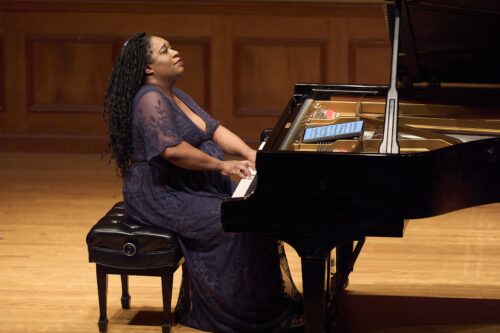
She began with the earliest one, Nora Holt (c.1885–1974). Only after playing the lively ‘Negro Dance’ did she inform the audience that because of a destructive break-in to the composer’s house, only two small works from her entire output survive. It is a tragic and devastating reminder of how fleeting one’s lifework can be. One can only hope that copies of some of Holt’s pieces will turn up in the way that Price’s have been rediscovered, because the brief evidence of the piece heard here suggests that Holt was an important spark, picking up the legacy of Scott Joplin and passing it on to the women who followed her in Chicago.
Cann continued on with Betty Jackson King’s ‘Four Seasonal Sketches’, endearing herself to the Cleveland audience by sharing that she came to the city after her Florida childhood to study at the Cleveland Institute of Music and knows all too well what winter on the Great Lakes is like. The piece proved vivid and pictorial. If the Spring movement seemed cautiously conservative at first, it proved to have a subtle tendency to telescope phrases and sideslip into new harmonic territory. The Summer interlude turned sensual and bluesy, while Autumn emphasized rhythm, which Cann swung infectiously. As predicted, the Winter finale glowered.
Florence Price’s ‘Fantasie nègre’ No.1 followed, one of Price’s highly successful syntheses of romantic piano manner with African American folk material. An intriguing contrast came with Irene Britton Smith’s ‘Variations on a Theme by MacDowell’. Edward MacDowell is a mostly-forgotten composer of the late-nineteenth century who mastered the European style of his day but began to introduce American ideas into some of his pieces. Smith was intent on composing variations on one of MacDowell’s melodies in a style just as articulately European as MacDowell’s, and she did so with considerable poise. If anything, the piece made me think that Smith was familiar with Jean-Philippe Rameau’s ‘Gavotte et Six Doubles’ from his Suite in A minor. Her work is just as stern and just as fluent, sounding indeed like a late romantic cousin of the Rameau, which is high praise indeed. Cann showed that she is by no means to be regarded as ‘only’ a specialist in music that fuses classical with influences such as jazz, blues and spirituals. She demonstrated her classical prowess playing this work, just as Smith did in writing it.
Most impressive of all was a suite of pieces inspired by spirituals, written by Margaret Bonds, a student of Florence Price. Cann even sang a verse of one of the spirituals – with a grand voice as regal as everything else about her bearing – before launching into the piano work with great intensity. Alternately brooding, moving and brilliant, the piece made for a triumphant closing to the concert and brought the audience to their feet.
After repeated curtain calls, Cann yielded to the audience’s demand for more. She appeared to launch into Liszt’s Hungarian Rhapsody No.2 in the grand manner. But a couple of pages in, she gave a sly grin to the audience and revealed that it was, in fact, the hilariously delightful arrangement of the Liszt by Hazel Scott, who became famous as both a jazz and classical pianist in the 1930s and 1940s, appearing in Hollywood films with Lena Horne. Scott’s jazz reinventions of famous classics are classics in their own right, and very much deserve to be heard alongside the other works in this program.
Hazel Scott’s career was ultimately derailed by McCarthyism, and her music also stands in need of reconciliation with a classical mainstream that has bowed to political trends for too long. It is heartening to see the Cleveland Orchestra sponsor a festival that dares to stand up to fascist nationalism with outreach like this program, bolstered further by a deluxe, curated program book featuring all the numerous events in the festival. Kudos above all to Michelle Cann, a vital and expressive performer who needs to be brought back for more of this kind of material (much gratitude to Cann for taking on the mantle of champion of this repertoire), but also in mainstream selections, for she is clearly more than just a specialist performer.
Mark Sebastian Jordan