
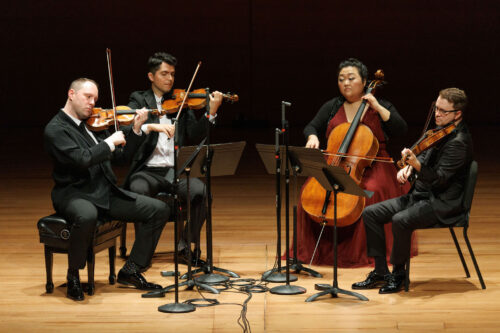
 United States Beethoven: Calidore String Quartet (Jeffrey Myers, Ryan Meehan [violins], Jeremy Berry [viola], Estelle Choi [cello]). Alice Tully Hall, New York, 18.5.2025. (ES-S)
Beethoven – String Quartet No.14 in C-sharp minor, Op.131; String Quartet No.16 in F major, Op.135
On Sunday afternoon, the Calidore Quartet – among the most esteemed younger chamber ensembles, formed in 2010 at the Colburn School in Los Angeles – brought to a close their complete Beethoven cycle at Alice Tully Hall, a season-long project presented by the Chamber Music Society of Lincoln Center.
Arguably, the program for the sixth and final chapter of their Beethoven saga – featuring the String Quartets Nos. 14 and 16 – was the most consequential. With its seven movements unfolding in a continuous sequence, No.14 in C-sharp minor stands as the culmination of Beethoven’s lifelong exploration of structural expansion. No.16 in F major followed with a more compact and elusive vision – one that glances back at Classical ideals and forward, already anticipating the uncertainties of music’s future.
The String Quartet No.14 demands that performers maintain a delicate equilibrium between long-range structural vision and sensitivity to the subtlest expressive detail. The Calidore met this challenge with striking assurance, shaping the performance as a continuous arc while honoring the distinct character of each internal transformation.
The opening Adagio fugue emerged with quiet intensity, its inward momentum building patiently. The players allowed the contrapuntal voices to breathe and entwine with a sense of suspended time – never overly rhetorical but deeply engaged. The sudden lift into the Allegro molto vivace brought a flash of brightness and dance-like vigor, animated by a buoyant, almost folk-like character.
The heart of the work, the Andante ma non troppo e molto cantabile, was rendered with both transparency and dramatic elasticity. Each variation unfolded as a fresh reflection, emotionally distinct yet bound by a shared lyric impulse, with Jeffrey Myers (first violin) and Estelle Choi (cello) trading expressive foreground lines, while Jeremy Berry (viola) and Ryan Meehan (second violin) shaded the texture with warmth and clarity.
In the Presto, the Calidore navigated the hairpin turns of rhythm and texture with agility and control. Pizzicati were tossed off with dry wit, and the abrupt tempo shifts – those sudden ‘molto poco adagio’ interjections – were not disruptions but felt fully integrated into the larger discourse. Toward the end, the quartet conjured a hushed, spectral texture as all four players bowed near the bridge (‘sul ponticello’). Spanning only several measures, this fleeting episode produced a sonority – glassy, fragile and otherworldly – that carried a startling sense of modernity. That such a sound could have been conceived, but not heard, by the deaf Beethoven speaks not only to his audacity but to the radical inner ear of a composer reaching far beyond his time.
In the final Allegro, the Calidore pushed forward with mounting intensity. The reappearance of the fugue motif from the opening movement was no mere echo, but a structural reckoning – urgent, almost combative. It was yet another sign of the ensemble’s commitment to treating the work not as a monument, but as a living challenge.
If the String Quartet No.14 projected intensity outward – structurally expansive and emotionally searching – the Quartet No.16 turned inward, offering something subtler, more self-contained. The Calidore embraced its concision and hints of irony without underplaying its complexity. The opening Allegretto had a conversational ease, with supple phrasing and subtle dynamics that let Beethoven’s expressive ambiguities emerge naturally. The four string players captured the movement’s surface poise while subtly revealing the harmonic detours and evasive cadences beneath – never overstated, but gently resisting any sense of full resolution. This undercurrent of hesitation lent the music a feeling of quiet questioning, one that seemed to foreshadow the more direct interrogations of the final movement.
In the Vivace, the Calidore conveyed Beethoven’s rhythmic gamesmanship with crisp articulation and a lean ensemble sound. Syncopations and asymmetrical accents gave the movement a taut, unsettled energy, its off-kilter phrasing delivered with a whiff of irony. It served as a vital jolt between the poised ambiguity of the Allegretto and the suspended introspection of the following Lento.
In the latter, the foursome drew out the movement’s gentle lyricism and inward tone. Jeffrey Myers carried the theme with quiet dignity, shaping its line with an almost hymn-like purity. A contemplative stillness permeated the performance, as if the music were probing a thought it could never quite articulate.
In the final movement, the Calidore treated the question – ‘Muss es sein?’ (‘Must it be?’) – and its answer – ‘Es muss sein!’ (‘It must be!’), which Beethoven inscribed in the score – not as resolution but as a question left deliberately alive. Their interpretation gave the exchange a quiet gravity, neither comic nor overwrought with existential angst, but reflective. One thought of Milan Kundera’s The Unbearable Lightness of Being, where this very question and answer encapsulate the tension between freedom and responsibility, lightness and weight – with resolution never quite in reach.
It was also a paradigm for the entire cycle – a reminder that the conversation with Beethoven’s quartets will never finish.
Edward Sava-Segal