 United Kingdom Ballet to Broadway: Wheeldon Works – Fool’s Paradise, The Two of Us, Us, An American in Paris: Dancers of The Royal Ballet, Orchestra of the Royal Opera House / Koen Kessels (conductor). Broadcast live (directed by Ross MacGibbon) from the Royal Opera House, London, to Cineworld Basildon, Essex, 22.5.2025. (JPr)

The work of British-born choreographer Christopher Wheeldon was celebrated in a programme of four of his works, with three new to the Covent Garden stage. What we were to see was introduced to the watching cinema audience by Petroc Trelawny and Dame Darcey Bussell. Petroc explained how ‘Chris has packed a remarkable amount in his 52 years. He had danced and been a full-time choreographer for two of the world’s A-list companies, New York City Ballet and The Royal Ballet, as well as founding his own transatlantic troupe, Morphoses.’ Darcey added how ‘He has created pieces for the Bolshoi, the Royal Danish Ballet, San Francisco Ballet, directed on Broadway, contributed to the closing ceremony of the London Olympics … just a month ago he also won his second Olivier Award for the sell-out show MJ The Musical.’
From the Director of The Royal Ballet, Kevin O’Hare, we heard how the mixed bill ‘Really is Ballet to Broadway; so you have this beautiful classical ballet [Fool’s Paradise] at the beginning really showing a mix of The Royal Ballet and New York City Ballet. Then there is two much more contemporary pieces [The Two of Us and Us] which are really interesting which show the influences of contemporary people that have been around him and contemporary voices. And then finishing with this real tribute to Broadway and Gershwin [An American in Paris].
Crucially we heard from Wheeldon himself and for me the important passage was about the way he works when he admitted – somewhat bravely in my opinion – how he believed he had ‘Certainly reached the point where I’ll come back to something like American in Paris and think that’s the seed of a step that ended up in Corybantic Games; there is a constant threading of ideas. Sometimes you get to the point in the day when you are so exhausted and have 60 dancers waiting for me to come up with something: is there a step that didn’t work in another piece you can draw from? That’s always fun to revisit and go, hallo, hallo old friend, I recognise you.’
In the end it was An American in Paris which made Ballet to Broadway worth seeing but why was it such a short programme with the two intervals not that much shorter than the 85 minutes of dancing? Sadly elsewhere despite O’Hare promising us a ‘mixture of range’ there were too much of Wheeldon’s revisiting of his old friends and you quickly recognised some of what you might describe as his ‘signature moves’; flexed or hyperextended arms and legs, hands gripping together, weight shifting, back bending, work on the floor or extravagant lifts with dancers suspended on high and sometimes upside down. Possibly there is not much else that any choreographer has in their arsenal for a contemporary work, but I would like to see that hidden better and not see the same movement time and again; particularly during the first three somewhat repetitive pieces regardless of how distinguished the performances they received were.
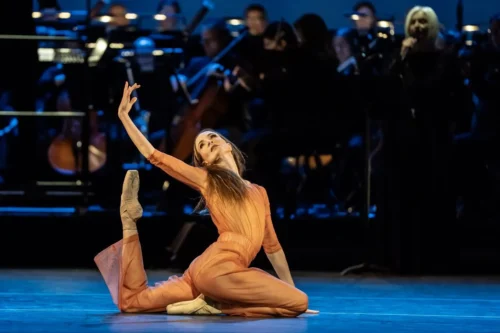
The Royal Ballet was dancing Fool’s Paradise once again after a gap of 12 years. There is a sculptural formalism to the differing neoclassical interactions of five men and four women – looking almost nude (men bare-chested) in Narciso Rodriguez’s almost-non-existent costumes – illuminated on an otherwise dark stage with falling gold glitter. It was danced to Joby Talbot’s dreamily melodic interpretation of ‘The Dying Swan’ and Talbot has since become Wheeldon’s frequent collaborator. How wonderful it was to see the remarkable Marianela Nuñez – who was in Fool’s Paradise in 2012 – dancing in it again and able to hold her own in the ensemble of otherwise younger dancers. The Two of Us was the first of the two central short works danced on the stage in front of conductor Koen Kessels and the orchestra. Four orchestrated Joni Mitchell songs were unidiomatically sung by Julia Fordham. Lauren Cuthbertson and Calvin Richardson were in gauzy jumpsuits; his pale blue and hers tangerine. There were solos before a suggestion of a romantic liaison to Mitchell’s famous ‘Both Sides’. Just like Fool’s Paradise Wheeldon’s choreography just seemed to be responding to the music and nothing more. This continued in Us a duet for two bare-chested men (Matthew Ball and Joseph Sissens) possibly exploring their relationship to Keaton Henson’s introspective, occasionally perpetuum mobile-like score.
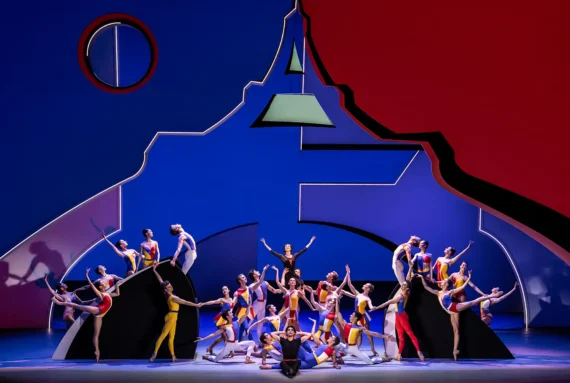
Wheeldon mentioned how there had been little classical ballet in current musical theatre until he choreographed the Tony Award-winning An American in Paris for Broadway about ten years ago. Prior to that he explained how ‘Ballet had a big part in the MGM classic new musical movies, so there’s always been – particularly in America – this crossover between ballet and musicals.’ This is an extended version of the dream ballet danced in the original 1951 film by Gene Kelly’s Jerry and Leslie Caron’s Lise to George Gershwin’s quasi-symphonic score. Its jazz-influenced music lifts Wheeldon’s choreography to greater heights than we had previously seen in his kaleidoscopic extravaganza.
Bob Crawley’s designs for the ballet are like a hallucinogenic reimagining of the works of Dutch painter Piet Mondrian. The company carried it off with great pizzazz and it all reached a crescendo in the Jerry/Lise romantic duet between real-life couple Cesar Corrales and Francesca Hayward and the final unforgettable tableau. Hayward’s Lise had poise and stylish elegance, whilst Corrales’s macho-posturing was a different take on Jerry compared to Gene Kelly. Corrales came back not too long ago after an absence through injury and proves a wonderfully secure partner (on the stage!) for Hayward whilst he soared and fizzed his way around the stage with the elan, breathtaking virtuosity and charisma which I am not sure any other current male principal of The Royal Ballet is capable.
The virtuosic musicians of the Orchestra of the Royal Opera House played their significant part throughout the programme in contrasting styles of music and they were sensitively conducted by their music director Koen Kessels whose priority is always to showcase the dancers in the best possible way.
Jim Pritchard
Featured Image: Dancers of The Royal Ballet in An American in Paris © Johan Persson
Fool’s Paradise
Choreography – Christopher Wheeldon
Music – Joby Talbot’s The Dying Swan
Costume designer – Narciso Rodriguez
Lighting designer – Penny Jacobus
Staging – Jason Fowler
Dancers – Akane Takada, William Bracewell, Marianela Nuñez, Lukas B. Brændsrød, Viola Pantuso, Liam Boswell, Téo Dubreuil, Annette Buvoli, Giacomo Rovero
The Two of Us
Choreography – Christopher Weeldon
Music – Joni Mitchell’s ‘I Don’t Know Where I Stand’, ‘Urge for Going’, ‘Both Sides Now’ and ‘You Turn Me on I’m a Radio’ (Orch. by Gordon Hamilton) sung by Julia Fordham
Lighting designer – Natasha Katz
Costume designers – Harriet Jung, Reid Bartelme
Principal Coaching – Robbie Fairchild, Zenaida Yanowsky
Dancers – Lauren Cuthbertson, Calvin Richardson
Us
Choreography – Christopher Wheeldon
Music – Keaton Henson
Lighting designer – Natasha Katz
Costume designer – Katherine Watt
Rehearsal Director – Christopher Saunders
Dancers – Matthew Ball, Joseph Sissens
An American in Paris
Choreography – Christopher Wheeldon
Music – George Gershwin
Designer – Bob Crowley
Lighting designer – Natasha Katz
Original Video designs – 59 Studio
Realisation and Additional Video designs – FRAY Studio
Design Associates – Jaimie Todd, Lynette Mauro
Staging – Dustin Layton
Rehearsal Director – Christopher Saunders
Dancers – Francesca Hayward (Lise), Cesar Corrales (Jerry) and Artists of The Royal Ballet