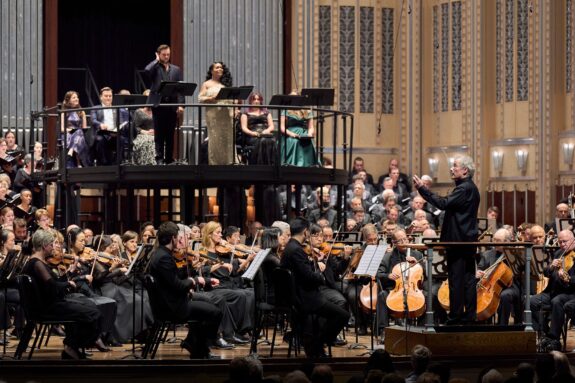
 United States Mandel Opera & Humanities Festiva; [2] – Janáček, Jenůfa (concert performance): Soloists, Cleveland Orchestra Chorus, Cleveland Orchestra / Franz Welser-Möst (conductor). Mandel Concert Hall at Severance Music Center, Cleveland, 22.5.2025. (MSJ)

If there is one composer whose value posterity has been slow to recognize, it is Czech composer Leoš Janáček. He started as one of the many composers inspired by Smetana and Dvořák, and he labored in their shadows for decades. If he were to be judged only by his early output, Janáček would be thought of as a distinguished but minor composer rubbing shoulders with the likes of Fibich or Foerster. But something almost unprecedented in the history of music happened when Janáček wrote the opera Jenůfa.
Struggling with the decline and death of his daughter Olga, Janáček was also at a point of creative restlessness, desiring a path forward from received tradition but not wanting to jettison everything he had learned about the mechanics of music and harmony. The key for him came in a study of the languages of the Czecho-Slovak region, and a startling realization that the natural, inherent rhythm of these eastern European tongues was fundamentally different from the Germanic languages which had dominated central European music. This new framework transformed how Janáček created phrases and rhythms, and it was a spark that took him out of the solid but unexceptional mainstream of Czech music, taking him to a level that we are still, even now, coming to terms with. Before Jenůfa, Janáček was a dutiful national composer. After Jenůfa, he was climbing the pathway to the pantheon of the greatest composers.
His forward leap was so thorough that even his orchestration was jarring in theaters, and he reorchestrated the opera to subdue what were perceived as garish colors. Now, of course, we know that those colors were Janáček’s true creative personality burning through for the first time. Since the restoration of the composer’s original orchestration in the 1970s, the work has earned a distinguished place in the stream of masterpieces that followed, despite its flaws.
Urgent to finish the work and let his daughter hear it before her passing, Janáček based the opera very directly on the 1890 play Her Stepdaughter by Gabriela Preissová. The play was cutting-edge in its realistic setting in small-town Moravia, and also in its detailed psychological study of the female leads. Janáček appreciated these elements and found inspiration in them, though modern audiences are typically left profoundly uneasy by the ‘happy ending’ where Jenůfa is married off to a man who scarred her earlier in the story. Perhaps, with more time, Janáček would have considered rewriting the ending, even though he had already spent almost ten years working on the piece intermittently, resulting in a stylistic shift from the first act to the later acts as he developed his breakthroughs.
And that stylistic shift is one of the key hurdles to clear in any performance. At the Mandel Opera & Humanities Festival, Cleveland Orchestra music director Franz Welser-Möst handled it by focusing the first act tightly, emphasizing how it points toward later Janáček, instead of dwelling on the elements which could be likened to earlier works. This remarkable focus made the act feel much shorter than its running time, and that time was, by comparison, several minutes quicker than the famous recording made by Janáček expert Sir Charles Mackerras in the 1980s. Welser-Möst’s conception of the piece started with quiet anxiety from page one, and its build was inexorable thereafter. This didn’t preclude considerable charm in the choral sections of Act I, but the sense of an overarching momentum was still in place. The second and third acts were given ample room to make their dramatic points but without losing momentum. That momentum kept things moving all the way through to the ending, but Welser-Möst’s handling of the diffident ‘happy end’ was marked by a refusal to unleash the brass in full blaze, emphasizing the unease. The orchestra was in great voice throughout, savoring Janáček’s mixture of folk color and tart directness.

The opera’s female leads, Jenůfa and her stepmother, the Kostelnička (village sacristan), are both starring roles and were filled gloriously in this performance. As Jenůfa, Latonia Moore brought gorgeous tone to the lyrical role of Jenůfa, but she wasn’t afraid to dive into dramatic intensity as Jenůfa gets done wrong, is abandoned by her lover and then has her baby murdered. As the Kostelnička, Nina Stemme used a controlled, cool tone to show her character’s sternness in Act I, but she revealed the terrifying steel of her voice in full flight as she showed the Kostelnička committing to her murderous course and then repenting at the end. Both singers delivered moments where Janáček’s abrupt pauses left their voices hanging over gaping, terrifying abysses of silence.
Samuel Levine was in gleaming voice as Laca, the half-brother of Jenůfa’s rogue lover. Psychologically, Levine did a fine job balancing the tricky role between his desire for Jenůfa, his disturbing, possibly accidental, scarring of her and his eventual redemption as her husband. Perhaps he was anxious to be in a fully staged scenario – the singer did have a distracting tendency to bob and weave as he sang – but his voice was excellent. Miles Mykkanen kept the realism of the work in perspective, embodying the arrogant Števa effectively without exaggerating the role of the faithless lover into parody. The rest of the cast was impressive, including Marianne Cornetti as a vocally rich Grandmother, and Will Liverman in robust voice as Štarek, the mill foreman. The Cleveland Orchestra Chorus was magnificent in its important moments, with portions of the group moved up to the dress circle sides in Mandel Hall, an effectively realistic way to evoke the sense of the characters being surrounded by the people of the village.
With the limited staging restricted by the use of a relatively small platform over the orchestra for the singers, physicality was limited. It would be wonderful to see the piece realized theatrically, as earlier Cleveland Orchestra festival productions of The Cunning Little Vixen and others have demonstrated. In all likelihood, the costs of such productions are prohibitive, although minimal set dressing and costuming wouldn’t be excessive. Given that Spartan staging is sometimes the case, it is nonetheless highly valuable for both the Cleveland Orchestra’s stylistic grasp and for the enrichment of the community that Welser-Möst and the orchestra’s management have been able to maintain a practice of yearly opera productions, something first established in the 1930s by Artur Rodziński but only intermittently achieved in subsequent years, until a long string of these productions began during Welser-Möst’s tenure.
It is the crown in a series of events exploring the Mandel Festival’s theme of ‘reconciliation’, a topic that must seem much more elusive today in the politically and culturally embattled United States than it did when they were planning the festival a year or more ago. Societal attitudes ebb and flow, which is something that makes Jenůfa’s mix of psychological and conventional attitudes even more pertinent than what it says about reconciliation. In the end, reconciliation and forgiveness are crucial elements of society, but the opera leaves it hanging uncertainly in a perhaps intentionally dubious ending. We constantly strive for ways as a society to find our true voices. But that doesn’t mean we always know what to say in order to pull it all together.
Mark Sebastian Jordan
Cast:
Jenůfa – Latonia Moore
Grandmother Buryjovka – Marianne Cornetti
Laca Klemen – Samuel Levine
Jano (Shepherd) – Lucy Baker
Štarek (Mill foreman) – Will Liverman
Kostelnička Buryjovka – Nina Stemme
Števa Buryja – Miles Mykkanen
Barena & Aunt – Sarah Hutchins
Shepherdess – Sarah Mesko
Mayor – Kyle Albertson
Mayor’s Wife – Olivia Vote
Karolka – Simone McIntosh
Creative Staff:
Miloš Repický (répétiteur)
Lucy Guillemette (stage manager)
Lisa Wong (chorus director)