 Bulgaria Wagner, Tannhäuser: Soloists, Chorus, Ballet and Orchestra of Sofia Opera and Ballet / Constantin Trinks (conductor). National Opera and Ballet, Sofia, 5.7.2025. (GT)
In his introduction to this Tannhäuser, Plamen Kartaloff reflected that 2025 marks a jubilee for the Latin Christian world. ‘Its motto is “Pilgrims of Hope”. In Richard Wagner’s opera, we can perceive a moral connection between the libretto and the music and the Church’s messages to society – calling for faith, optimism, and hope in today’s world of war, a world that has forgotten the human values of virtue, forgiveness, redemption, and salvation from the sins of arrogance and greed, from excess and the lust for power.’
‘Venus embodies the society of pleasure – a world constructed as a ritual theatre of desire. In my staging, I replace the traditional ballet with pantomimic scenes evoking mythological and symbolic images of love: Leda and the Swan, Psyche and Eros, Helen and Paris, Susanna and the Elders, A Ploughman with a phallus fertilizing the earth – an image of fertility, the Abduction of Europa, and Dionysus leading all into ecstatic orgy.’ Kartaloff contrasts this Society of Pleasure with the Wartburg which is ‘the Society of Harmony – A World Without Mercy. This is a realm of spiritual order and lofty morality, yet is devoid of compassion. […] Tannhäuser is a metaphor for modern man – who refuses to choose between soul and body, between impulse and order, between truth and expectation. The production speaks of the pain of continuous searching, of the spiritual wandering of a person who perishes not because he has sinned, but because he has realised: freedom demands not only choice, but the courage to bear its consequences.’ Finally, Kartaloff poses a question, ‘Can we forgive not the sinner, but the one who reveals the inconvenient truth about ourselves?’
‘The stage […] is an abstract space – a space of the thoughts, feelings and spiritual journey of the characters. Lines, shapes, light and movement create an interior world, in which all is symbolic and suggestive, not a literal reality.’
In this year’s Wagner Festival, Sofia Opera engaged two conductors: Evan-Alexis Christ for the Ring cycle, and Constantin Trinks for the two performances of Tannhäuser. Both are outstanding Wagnerian conductors, yet each have a distinctive style, one bringing out the themes while the other concentrates on the phrasing and the drama. In the Overture, Trinks opened out the themes of the opera, from the theme of the Act III ‘Pilgrims Chorus’, and from the Venusberg, all of which are gloriously romantic yet within hints poignantly of tragedy.
The Venusberg was decorated by a great purple blue backdrop portraying the lake yet hinting at sensuality and lust in its vision against which the Naiads are bathing. The movement was quickly changing with the Sirens behind, and the scenes of lust and sensuality engaging in an orgy of young Nymphs, Bacchantes and of couples making love. The entry of Venus embraced by Tannhäuser on her chariot was dramatically effected, yet he becomes reluctant to make love and appears to be ashamed. An offstage choir ‘Naht euch dem Strande’ is heard as the dancing gets ever wilder, and as the sculpture of a giant Centaur moved through the orgy of young people. Scene Two sees the disappearance of the fleeing young people and Tannháuser’ now feels himself in despair and his ‘Mein Heil ruht in Maria’ breaks the spell and everything collapses.
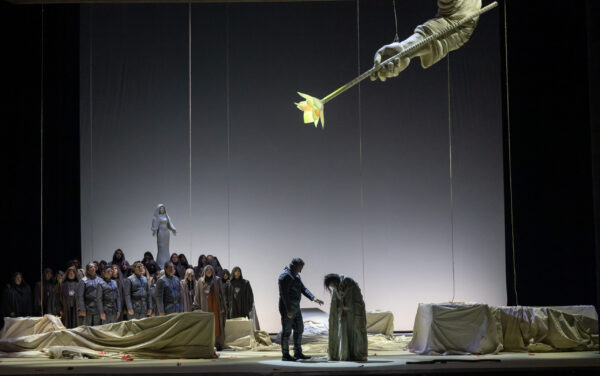
Scene Three shows open country near the Wartburg and opened, as bells toll offstage, when Tannhäuser is praying before the statue of the Virgin Mary. The entry of the young shepherd with ‘Frau Holda kam aus dem Berg hervor’ enchanted in its lonesomeness and beauty as she slowly moved from the far background to the front and then away into the distance. The pilgrims singing the hymn ‘Zu dir wall ich, mein Jesus Christ’ enter and Tannhäuser collapses in appreciation. This was a wonderfully expressive moment, quite enthralling in its beauty.
The Landgrave’s hunting party see Tannhäuser and greet their friend ‘Heinrich! Heinrich! Seh ich recht?’, he is reluctant to join them, yet Wolfram, superbly played by Ventseslav Anastasov, reminds him of his friendship for Elisabeth ‘Bleib bei Elisabeth!’ leading him to cry out for her return. Again the offstage horns are heard as Tannhäuser cries ‘Zu hir! Zu hir!’ This Wartburg scene was outstanding and magisterially led by Petar Buchkov’s Hermann. His strident darkly-toned bass was matched by his commanding stage presence.
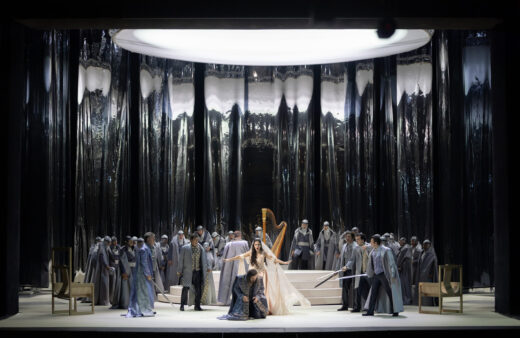
Act II opened in the Minnesingers Hall of the Wartburg with the entrance of Elisabeth; it was immediately clear that both in her stage presence, beauty and singing that we were watching the appearance of a new young star in her ‘Dich, teure Halle’. The singing was amazing from the freshly youthful beauty and expression by the young Eleonora Djodjoska-Mladenova making her debut here in Sofia. The scene of Tannhäuser meeting with Elisabeth was emotive as he flung himself at her feet and their duet was powerful in its passion ‘Gepreisen sei die Stunde’. The song contest was meticulously staged with the guests encircling the raised platform, their costumes were of light grey robes and were slightly daunting in their masked faces.
Tannhäuser’s disclosure of his past love for Venus ‘Dir Göttin der Liebe, soll mein Leid ertonen’ instantly transforms the contest and swords are drawn and only Elisabeth prevents the violence ‘Haltet ein!’ In atonement, he is despatched to Rome.
Act III opens with Elisabeth praying before the Virgin Mary, and the pilgrims praying offstage created a deeply emotive moment as Wolfram and Elisabeth listen to the hymn, yet Tannhäuser is not among the returning pilgrims. Wolfram’s ‘O du mein holder Abendstern’ was sung by Atanasov intensely and beautifully. Tannhäuser’s arrival and meeting with Wolfram was poignant both in invocation of the plight of Tannhäuser’s curse and in the humanity of Wolfram. Venus appears welcoming her lover back ‘Zu mir! Zu mir!’ As if by magic the words from Wolfram ‘Elisabeth’ break the spell and Tannhäuser now sees the funeral procession for Elisabeth singing the hymn ‘Der Seele Heil, die nun entflohn’. Tannhäuser collapses as the pope’s staff appears from above proclaiming a miracle. ‘Heil! Heil! Der Gnade Wunder Heil!’
The 20-year-old Djodjoska-Mladenova as Elisabeth is a genuine discovery of the Wagner Festival. Her confidence and characterisation and magnificent lyric soprano highlighted the entire evening. She is surely a future star of Bulgarian opera. The Venus of Radostina Nikolaeva was astonishingly well sung and acted, amongst the finest performances of the whole evening.
The Tannhäuser of Martin Iliev was another star with his magnificent vocal and acting performance together with the stamina of such a demanding part. Anastasov’s Wolfram was also outstanding notably in his beautifully performed Act III aria, and his acting/singing throughout. The beauty and eloquence of his singing was of the highest standard. Petar Buchkov’s Hermann was another outstanding display of magnificent characterisation in his deeply black bass voice. Just two days after his superb Hagen in the final night of the Ring cycle – this was a triumphant performance. The Heinrich was yet another highlight with a top-class characterisation by Angel Antonov. The stage presence and the characterisations in the scenes of the song contest were outstanding, as was the brilliant acting of all concerned elsewhere.
The choreography by Maria Ilieva was masterful and immensely contributed to the dramatic narrative. The costumes were often magical and brilliantly colourful with beautiful dresses for the ballet dancers in the opening Venusberg Scene, while those for the chorus, whether humble pilgrims or as guests at the Wartburg song contest were superb in capturing each scene’s idiom. The sets by Sven Jonke were both unassuming while they presented a dramatic scene of lust and passion in the colours and décor of the Venusberg, while the Wartburg Castle was stunning in its grandeur.
The contribution of the offstage chorus was magnificent, as if singing in heaven, also the intonation of solo instruments offstage was wonderfully atmospheric for the scenes of great moment. The lighting particularly ensured that exquisiteness was at the core of this staging. This was a beautiful production and very unpretentious in its similarity to the Parsifal seen here two years ago (review here) using canopies hanging high above the stage and either raised or becoming part of the stage scenery. In all, this new production is another triumph for Plamen Kartaloff and for Sofia Opera and Ballet.
Gregor Tassie
Production:
Director – Plamen Kartaloff
Sets – Sven Jonke
Lighting – Andrej Hajdinjak
Choreography – Maria Ilieva
Musical preparation – Velizar Genchev
Assistant Director – Yulia Krasteva
Artist – Nella Stoyanov
Chorus director – Violeta Dimitrova
Cast:
Tannhäuser – Martin Iliev
Elisabeth – Eleonora Djodjoska-Mladenova
Hermann, Landgrave of Thuringia – Petar Buchkov
Wolfram von Eschenbach – Ventseslav Anastasov
Walther von der Vogelweide – Emil Pavlov
Heinrich der Schreiber – Angel Antonov
Biterolf – Stefan Vladimirov
Reinmar von Zweter – Angel Hristov
Venus – Radostina Nikolaeva
A Young Shepherd – Maria Pavlova