
 United States Various – ‘Summer Evenings’: Gilles Vonsattel, Evren Ozel (piano), Julian Rhee (violin), Dmitri Atapine (cello). Alice Tully Hall, New York, 8.7.2025. (ES-S)
Mozart – Sonata in F major for Violin and Piano, K.376
Beethoven – Trio in E-flat major for Piano, Violin and Cello, Op.1 No.1
Lily Boulanger – Three Pieces for Cello and Piano
Brahms – Trio in C major for Piano, Violin and Cello, Op.87
On Tuesday the Chamber Music Society of Lincoln Center launched a new edition of its ‘Summer Evenings’ series at Alice Tully Hall. Marking the initiative’s tenth anniversary, CMS’s co-artistic director Wu Han in her opening remarks reflected with evident pride on its remarkable success.
While the concerts the Society typically presents are often built around a unifying theme, the six performances offered this month are joyfully eclectic. They lead listeners on a path of discovery, combining familiar and lesser-known repertoire – an experience shaped by the artistic insight of CMS’s performing members.
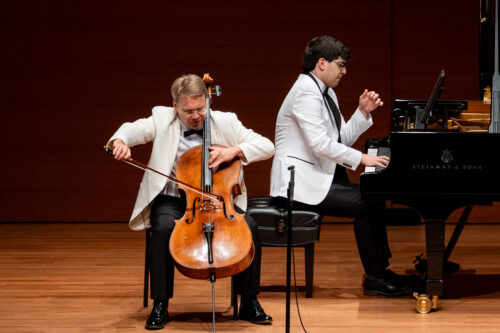
In an opening program that traced the evolution of chamber music in the German-speaking world – from Mozart to Brahms – a more modern accent emerged as the evening’s surprise and, arguably, its high point. This striking moment arrived in the form of Nadia Boulanger’s luminous Three Pieces for Cello and Piano, composed in 1914. Cellist Dmitri Atapine and pianist Evren Ozel gave an understated, attentive reading – eschewing dramatics in favor of clarity and inwardness. Heard between Beethoven and Brahms, the set offered a moment of repose and introspection: a shift from structural grandeur to miniature form, and from rhetorical gesture to distilled mood. The ‘Modéré’, with its dark, gently rocking piano and long-arched cello line, unfolded in a muted, dreamlike haze. The closing ‘Vite et nerveusement rythmé’ – by contrast – broke the stillness with kinetic energy and a flicker of Spanish dance, its off-kilter rhythms and sudden accents offering a final spark of vitality before yielding to the broader gestures of the nineteenth century.
The Classical spine of the program came in the form of two works that, while far from their composers’ most celebrated creations, nonetheless revealed the shaping influence of Haydn. Mozart’s Sonata in F major and Beethoven’s Trio in E-flat major share a sense of formal clarity, thematic generosity and playful elegance that clearly trace their lineage to Haydn’s style and innovations.
In the Mozart, violinist Julian Rhee and pianist Gilles Vonsattel offered a reading marked by clarity, poise and, above all, restraint. This is one of Mozart’s more understated duo sonatas – lyrical rather than virtuosic – and the performers wisely let its charm emerge without affectation. Vonsattel maintained a transparent texture in the keyboard part, avoiding any undue weight, while Rhee’s tone was warm but never insistent, staying within the music’s natural expressive boundaries. True to the sonata’s original billing as a work for piano with violin accompaniment, Vonsattel often led the musical discourse, with Rhee subtly shading and responding. Their interplay in the first movement conveyed a quiet, conversational elegance, with phrasing that gently leaned into cadences without breaking the line. In the middle movement, a single, lyrical theme unfolded with graceful continuity, and the duo traced its gentle rise and fall with quiet confidence, trading lead and accompaniment with seamless coordination. The finale’s grace was never rushed, and its tapered ending – a soft recollection of the rondo theme – was delivered with exquisite understatement. This was not a performance that tried to inflate the sonata into something it is not: rather, it allowed the music’s Classical proportions and conversational intimacy to speak for themselves.

Beethoven’s Trio in E-flat major brought violinist Julian Rhee back to the stage, now joined by cellist Dmitri Atapine and pianist Evren Ozel – making what was likely his first New York appearance since earning the bronze medal at the acclaimed Van Cliburn Competition. The performance captured the balance between Classical inheritance and emerging Romantic gesture that defines Beethoven’s early style. From the outset, Ozel’s crisp articulation and rhythmic control gave the music buoyancy, while Rhee and Atapine brought supple lyricism to their lines, especially in the slow movement’s elegant duet passages. The trio’s coordination was especially tight in the Scherzo, where Beethoven’s rhythmic feints and offbeat figures were rendered with finesse rather than force. If there was a touch of caution in the first movement’s development, it was offset by the group’s attention to phrase shape and structural pacing. In the finale, Beethoven’s leaping figures and sudden swerves were delivered with lightness and wit, never overplayed, and all the more effective for their understatement. What emerged was a portrait of Beethoven at a transitional moment: still shaped by Haydn’s influence but unmistakably finding his own voice – an artistic evolution the performers traced with intelligence and finely tuned ensemble work.
With Brahms’s Trio in C major, the evening arrived at its most expansive and architecturally ambitious music. The work’s density – structural, harmonic and emotional – marked a dramatic shift from the Classical refinement of the earlier pieces. As noted by Atapine in one of his brief, insightful remarks on each of the works, Brahms seemed to have conceived the trio as a dialogue between the piano and a unified string voice – violin and cello often functioning as a single entity. From the first bars, Rhee, Atapine and pianist Gilles Vonsattel took a spacious, deliberate approach, allowing Brahms’s intricate layering to unfold with clarity and patience. Vonsattel’s playing was particularly alert to texture and balance; he resisted the temptation to dominate, instead shaping inner voices and rhythmic figures with restraint and color. Rhee and Atapine, often paired in octaves or close counterpoint, brought a warm blend and a keen sense of ebb and flow – especially in the variation movement, where Brahms’s Hungarian-inflected theme undergoes a series of transformations from Schubert-evoking melancholy to grandeur. The group captured the shadowy momentum of the Scherzo with hushed intensity, making the trio’s sudden shift into calm and warmth all the more affecting. In the finale, they sustained energy without force, drawing attention to Brahms’s playful cross-rhythms and the subtle logic by which thematic fragments resurface and evolve. If the Mozart sonata offered intimacy and the Beethoven trio youthful drive, this performance of the Brahms trio illuminated his mature voice in all its complexity – broad in gesture but anchored in the intimacy and focus of chamber playing.
It was an evening of modesty as well as excellence, evoking the spirit of music-making in a nineteenth-century household.
Edward Sava-Segal