Anna Clyne on the upcoming NYC premiere of PALETTE on 18 September

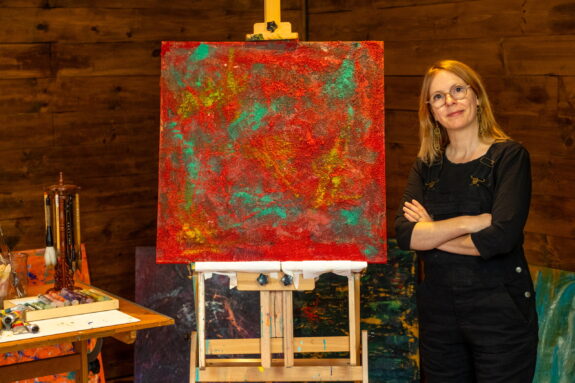
Fantastic, energetic studies of electrifying color is one way to describe the abstract paintings by composer Anna Clyne. Currently on display at the Juilliard School of Music, they connect to the upcoming performance of PALETTE, her innovative Concerto for Augmented Orchestra, as part of Juilliard’s Second Annual Fall Festival. Each movement in PALETTE is named with an anagram that links a color to its respective painting: plum, amber, lava, ebony, teal, tangerine and emerald. Eager to know about her process, her approach to electronics and her breadth of interdisciplinary compositions as well as these singular hues, I had the opportunity to chat with Anna over Zoom. A charming room behind her displayed a rich collection of books, prints on the walls and an eye-catching lamp (possibly made from an antique hunting horn) on the piano next to her. Here is what she had to say about creativity, collaboration and compositional community.
Daniele Sahr: Today, we’ll talk about the compositional process behind PALETTE, which will be performed by the Julliard Orchestra under Stephanie Childress at Alice Tully Hall on 18 September. Let’s jump back first to hear about your start in composing with an interdisciplinary style.
Anna Clyne: Before we jump back . . . in the present, I love collaborating because it allows me to see my own creative process and music through a different lens. In terms of where that fascination with multi-disciplinary arts came from, I think it was there right at the beginning. I actually began writing when I was seven. Family friends gave us a piano, and it had some randomly missing keys at the top. As soon as I started playing, I would write pieces, avoiding those notes, of course. One of my closest friends at the time played flute, and I’d write piano and flute duets.
I have always been fascinated with anything creative. In addition to writing music, I would paint and draw, read and write poetry. When I went to university, I was close with friends at the Edinburgh College of Art, and I did collaborations there. With dance, with theater. It’s always been part of the narrative of my creative journey – collaborating with artists who really inspire me from all different kinds of fields.
Your music definitely reflects the influence of this broad variety of interests. PALETTE is a work with paintings you yourself have painted. Are you a self-taught painter, or are you professionally trained? It sounds like you were always teaching yourself, even as a child, across the arts!
Not professional. At school we all had high school arts classes. During the pandemic, I took drawing classes at the Arts Students League of New York, which I had wanted to go to for many years. I lived in Brooklyn. Now I live in Upstate New York. With the pandemic, online courses became available, so I took drawing classes there and some abstract painting classes at the Woodstock School of Art. Other than that, I’m really self-taught, which is quite liberating in a way. Because I’m not too self-critical: I just let myself express myself visually.
Tell me about the realization process for PALETTE. I have been wondering if the paintings came first, or if you had an idea of what you wanted for the music and that inspired the painting process.
It was really a symbiotic relationship between the music and the arts. One informed the other and vice versa. I tend to write chronologically and that was the case with this piece – starting with ‘Plum’ and ending with ‘Emerald’. The thing with music is that one can write very quickly. With painting, especially oil painting, you have to leave a lot of time for the layers to dry. In fact, they only dried in these last couple of months. Thank goodness, because we are exhibiting them at Juilliard, and they were able to transport them.
Once the music was completed and I heard it with a workshop at Julliard, I went back to the paintings and added more textured layers. For the premiere with the St. Louis Symphony (February 2025), we had to use high-resolution photographs instead of the paintings.
I see! This is a first opportunity to see the paintings themselves. Your project makes me think of Kandinsky and the concept of synesthesia. But I’m thinking that there can also be a representational relationship between music and painting. Where does the process take you?
When I’m writing music, I think a lot about structure, form and elements such as light and texture. I was really interested in how those elements can be expressed both visually and sonically. In each of the movements, I am exploring. Like in ‘Plum’ – visually, there are rich, sumptuous tones. Similarly in music, I’m finding tonalities that evoke that warm, dark sumptuous image and the counterpoint that lends to that. Really, I’m exploring light and dark and contrast and texture and form between the two art forms.
When you were writing the movements had you decided the colors in advance for PALETTE? Or were decisions made as the process developed?
This piece is a concerto for Augmented Orchestra. I knew I wanted to write a piece in multiple movements – each featuring different sections within the orchestra, following Bartók’s Concerto for Orchestra model. Thinking about structure for a 35- to 40-minute piece, you want to really plan how you are going to take an audience on that journey through that amount of time: keep the music engaging and contrasting but also have a thread connecting it. I knew that I wanted to explore synesthesia not through my own experience – I don’t have synesthesia – but I do correlate certain harmonies and textures (textures more so with certain colors). I thought both visually and musically, and about the idea of painting with sound. You are taking different colors within the orchestra and combining them to create new colors – in a way, a very literal transference.
I wanted to call the piece PALETTE so it was a matter of finding seven colors that spell [the word]. For each one, I spent a lot of time with pen and paper writing possibilities: plum, purple, pine . . . I wanted to find a color palette that covered a wide range. That’s how I ended up with movement titles.
The names of the colors already give one an energetic vibe and a sense of what one will experience sonically. I’d like to hear more about the Augmented Orchestra. Many composers use electronics for sampling or recording and shuffling instrumental sounds live, often manipulating the sound. How would you distinguish your creation of the Augmented Orchestra model from other electronic-based models?
It is better in some ways to define what Augmented Orchestra or ‘AO’ isn’t. It’s not sampling, it’s not pre-recorded, it’s not looped. It’s all derived from the orchestra in real time. We are really expanding the boundaries or the limitations of the orchestra. For example, with range: the double bass is the lowest [range] instrument in the orchestra but with live electronic processing we are able to drop that down an octave. Or we can take a triangle and have its resonance decay over a longer period of time so it hovers or deflates beyond its natural decay. We can take a clarinet and run it through a distortion so it transforms the sound, almost like an electric guitar. With AO, it is happening in real time. It’s responding to the tempo of the conductor, to the phrasing of the musician and to the acoustics of the hall. It is really new in that it’s an organic extension of the acoustic orchestra.
Is there any improvisational aspect to the music since it takes into account these organic qualities dependent on the hall and the moment?
It’s actually written into the score, like a percussion part would be. At specific moments it can be as precise as a sixteenth note. In PALETTE we have microphones on eight different kinds of instruments – string, brass, woodwind and so on. At very specific moments in the score, a microphone is opened and a process is applied to it. Then it is closed. And we use it very judiciously so that it’s only used to serve the music. It’s not a gimmick. Often, our experience with audience members is they can’t discern what is the acoustic orchestra and what is the electronic processing, which is perfect because that’s what our goal is. It is meant to be like adding another instrument, another color to the orchestra.
How do you test the sounds you are planning to get in a specific moment from a specific instrument?
One of the perks of AO is that it is a collaboration with Jody Elff who is a fantastic sound design and engineer. He’s also my husband!
It is very much a family project. If I am writing, doing a clarinet line and thinking what will that be with distortion, I can bounce out a midi track, share it with Jody, and he can emulate that process to get a sense of what those sonorities are going to sound like. I also have a strong background in electro-acoustic music which makes me quite familiar with a lot of the processes and sounds. When I was at Edinburgh University, I did a lot of electro-acoustic composition. Those processes transferred organically to writing for the orchestra. For the last fifteen years, I wrote predominantly acoustic orchestra music, and now I’m re-integrating the electronics in a new way.
Coming back to Jody, tell us about the process of working with a sound engineer since, as an audience, we see the performers, we know who has written the composition but we see less of the important work going on behind the scenes. Do you see Jody as another musician or a different kind of collaborator?
In PALETTE, Jody’s role is performer not sound engineer. There will be an audio engineer monitoring the sound balance. What Jody has done is create custom software. PALETTE is our third AO piece and the most ambitious. The first was ‘Wild Geese’ – a five-minute piece to test the waters. The second was the Gorgeous Nothings, a more extensive implementation of AO, for seven singers and orchestra. In the performance, Jody follows a score just as a musician does and with his custom software different keys [she demonstrates for me with her fingers tapping in the air] trigger the different processes. The interface looks clean and crisp, but the workings behind it are very complex. We’ve been fortunate because one of the six co-commissioners is the Juilliard School and, as part of the collaboration, we’ve had two workshops with them: in May 2024 with the eight instruments that have been augmented, and then last September a workshop with the full orchestra. We had almost a year to really finesse it.
Returning to the connection with visual arts, you have written a piece around works by Gerhard Richter and another, Color Field, inspired by Mark Rothko which will be featured on your upcoming album [Abstractions from the Naxos label]. Tell us about some of your musical influences as well.
Stravinsky and Bach are two of my great influences. The thing I love about Stravinsky is the physicality of the music, and his wealth of experience writing for ballet. Similarly, Bach’s music – the suites are all dance forms. I’m drawn to music that has that physical connection.
Are there other visual artists who are particular influences?
Of course, the ones I’ve already drawn inspiration from that you mentioned – Richter, Rothko. I also have a piece for orchestra called Abstractions that responds to five different pieces of contemporary art, including one by Julie Mehretu, whom I love. Artists in the abstract expressionist movement. The sixties here in New York – Joan Mitchell, in particular. Also, seeing the great Dutch masters and their use of light. Turner, too. I have broad interests! But abstract images are more intriguing to me.
I can see that you express openly through your music what you take as inspiration. There is an engrossing narrative quality to your artistic output which you conjure through a blend of harmonic and tonal exploration. Also, your music captures a mood very distinctly. I’d love to hear you talk about PALETTE in terms of different moods.
Thank you very much for that comment. With PALETTE I really wanted to have contrast be a defining element. So that it’s an extension of how people who have synesthesia experience music and mood, visuals and mood. Tempo, tonality, or degree of contrapuntal devices can impact that. The movement ‘Plum’ has a more reflective mood and a stately quality with its repeating pattern. Often in a score, I will write adjectives that give specific moods: tender, regal, electric, fiery. These give an immediate indication to the conductor and musicians of the kind of mood I’m after.
How will the performance be staged in regards to displaying the paintings?
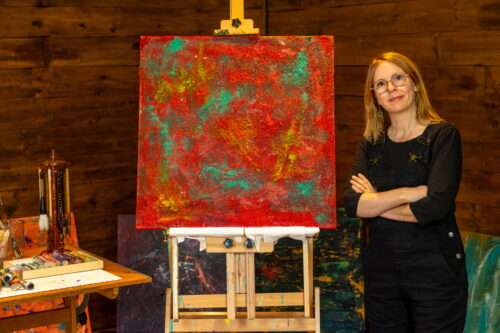
In terms of the actual physical paintings, they are now on display at the Juilliard school, and they will be there until October 14th. The paintings are installed in a performance space that’s surrounded by windows so if you are walking down Broadway you can see [them]. It’s also the venue for the Rush Hour chamber music series. There will be a pre-concert talk in that space where I’ll talk to people about the process. For the performance itself, Juilliard is going to do a splash of color behind the orchestra for each movement. Each co-commissioner of the piece has done the display differently based on venue and budget.
I’d love to pivot and hear about your involvement with music education and development for young composers, which I know is an area close to your heart.
I’m committed to creating opportunities for younger, more diverse artists and composers. I’m fortunate to have had some residencies that have enabled that. I was associate composer for the Scottish Chamber Orchestra for 2019 to 2022. We developed the new voices program, which is for female-identifying composers, and it was wonderful to enable them to have access to a professional level of musicianship, especially at the age when they are emerging and finding their own voices.
With the Orchestra of St Luke’s, we developed the DeGaetano Composition Institute which I helped found and is now led by Augusta Reade Thomas. It has been great to have these relationships with orchestras where I’ve been able to collaborate with them to build new opportunities for younger voices.
These opportunities are so important with the landscape changing when it comes to funding for diverse groups across many sectors. The endeavors you have been a part of are crucial. Now, as we wrap up, I would like to ask if you have any words for audience members on how to approach their experience with PALETTE. Also, do you have a favorite part of the piece?
Come to the piece with an open mind, open ears. And know that there are seven quite different musical personalities in these movements. It’s okay to dislike one and maybe find one that you love. It is a mixed bag, and hopefully everyone will find something to enjoy.
I love ‘Tangerine’ which is the most playful, and it features the brass. That is a lot of fun and very different from the other six movements. The live electronics with AO added a new layer which had some uncertainties and surprises along the way for me. It was really exciting to have access to these new colors to blend with the acoustic orchestral sound world.
Thank you for talking to me and showing us why this upcoming performance of PALETTE is one not to miss this month at Alice Tully Hall. I encourage audience members to see your paintings at the Juilliard – a special opportunity for inspiration before hearing the work.
Daniele Sahr