 United Kingdom George Bernard Shaw’s Mrs. Warren’s Profession: Recorded live (directed by Tim Van Someren) at London’s Garrick Theatre and shown widely in cinemas by National Theatre Live across the UK and Ireland from 23rd October. (JPr)

On the cast sheet you will get when you see this in the cinema is an excerpt from Michael Billington’s introduction to George Bernard Shaw’s Mrs. Warren Profession from the theatre programme. It begins by considering how the play – which was one of three Shaw published in 1898 to challenge audiences morally and socially, rather than merely entertain – ‘had a particularly difficult birth — not altogether surprising given Shaw’s exploration of the links between sex and society. There was no question of the play being granted a license by the Lord Chamberlain, who, until the abolition of theatrical censorship in 1968, enjoyed the power to prohibit public performance.
What is saddening, however, is to see how even Shaw’s champions turned against him over Mrs. Warren’s Profession. J. T. Grein was a visionary Dutchman who set up the Independent Theatre Company to give private performances of unlicensed plays … It, however, was a step too far even for Grein, and the play had to wait until 1902 to be given two private performances by the Stage Society.
Mrs. Warren’s Profession had to wait until 1925 to receive its first public performance in England … Since then, Shaw’s play has become an established part of the repertory. Ronald Eyre staged it for the National Theatre Company at the Old Vic in 1970 with a fine cast headed by Coral Browne. A second National Theatre production followed in 1985 directed by Anthony Page with Joan Plowright and Jessica Turner as mother and daughter.’
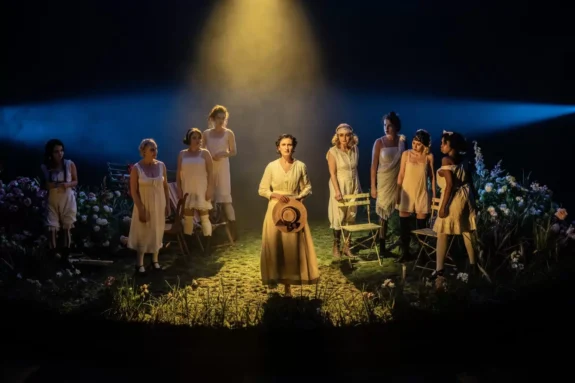
There is much that is Oscar Wilde about Mrs. Warren’s Profession whilst Shaw presents it as a treatise on the sexual politics of his time and critiques Victorian morality, (forced) marriage and the oppression of women. The play begins in a sun-drenched Haslemere cottage garden setting (designs by Chloe Lampford and lighting by Jon Clark) with the Victorian/Edwardian costumes suggesting we are in the early years of the twentieth century. Vivie Warren rarely sees her mother but has been given a good upbringing resulting in her being successful in the Mathematical Tripos at Newnham College Cambridge, though it has not brought her much joy. Vivie reveals how ‘It means grind, grind, grind for six to eight hours a day at mathematics, and nothing but mathematics. No, I’m supposed to know something about science; but I know nothing except the mathematics it involves. I can make calculations for engineers, electricians, insurance companies, and so on; but I know next to nothing about engineering or electricity or insurance. I don’t even know arithmetic. Well, oh, outside mathematics, lawn tennis, eating, sleeping, cycling, and walking, I’m a more ignorant barbarian than any woman could possibly be who hadn’t gone in for the Tripos.’ Vivie’s aim is to ‘turn it to very good account … I shall set up chambers in the city and work at actuarial calculations and conveyancing under the cover of that. I’ll do some law with one eye on the stock exchange all the time.’
Vivie’s mother soon arrives for a reunion bringing along the middle-aged, wealthy and outwardly respectable Sir George Crofts who is interested in marrying Vivie as something of a trophy wife. Along the way we are introduced to Vivie’s two other potential suitors: Frank Gardner and Mr. Praed, as well as Frank’s father, the rather dissolute Rev. Samuel Gardner. There has been some pruning by director Dominic Cooke so his slick staging does not overstay its welcome despite all the speechifying it still involves; there is much debate about what Vivie wants for herself, what her mother wants for Vivie, what Sir Frank is eager for, whilst secrets will out about Evie’s parentage and, of course, Mrs. Kitty Warren’s ‘profession’. We are never told explicitly what that is and perhaps there shouldn’t be too many spoilers; but we learn that Sir George is Mrs. Warren’s business partner to the tune of £40,000 in a string of ‘hotels’ in Brussels, Ostend, Vienna and Budapest of which she is ‘managing director’. We also learn of Vivie’s half-sisters; one who had an ‘honest job’ but died of lead poisoning from her factory work and another who was successful after working with her mother.
It eventually leads to Vivie confronting her mother and saying ‘Everybody has some choice, Mother. The poorest girl alive may not be able to choose between being Queen of England or her principal at Newnham; but she can choose between rag-picking and flower-selling, according to her taste. Oh no, people are always blaming their circumstances for what they are. I don’t believe in circumstances. No, No, the people who get on in this world are the people who get up and look for the circumstances they want, and, if they can’t find them, make them.’
Eventually, we see Vivie working in her London office where she faces-off against her mother for the final time and explains ‘No, I am my mother’s daughter. I am like you. I must have work, and I must make more money than I spend. But my work is not your work, and my way is not your way. We must part well …’ though they will not in the end.
Perhaps the play is of its time, particularly having stuck with setting it in its time. The arguments provide much food for thought and resonate through to 2025; especially with a silent ghostly reminder of what Mrs. Warren’s work actually is by the scene-shifting ensemble of 10 in their white Victorian underwear.
Of course, the biggest draw is watching five-time Olivier Award-winner Imelda Staunton acting opposite her real-life daughter Bessie Carter for the very first time. Staunton is a tour de force as Mrs. Warren when formidably standing her ground, whilst Carter makes Vivie very likeable and understandable in her striving for independence. There is strong support from two other TV stalwarts: Robert Glenister (a boorish Sir George Crofts) and Kevin Doyle (Rev. Samuel Gardner) with excellent support from two newer names, at least for me, Reuben Joseph (Frank Gardner) and Sid Sagar (Mr. Praed).
Jim Pritchard
For more information about a showing of Mrs. Warren’s Profession near you click here.
Featured Image: Bessie Carter (Vivie Warren) © Johan Persson
Cast:
Mrs. Kitty Warren – Imelda Staunton
Vivie Warren – Bessie Carter
Rev. Samuel Gardner – Kevin Doyle
Sir George Crofts – Robert Glenister
Frank Gardner – Reuben Joseph
Mr. Praed – Sid Sagar
Ensemble – Liz Izen, Lizzie Schenk, Michelle Hanks, Abbie-Marie Howe, Kabira Imona,
Karen McCaffrey, Marusia Makhmutova, Carlotta Mastracchi, Alessandra Michelucci-Dunn, Emma Riches
Creatives:
Director – Dominic Cooke
Set and Costume designer – Chloe Lamford
Lighting designer – Jon Clark
Sound designer – Christopher Shutt
Composer – Angus MacRae
Excellent production. Wonderful acting, but very disappointed in the modern physicality with both women crossing their legs, something that was never done in that period … ankles only were allowed.
Play beautifully acted and thought-provoking. Final interaction between mother and daughter deeply moving. Thanks to National Theatre Live.